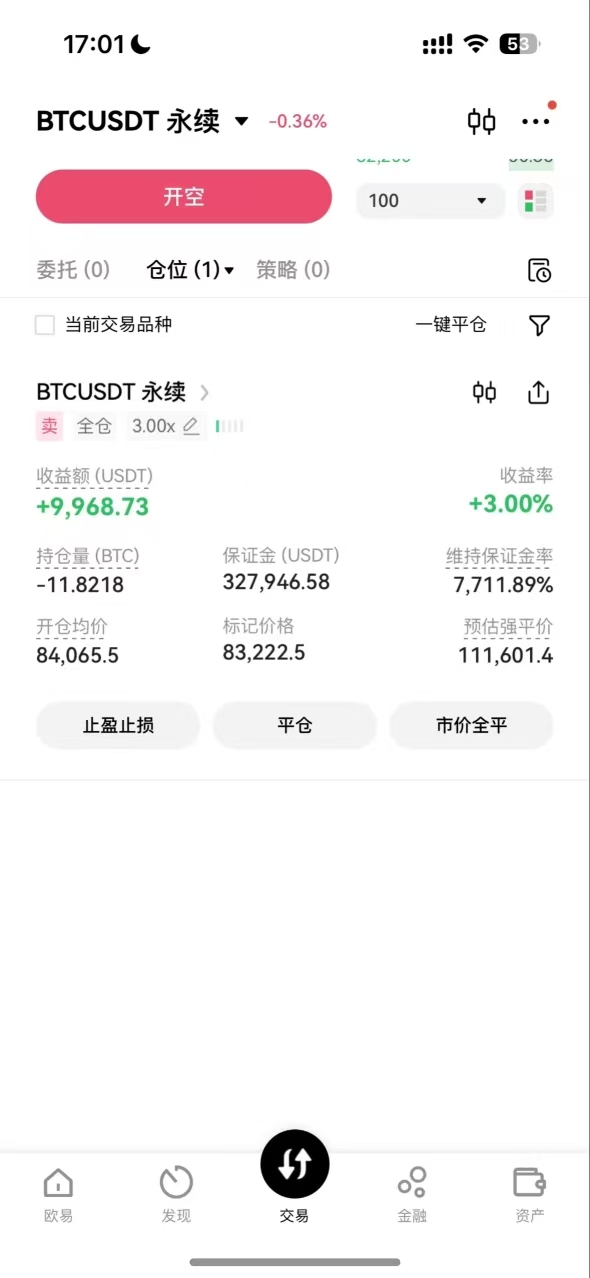
In the cryptocurrency world, 90% of retail investors lose money because they 'don't manage their positions'—either they go all in and get liquidated, or they randomly average down their losses, ultimately losing their principal in the fluctuations of the candlestick chart. True long-term profitable traders understand that 'position size is the lifeline of trading.' Here are 8 verified rules of position management that can help you lock in profits and mitigate risks amidst volatility:
1. Golden ratio position method: Lock in risk within a controllable range.
Core logic: Never put all your eggs in one basket. Use the 'five equal parts capital management rule,' dividing the total capital into 5 parts, using only 1/5 of the position for a single trade.
- Risk control: set single stop loss at 10%, corresponding to total capital only losing 2% (10% stop loss × 1/5 position), even with five consecutive stop losses, total loss is only 10%, retaining the chance for recovery;
- Profit logic: set profit target above 50%, taking 100,000 yuan as an example, single position of 20,000 yuan, 50% profit can yield 10,000 yuan, with a risk-reward ratio of 5:1, building a positive return curve with 'small losses and big gains'.
Two, trend-following position addition rules: money in the trend should be 'fully earned'
The core of profit in the cryptocurrency market is 'going with the trend', pullbacks in an upward trend are good opportunities to add positions, while rebounds in a downward trend are traps.
- Position addition timing: in an upward trend, when the price pulls back to the 30-day moving average or previous support level, and volume decreases, add positions, with the position still not exceeding 30% of total capital;
- Practical case: referring to Bitcoin's bull market in 2023, the success rate of increasing positions during fluctuations is 67% higher than blindly bottom-fishing, which can lower holding costs and amplify profits.
Three, explosive avoidance iron rule: stay away from the temptation of 'short-term doubling'
Short-term explosive coins with over 50% increase may seem tempting but actually hide danger—these coins are often speculative and lack fundamental support, like the sword of Damocles hanging high.
- Data warning: a certain altcoin surged 300% in 72 hours, but retraced all gains within two weeks, with 95% of latecomers trapped;
- Operating principle: resolutely do not chase explosive coins, if indeed optimistic, wait for a pullback to 50% of the explosive starting point, and only test with 1/10 position after volume stabilizes.
Four, MACD double sword combination: use indicators to determine position rhythm
The MACD 'zero axis crossing rule' serves as a 'navigator' for position management, accurately judging the transition between bullish and bearish, avoiding blind position adjustments:
- Additional position signal: DIF line and DEA line form a golden cross below the zero axis and break through the zero axis simultaneously, indicating a shift from bearish to bullish, can increase position from 1/5 to 2/5;
- Reduction signal: a death cross above the zero axis indicates that bullish strength is exhausted, immediately reduce position to 1/5 to lock in existing profits;
- Practical verification: in the Bitcoin trend of April 2024, this strategy successfully captured an 18% upward wave, while perfectly avoiding subsequent pullback risks.
Five, overturning cognition: adding positions is an 'accelerator' for losses
The biggest misconception among retail investors is 'averaging down losses', but the reality is that incorrect averaging down can snowball a 10% loss to 50%.
- Correct principles: increase on profits, stop losses on losses, never add to a losing position;
- Practical method: when holding profits reach 20%, use the profit part for secondary position building, keeping the capital in a risk-free state, both amplifying returns and protecting the principal.
Six, volume-price code: use trading volume to judge the weight of positions
Trading volume is the 'thermometer' of the cryptocurrency market, accurately identifying the authenticity of trends, determining position size:
- Addition signal: low volume breakout above previous highs indicates capital entry, strong trend, can appropriately increase position;
- Reduce position signal: high volume stagnation at a peak (such as a popular coin at the top in June 2024) indicates capital escape, immediately reduce to light position;
- Core principle: remember 'huge volume, high price; low volume, low price', when volume and price diverge, reduce positions regardless of bullish or bearish.
Seven, moving average navigation system: multi-period position layout
Build a trend matrix using four moving averages, with different periods corresponding to different position strategies, accurately grasping short-term, medium-term, and long-term opportunities:
- 3-day moving average upward: ultra-short-term opportunity, position not exceeding 1/5, quick in and out;
- 30-day moving average turning: medium-term wave signal, position can be increased to 2/5, hold until the moving average turns;
- 84-day moving average rising: primary uptrend market, position can be increased to 3/5, let profits run;
- 120-day moving average bullish: long-term investment signal, can allocate 1/5 position for long-term holding.
Eight, review alchemy: optimize position strategies in three steps daily
Position management is not static; it needs to be dynamically adjusted through daily reviews to avoid emotional decisions:
- Logical review: whether the fundamentals of held coins (such as project progress, regulatory policies) have changed, determines whether to continue holding;
- Technical review: check whether the weekly K-line shapes and moving average arrangements meet expectations, judge whether the current position is reasonable;
- Emotional review: reflect whether daily trading decisions were influenced by market emotions (such as FOMO, panic), and avoid impulsively adding or reducing positions.