
1. Overview
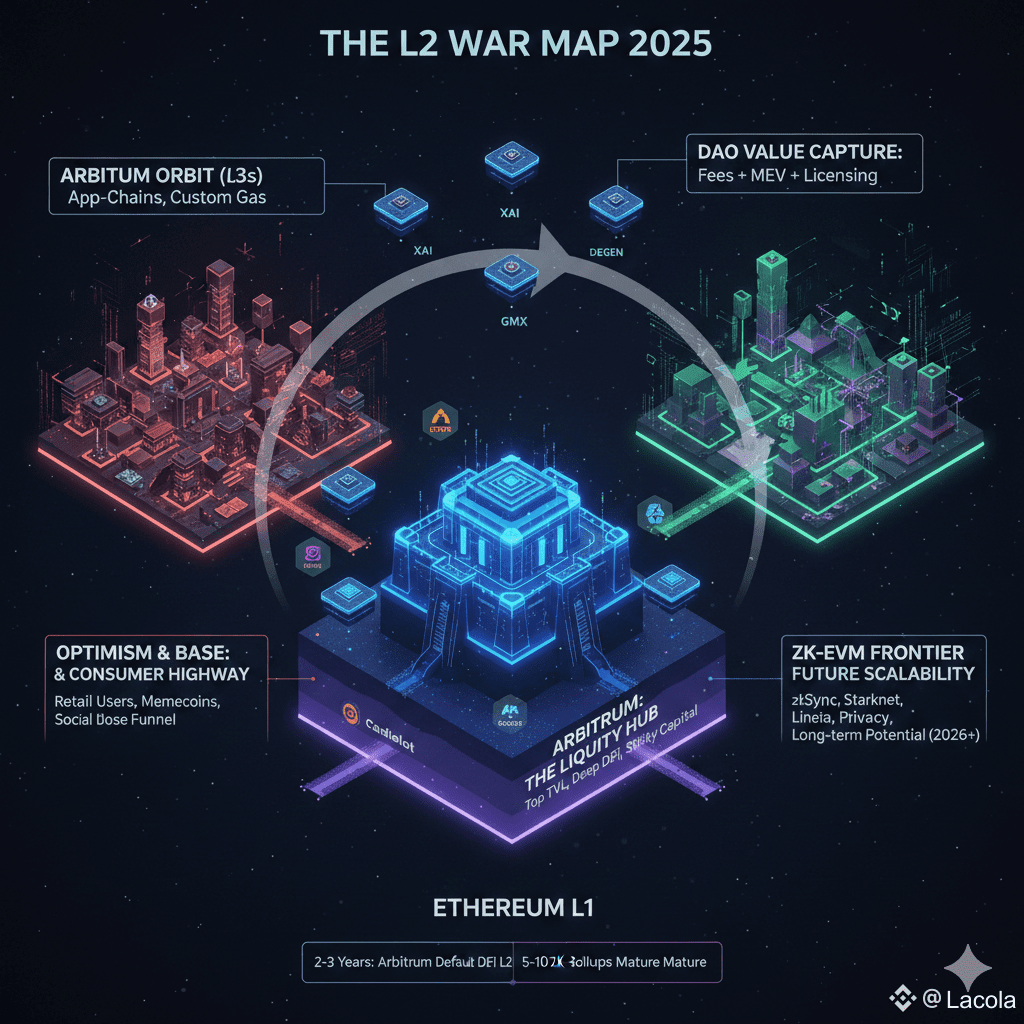
Arbitrum is currently one of the leading Layer 2 networks on Ethereum by TVL, built on an Optimistic Rollup architecture that focuses on scaling throughput while inheriting L1 security. In a landscape where zk-EVM, Parallel EVM, and emerging Layer1s like Monad are competing for capital and attention, Arbitrum maintains its position thanks to a dense DApp ecosystem, straightforward yet clear Tokenomics, and long-term incentive strategy.
2. Key Insights
(1) Technology & Architecture
Arbitrum uses Optimistic Rollups with a fraud-proof mechanism, optimized for high throughput and low fees.
Instead of chasing zk-EVM, Arbitrum is expanding via Stylus and BOLD, focusing on improving the developer experience.
It is not a Layer1 like Monad, but Arbitrum directly competes with Parallel EVM chains at the UX and deployment speed level.
(2) Ecosystem & TVL
Arbitrum leads the L2 sector in TVL, driven by DeFi protocols like GMX, Radiant, Camelot and various derivatives platforms.
Sticky liquidity and stable TVL make it harder for new L1/L2s to completely pull users and capital away.
(3) FDV & ARB Tokenomics
The FDV of ARB reflects the market’s expectation that Arbitrum will remain “blue-chip infrastructure” in the Ethereum stack.
Current Tokenomics: ARB is primarily used for governance; there is no strong fee-capture mechanism yet, but this leaves room for future upgrades (e.g., shared sequencer, revenue sharing to the DAO).
3. Why This Matters (In the zk-EVM & Parallel EVM Race)
zk-EVM solutions (StarkNet, zkSync, etc.) have advantages in finality and privacy, but their UX and ecosystems are not as mature as Arbitrum’s.
Parallel EVM chains like Monad promise higher throughput through parallel transaction execution, but as new Layer1 networks, they must rebuild both user and developer networks from scratch.
Arbitrum is already “running in production”: high TVL, deep liquidity, real revenue-generating DApps, and a DAO treasury with billions of dollars for incentives.
→ From an airdrop/retroactive perspective: the biggest edge is no longer in ARB itself, but in DApps on Arbitrum and Orbit chains building on the Arbitrum stack.
4. Action Plan for Users & Researchers
Daily:
Use 1–2 core DeFi protocols (swap, lending, perpetuals) to maintain consistent on-chain history.
Track TVL and volume on Arbitrum to identify hot/cold capital flows.
Weekly:
Scan for new projects on Arbitrum, especially those without tokens but with point systems or incentive programs.
Skim Arbitrum DAO proposals related to new incentives, grants, or Orbit ecosystem expansion.
One-time:
Map out the major DApps on Arbitrum and categorize which ones have high retroactive potential or point-based systems.
Compare ARB’s current FDV with other L2 tokens to evaluate long-term upside.
5. Scoring Model (Personal View)
Reward Potential (via DApps + Orbit): 8/10
Difficulty: 3/10 (good UX, low fees)
Cost: Low
Retroactive Probability (DApps + infra): Medium–High
Long-term Relevance: 9/10
6. Risks
Direct competition from zk-EVM solutions and Parallel EVM Layer1s like Monad.
ARB Tokenomics are not yet optimized for value accrual to holders without additional fee-capture mechanisms.
Liquidity fragmentation risk as more L2/L3 networks emerge.
7. Final Takeaway
Arbitrum is no longer a “hidden gem,” but it remains core infrastructure for the next Ethereum cycle. The real alpha is not in chasing ARB’s price, but in going early on DApps, Orbit chains, and infra campaigns built on the Arbitrum stack.
@Arbitrum Foundation


