

To be honest, when I first heard about the Lorenzo Protocol, I had some doubts in my mind. Another project focused on Bitcoin liquidity? This field is becoming overly saturated; why should I believe you can create something new? However, after diving deeper, I found that this team is indeed doing things that others haven't or dared to do.
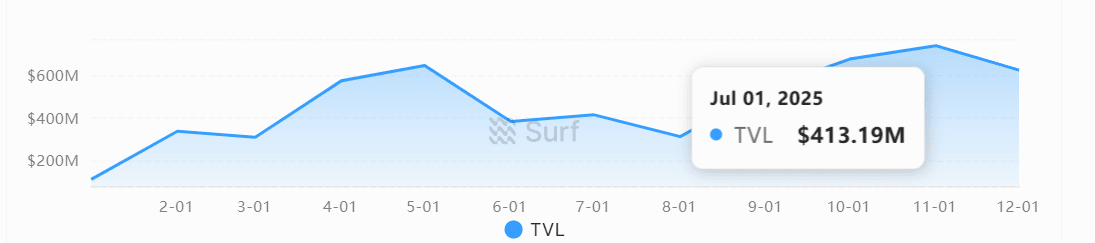
First, let's talk about the most intuitive data - Lorenzo's TVL skyrocketed to a historic high of $737 million in November 2025. You might say, what's the big deal about a high TVL? Many projects can pile it up relying on subsidies and high APY. But the problem is, Lorenzo's growth curve is quite healthy, steadily climbing from $111 million in January. Although there were fluctuations in between, the overall trend is upward. What does this indicate? It indicates that real money is flowing in, rather than just a fleeting influx of hot money.
The real dilemma of Bitcoin DeFi
Let's be clear: Bitcoin's entry into DeFi has been touted for years, but very few have truly achieved results. Why? Because Bitcoin's design itself is not intended for smart contracts. It is secure and decentralized, but also slow, expensive, and functionally limited. Want Bitcoin holders to take their coins out to play DeFi? Then several core issues need to be resolved:
First, security. Bitcoin holders care most about asset security; if you ask me to transfer BTC to a certain protocol, what if it runs away? What if it gets hacked?
Second, liquidity. Traditional Bitcoin staking either locks assets immovably or has lengthy unlocking periods. This is a nightmare for users who wish to operate flexibly.
Third, yield rates. If you ask me to lock BTC, you must at least offer some reasonable yield, right? But now, many so-called 'BTCFi' projects have yields that are even lower than just keeping it in centralized platforms.
Lorenzo's team is clearly aware of these pain points. Their solution is not simply to crudely package a 'liquid staking token' and call it a day, but to rethink from the underlying architecture.
enzoBTC and stBTC: Two weapons to meet different needs
The two core products that Lorenzo launched—enzoBTC and stBTC—may look similar at first glance, but upon closer examination, their design philosophies are completely different.
enzoBTC is essentially a wrapped token pegged 1:1 to Bitcoin, but it does not directly offer you returns. Sounds like a loss, right? Not so fast, this thing is positioned as a 'pass'. With enzoBTC, you can freely navigate across more than 20 chains within the Lorenzo ecosystem and participate in various DeFi protocols—lending, trading, liquidity mining, all of it. As of early December, enzoBTC's TVL reached $538.9 million, a figure that speaks to market recognition.
And what about stBTC? This is the true 'yield-bearing asset'. It achieves Bitcoin staking through the Babylon protocol, allowing holders to not only earn staking rewards but also gain Lorenzo points. Although its TVL is only $10.24 million, far less than enzoBTC, it precisely illustrates the logic of user choice—most people prefer to use enzoBTC to actively seek yield opportunities rather than passively waiting for staking dividends.
This 'active + passive' dual-track design is actually quite clever. It gives users the choice: if you are an aggressive player seeking high returns, use enzoBTC to play in DeFi. If you are a conservative player looking for ease, just lock up stBTC and earn passively.
USD1+: The 'Yu'ebao' of the Bitcoin circle?
If enzoBTC and stBTC are Lorenzo's 'left and right guardians,' then USD1+ is its 'nuclear weapon.' The ambition of this product is astonishing—it aims to be a 'financial supermarket' for on-chain asset management.
The 7-day annualized yield of USD1+ once surged to 40%, a truly exaggerated figure. But you need to understand how it achieved this: three sources of returns—RWA (real-world assets, like tokenized US treasury bonds), CeFi quantitative trading, and DeFi protocol yields. In short, it integrates the advantages of traditional finance, centralized trading, and decentralized finance.
Many might question: can a 40% yield be sustained? To be honest, this figure is definitely temporary and cannot be maintained long-term. But the focus is not on the number itself but on how Lorenzo has proven that on-chain asset management can be as professional as traditional finance, even more flexible.
USD1+ also has a very key detail: it has partnered with World Liberty Financial (WLFI), which directly purchased $40,000 worth of BANK tokens. Who is WLFI? A DeFi project backed by the Trump family. Although this investment is not large, its symbolic significance is enormous—traditional capital and political forces are beginning to pay attention to innovative protocols like Lorenzo.
CeDeFAI: Redefining Yield Distribution with AI
Speaking of the innovation that impresses me most about Lorenzo, it must be CeDeFAI. The core logic of this platform is to use AI to optimize asset allocation strategies, which sounds very sci-fi, but the actual application scenarios are very pragmatic.
For example, traditional DeFi yield aggregators basically set strategies manually: if Aave's yield is high today, move the money there; if Compound's interest rate rises tomorrow, transfer the funds again. This operation is inefficient and difficult to respond to market changes in real time.
The Financial Abstraction Layer (FAL) of CeDeFAI is designed to address this issue. It uses AI algorithms to monitor real-time yield rates, risk parameters, and liquidity depth across multiple protocols, then automatically allocates funds to the optimal strategy combination. Moreover, this process is completely transparent, allowing users to see the flow of funds and sources of returns at any time.
Some may worry: could AI make mistakes? Could it be manipulated? Lorenzo's approach is to layer decision-making authority—core asset allocation is executed by smart contracts, while AI is responsible for providing strategic recommendations, with the final approval remaining in DAO governance. This 'human-machine collaboration' model retains the efficiency advantage while avoiding the risks of full automation.
Cross-chain ecosystem: Ambitions and challenges of over 20 chains
Currently, Lorenzo supports over 20 chains, including BNB Chain, Mantle, Taiko, Manta, Arbitrum, Sui, Ethereum, and more. This number seems impressive at first glance, but I need to temper expectations—multi-chain deployment does not equal deep integration.
Many projects claim to support dozens of chains, but in reality, they simply bridge tokens over with poor user experience and liquidity. How does Lorenzo perform in this regard? From the data, it indeed puts in the effort.
First, the bridging solutions used are top industry options like Chainlink, LayerZero, and Wormhole, ensuring security. Secondly, its collaborations with various chains are not just about 'listing tokens'; they involve deep integration of ecosystem resources. For example, the partnership with Hemi Network not only deployed the stBTC bridge but also provided liquidity incentives and plans to implement a direct minting function from hBTC to stBTC on Hemi L2.
Another example is the collaboration with B²Network, focusing on cross-chain yield optimization. When you lock BTC in Lorenzo's vault, it can automatically find the optimal mining or lending strategy on B² and return the profits to you. This 'one-click cross-chain yield aggregation' experience is indeed much stronger than traditional manual operations.
Of course, the multi-chain strategy has its risks. The more chains, the higher the maintenance costs and the more dispersed security risks. Lorenzo uses COBO, CEFFU, and SAFE for multi-signature custody, which provides some security assurance. But honestly, with over 20 chains operating simultaneously, if any one chain has a vulnerability or if a bridging protocol is attacked, the impact could be significant. This is a systemic risk faced by the entire multi-chain DeFi, and Lorenzo is no exception.
Babylon Integration: The Legitimacy Battle of Bitcoin Staking
Lorenzo's collaboration with Babylon somewhat determines its position in the BTCFi track. Babylon is currently the most recognized protocol in the Bitcoin staking field, allowing BTC to provide security for other PoS chains through Bitcoin timestamp technology. Lorenzo's stBTC is based on this implementation.
As of early December, the total amount of BTC staked through Lorenzo via Babylon reached 6015.33 BTC. How does this figure rank within the entire Babylon ecosystem? Although there are no direct comparison figures, it can be inferred that Lorenzo has put in considerable effort in integration with Babylon.
But the problem is that Babylon itself is also rapidly iterating, and its partners are not limited to just Lorenzo. If Babylon launches its own liquidity solutions in the future, or supports other competitors, where will Lorenzo's moat be? I think the key lies in ecological depth—Lorenzo cannot just be a 'porter' for Babylon but needs to create incremental innovations based on Babylon. USD1+ and CeDeFAI are embodiments of this idea, combining Bitcoin staking yields with on-chain asset management to create value that Babylon itself cannot provide.
Team strength: Academia meets practical experience
After discussing so many products and technologies, let's talk about the team. Lorenzo's core trio—CEO Matt Ye, CTO Fan Sang, and CFO Toby Yu—have quite interesting backgrounds.
Matt Ye graduated from the University of Illinois at Urbana-Champaign and is quite active on social media, often expressing his views on the market. In October, he tweeted a warning about leverage risks, mentioning the 1929 crash and the 2022 collapses of 3AC and FTX. This risk awareness is quite important for DeFi teams. Many project founders have a 'bull market mentality,' focusing solely on TVL growth and token prices, neglecting the accumulation of systemic risks. Matt is clearly not one of those people.
CTO Fan Sang holds a Ph.D. from Georgia Tech and has a solid technical background. He is quite active on GitHub, indicating that he is indeed writing code rather than just holding a title. Lorenzo's technical architecture—from Cosmos appchain to Ethermint's EVM compatibility, to the BTC L1 relayer synchronization mechanism—shows that it has been thoughtfully constructed, not just pieced together at the last minute.
CFO Toby Yu has relatively little information available, which is quite common in the crypto circle. Many project financial leaders tend to be low-profile, as it involves fund management, and being too high-profile can easily attract hackers or regulatory scrutiny.
Overall, Lorenzo's team is a combination of 'academia and practice,' possessing both technical depth and market sensitivity. However, the team is not large, and with core members like COO, marketing, and community, it barely consists of a dozen people. Can such a small team support a complex ecosystem of multiple chains and products? I think the key lies in execution and resource integration capabilities.
Financing and Token Economics: Low-key but not simple
Lorenzo's financing data is quite interesting—only about $200,000 in total financing, with $200,000 raised in the IDO in April 2025 and another $1,000 in June 2024. This number feels 'poor' compared to crypto projects that often raise tens of millions or hundreds of millions.
But don't underestimate it. Lorenzo did not follow the traditional VC route of 'large financing - high valuation - heavy marketing,' but chose a more grassroots and community-oriented approach. Sats Ventures, as a strategic investor, focuses on the Bitcoin ecosystem, which aligns perfectly with Lorenzo's positioning. Moreover, Lorenzo's total supply of BANK tokens is 425.25 million, all in circulation, with no so-called 'VC unlock dumping' risk.
The uses of BANK are also clear: governance voting, staking to obtain veBANK (enhanced voting power), and distributing protocol rewards. This vote-escrow mechanism is learned from Curve and has been market-tested, indeed enhancing the long-term holding incentives for tokens.
On November 13, BANK was listed for spot trading on Binance, paired with USDT, USDC, and TRY, while also carrying a Seed Tag (high-risk label). This label is actually a double-edged sword—on one hand, it warns investors of risks; on the other, it suggests that Binance believes this project is still in its early stages and will have considerable volatility. After its launch, BANK indeed experienced a surge, but then corrected, which is normal since the liquidity of small market cap tokens is inherently weak and prone to manipulation.
Community and governance: The value of 200,000 fans
Lorenzo's Twitter account has 200,000 followers, and Discord has 57,000 members. This number is considered above average among crypto projects, but the quality of followers is more important than quantity. I checked Lorenzo's Twitter interactions and found the ratio of likes, retweets, and comments to be relatively healthy, unlike some projects filled with zombie followers and bots.
In terms of community activities, Lorenzo has made some interesting attempts. In August 2024, they opened the BTC staking activity of Babylon, where users staked 129 BTC and received proportionally distributed rewards and points. In February 2025, they also held a Discord knowledge competition with over 10 teams participating, and the prize was BANK tokens. Such small-scale, high-interaction activities are much more reliable than those 'airdrop marketing' campaigns that often offer millions of dollars.
In terms of governance, BANK holders can lock up their tokens for veBANK and then vote on protocol proposals—product updates, fee adjustments, token release speeds, etc. But to be honest, Lorenzo's governance is still relatively centralized at this stage, with many key decisions led by the team. This is normal since the product is still in a rapid iteration phase, and relying solely on community voting is too inefficient.
Where is Lorenzo's moat?
After all this, why can Lorenzo survive in the red ocean of BTCFi? I have summarized a few points:
First, the completeness of the product matrix. From the liquidity packaging of enzoBTC to the staking yields of stBTC and the asset management of USD1+, Lorenzo covers various needs of Bitcoin holders. Many competitors only focus on one point, whereas Lorenzo addresses an entire spectrum.
Second, the openness of the technical architecture. Lorenzo is based on Cosmos SDK, which inherently supports cross-chain functionality and has achieved EVM compatibility through Ethermint. This means it can benefit from the dividends of the Cosmos ecosystem while seamlessly connecting to Ethereum's DeFi protocols. This 'dual advantage' strategy is far more flexible than simply betting on a single chain.
Third, the quality of partners. Babylon, World Liberty Financial, Hemi Network, B²Network—these are all leading projects in their respective fields. Lorenzo does not work in isolation but actively integrates into a larger ecosystem, leveraging synergies.
Fourth, the team's pragmatic style. Lorenzo does not engage in flashy marketing or make unrealistic promises of sky-high returns. Every step they take is solid, with tangible achievements in TVL growth, product launches, and partnerships.
Of course, Lorenzo also has obvious shortcomings. Insufficient funding means a lack of capital reserves, which could be untenable in the event of a market winter or technological crisis. Multi-chain deployment may seem impressive, but it has high maintenance costs and a greater chance of issues arising. Also, regarding community size, while 200,000 followers is not insignificant, it is still a noticeable gap compared to top DeFi projects.
Lorenzo Protocol is an ambitious, capable project, but it also has its limitations. It is not the type of project that breaks out through hype and marketing; rather, it is earnestly focused on product development, technology, and ecosystem building. The growth curve of such projects is often slower, but once they survive the early stages, their explosive potential can be significant.
The BTCFi track, after all, reflects that the needs of Bitcoin holders have not been fully met. Lorenzo seized this opportunity and provided a relatively reliable solution with enzoBTC, stBTC, and USD1+. Whether it can truly break through and become a leader in BTCFi will depend on its execution and market response in the coming period.
But at least at this stage, Lorenzo has already proven its value—it is not just another fleeting air project, but an innovative protocol that deserves attention, study, and expectation.


