
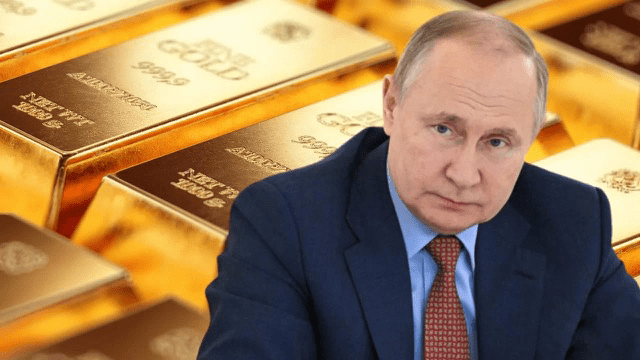

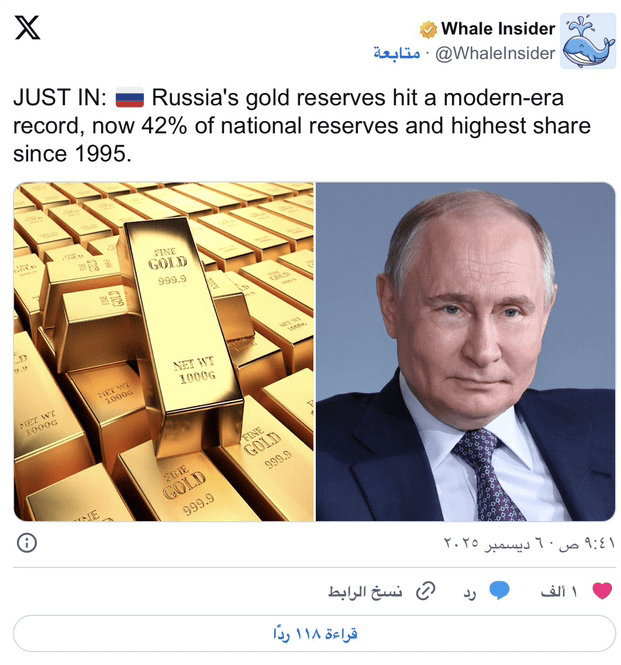
Russia's gold reserves reached 310 billion dollars, now accounting for 42.3% of its total international reserves (734.6 billion dollars), the highest share since 1995.
This step represents a defensive strategy to acquire sovereign assets protected from sanctions that cannot be frozen or used as a weapon like assets linked to the US dollar.
The fixed supply of Bitcoin contrasts with the increasing supply of gold, leading to speculation that a modest sovereign allocation of Bitcoin could cause a supply shock.
Despite rising gold prices, Russia avoids Bitcoin due to volatility but is actively exploring blockchain-based digital gold and BRICS settlement alternatives.
Russia sent a clear message in the global financial landscape. Its gold reserves surpassed $310 billion in December. Gold now represents 42.3% of total reserves, the highest percentage since 1995. At the same time, total international reserves rose to $734.6 billion. This is the fourth consecutive monthly increase in gold holdings. The trend is clear: Moscow is strongly moving toward hard assets, while simultaneously reducing its exposure to dollar-linked assets.
Since the invasion of Ukraine, Russia has faced one of the harshest financial sanctions in modern history. About $300 billion of its foreign reserves have been frozen by Western governments. This was a pivotal event. It proved that dollar-denominated assets can be frozen, restricted, and weaponized. However, gold stored within the country cannot be.
Gold as a sovereign shield against sanctions
Gold provides Russia with what no foreign currency can offer: sovereign control. Physical gold cannot be blocked through the SWIFT system, nor can it be frozen by a foreign court's decision. It exists within Russian borders. This makes it a powerful hedge against confiscation risks. It also explains why Russia continues to buy more of it even when prices rise. This is not about short-term trading, but rather a long-term defensive positioning.
At the same time, Russia is deepening its non-dollar trade with China and other partners. The use of yuan settlements has increased. The BRICS countries continue to explore alternatives to the dollar-based financial system. All roads point to a path of 'abandoning the dollar.' However, as this traditional approach relying on gold intensifies, a new analogy continually emerges: Bitcoin.
Bitcoin as 'digital gold' and the issue of supply shock
Gold and Bitcoin today stand in one macroeconomic context. Both are non-sovereign assets and are not under the control of a single government. However, their supply stories are completely different. Gold supply is increasing by about 1.7% to 2% annually through mining operations. Bitcoin, on the other hand, has a fixed supply of 21 million coins forever. Its issuance rate decreases every four years due to the 'halving' process. No central bank can change or inflate that through emergency policy.
And here arises the question of 'what if?'. If Russia's purchase of gold in such quantities could pressure global supplies, what could happen if a major country began accumulating Bitcoin for the same geopolitical reasons? The Bitcoin market is much smaller than the gold market. Even a modest sovereign allocation could cause a severe supply shock. This is why officials in the United States and elsewhere are openly discussing the idea of creating strategic reserves of Bitcoin.
Why does Russia still prefer gold over Bitcoin?
So why has Russia not directly adopted Bitcoin? The answer is simple: volatility. Gold moves slowly and does not double or crash within months. Central banks prefer stability over quick gains. Bitcoin, however, still behaves as a high-growth asset, making it difficult to use currently as a primary reserve asset.
However, Russia does not overlook the infrastructure for digital currencies. BRICS countries have explored launching gold-backed digital currencies for cross-border settlements. Russia has also tested digital systems based on blockchain to transfer gold value without going through the dollar.
This development is significant. Even if Bitcoin is not the preferred asset today, the technology behind it is becoming more entrenched. The Russian gold boom sends a clear message: countries are looking for politically neutral hard assets. Gold currently fills this role. Bitcoin is digitally paving its way toward this. The path may be different, but the destination seems the same. Scarcity has now become the decisive factor in global reserve strategies.
#BinanceSquareFamily #BinanceSquare #NewsAboutCrypto #newscrypto #GOLD_UPDATE