
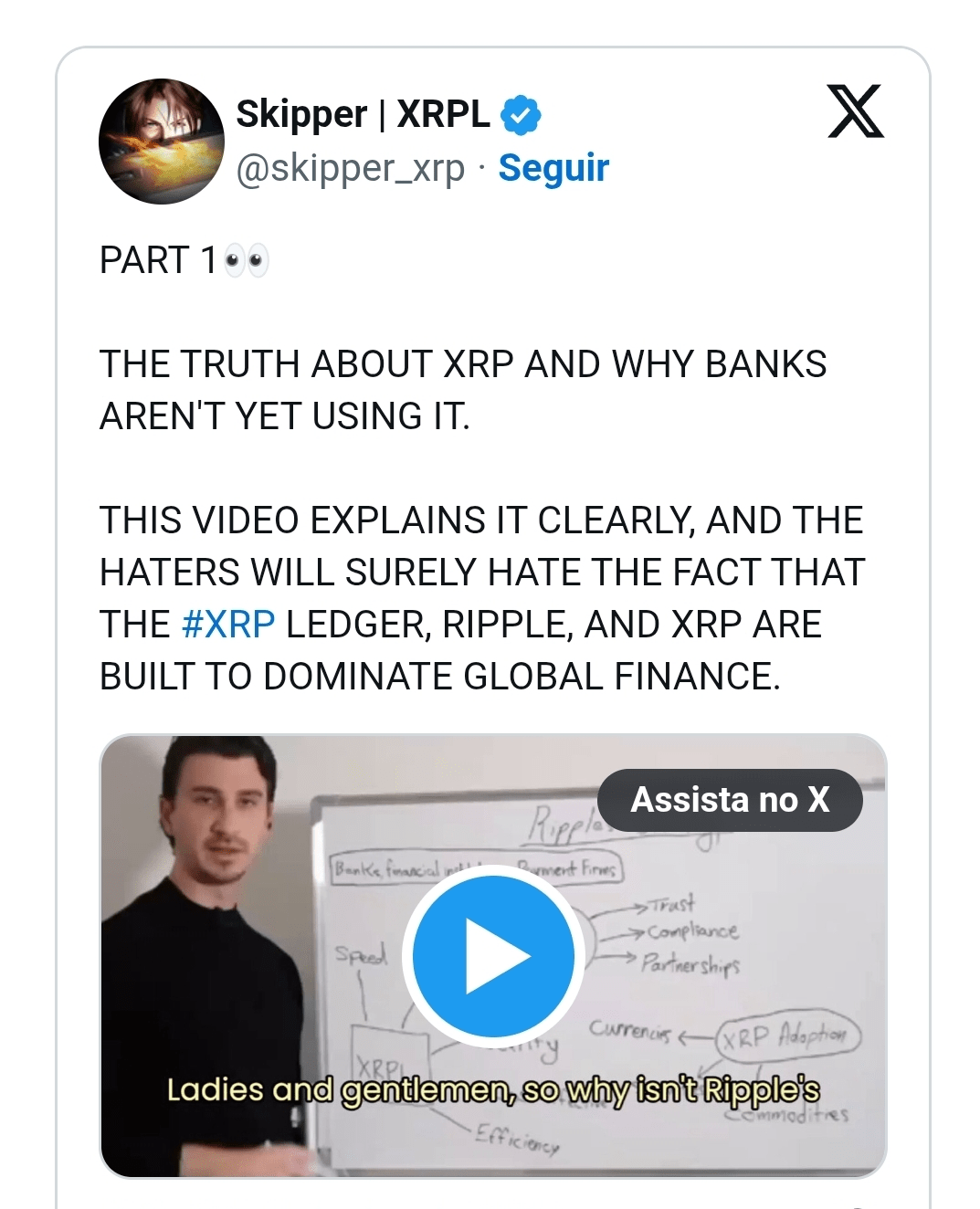
Many observers continue to question why major financial institutions working with Ripple have not yet adopted XRP for global settlement. Cryptocurrency enthusiast Skipper addressed this issue by sharing a video that describes the main reason behind the current pace of adoption.
The video addresses the structural, technical, and institutional steps necessary for a digital asset to function at the center of global financial systems.
Skipper's publication focuses on these fundamental elements, presenting them as the key to understanding the broader trajectory of the intended role for XRP.
Infrastructure as the first phase
According to the explanation provided in the video, the absence of widespread institutional consensus regarding XRP is not a sign of failure or hesitation. Instead, it reflects a planned sequence of development.
The speaker detailed that Ripple's initial goal was not the immediate use of assets, but rather the creation of a resilient and scalable financial architecture. This stage involved building the XRP Ledger, a system designed to support the rapid, cost-effective, and secure settlement of institutional value.
The protocol was designed to move large sums globally, addressing operational demands that exceed typical retail activity. The video emphasized that institutional adoption can only begin when the foundation demonstrates consistent reliability.
Establishing trust with key institutions
The second stage described in the video focused on integration. This stage involved building trust with central banks, regulated financial institutions, payment companies, and other entities that influence global monetary processes. The speaker noted that these partnerships were never aimed at forcing the immediate settlement of XRP.
Instead, the goal was to incorporate Ripple's technology into the existing financial infrastructure. By integrating the ledger and related systems directly into traditional financial systems, Ripple established a level of familiarity and operational trust that institutions require before transitioning to new settlement standards.
Why adoption cannot be instantaneous
The video also highlighted that no major financial system will adopt a new protocol overnight. Widespread institutional use depends on proven reliability, compliance, interoperability, and assurance that the technology can operate seamlessly on a global scale. The speaker explained that this is why Ripple focused first on technological enhancement and institutional alignment, rather than the early implementation of XRP.
The process involves ensuring speed, efficiency, scalability, and environmental sustainability, aspects for which the XRP Ledger was designed. For global institutions, these guarantees are prerequisites, not optional features.
Future usage perspectives
Skipper's publication highlights a perspective that portrays the adoption path of XRP as a gradual process, going through defined phases rather than a sudden implementation. The explanation given in the video suggests that the groundwork being done aims to support large-scale settlement when trust, infrastructure, and integration are fully aligned.
Observers monitoring institutional movements often focus on short-term indicators. However, the video positions the current stage as part of a long-term strategy, where widespread use occurs after the completion of fundamental requirements.
Remember folks, that nothing said here represents a recommendation to buy, sell, or maintain assets.
Thank you all!
