
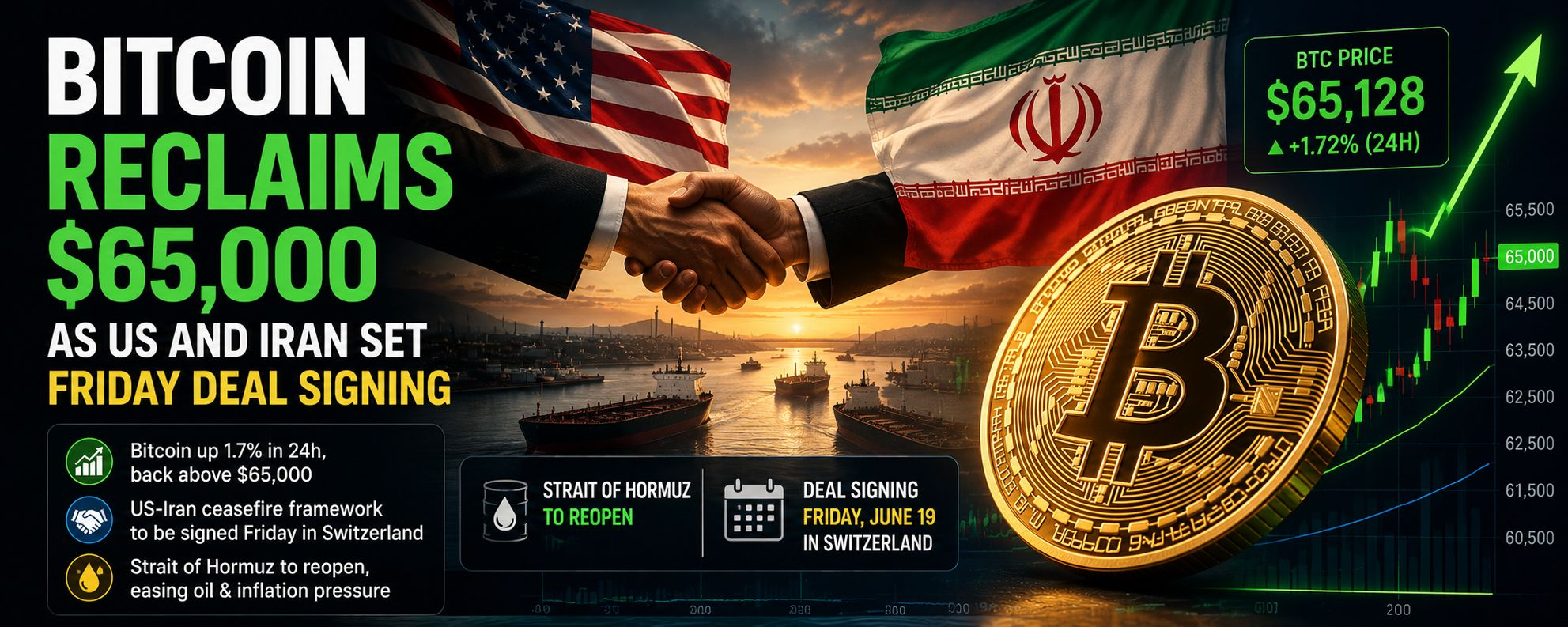

Bitcoin has climbed back above the $65,000 level after the United States and Iran announced a ceasefire framework expected to be formally signed later this week, a development that could reshape one of the largest macroeconomic pressures weighing on global markets throughout 2026.
The move marks more than a typical geopolitical reaction.
For weeks, markets had been pricing in the inflationary consequences of disrupted oil flows through the Strait of Hormuz one of the world’s most critical energy corridors. With the latest agreement pointing toward the reopening of that route, traders are now rapidly reassessing inflation expectations, interest-rate pressure, and overall risk appetite.
Bitcoin’s rebound reflects that shift directly.
The Ceasefire Framework That Changed Market Sentiment
According to reports surrounding the negotiations, the United States and Iran have agreed to extend their ceasefire arrangement for 60 days, with a formal signing ceremony expected Friday in Switzerland.
The framework also includes steps toward reopening the Strait of Hormuz, a passage that historically carries roughly 20% of global oil and liquefied natural gas flows.
Since military tensions escalated earlier this year, disruptions in the strait had fueled fears of prolonged energy shortages and sustained inflation pressure across global economies.
Those concerns pushed oil prices higher through the spring and created additional pressure on already fragile financial markets.
President Donald Trump publicly described the agreement as effectively complete, stating that the reopening of the strait would restore regional and global oil flows once the final signing occurs.
Iranian officials also acknowledged the agreement publicly, reinforcing market confidence that negotiations are progressing toward implementation.
Why Bitcoin Reacted So Strongly
At first glance, a Middle East ceasefire and Bitcoin prices may appear only loosely connected.
But the relationship becomes clearer when viewed through the broader macroeconomic chain reaction.
Higher oil prices feed directly into inflation. Rising inflation pressures central banks especially the Federal Reserve to maintain restrictive monetary policy or delay interest-rate cuts. Higher interest rates then reduce liquidity and weaken demand for risk-sensitive assets such as Bitcoin and equities.
That exact sequence has dominated financial markets for much of 2026.
By reducing fears around oil supply disruption, the U.S.-Iran framework effectively removes one of the key inflation drivers that had been keeping markets defensive.
This is why traders treated the development differently from typical geopolitical headlines that often create only temporary volatility.
Most geopolitical news events generate emotional reactions that fade quickly once no concrete economic change occurs.
This situation is different because it directly affects a measurable macroeconomic variable: global energy supply.
Markets are not simply reacting to sentiment. They are repricing inflation expectations themselves.
Oil, Inflation, and the Federal Reserve Connection
The Strait of Hormuz is one of the most strategically important shipping routes in the world.
Any disruption to oil and LNG flows through the corridor immediately affects energy markets globally.
During the height of tensions, rising energy costs strengthened concerns that inflation could remain elevated for longer, making it harder for the Federal Reserve to ease monetary policy.
That environment created sustained pressure on Bitcoin and other risk assets.
Now, with oil prices softening following the ceasefire announcement, traders are beginning to price in a less aggressive inflation outlook.
That shift improves conditions for speculative and liquidity-driven assets.
In many ways, Bitcoin’s move above $65,000 represents a broader macro trade rather than a crypto-specific rally.
Why the $65,000 Level Matters Technically
The rebound also carries technical importance beyond the headline itself.
Bitcoin had spent much of the spring trapped below key moving averages while broader market sentiment deteriorated. Previous recovery attempts repeatedly failed before momentum could fully reverse.
This breakout differs because price has now reclaimed the rising 50-day moving average near $63,200 while challenging the descending 100-day moving average around $65,450.
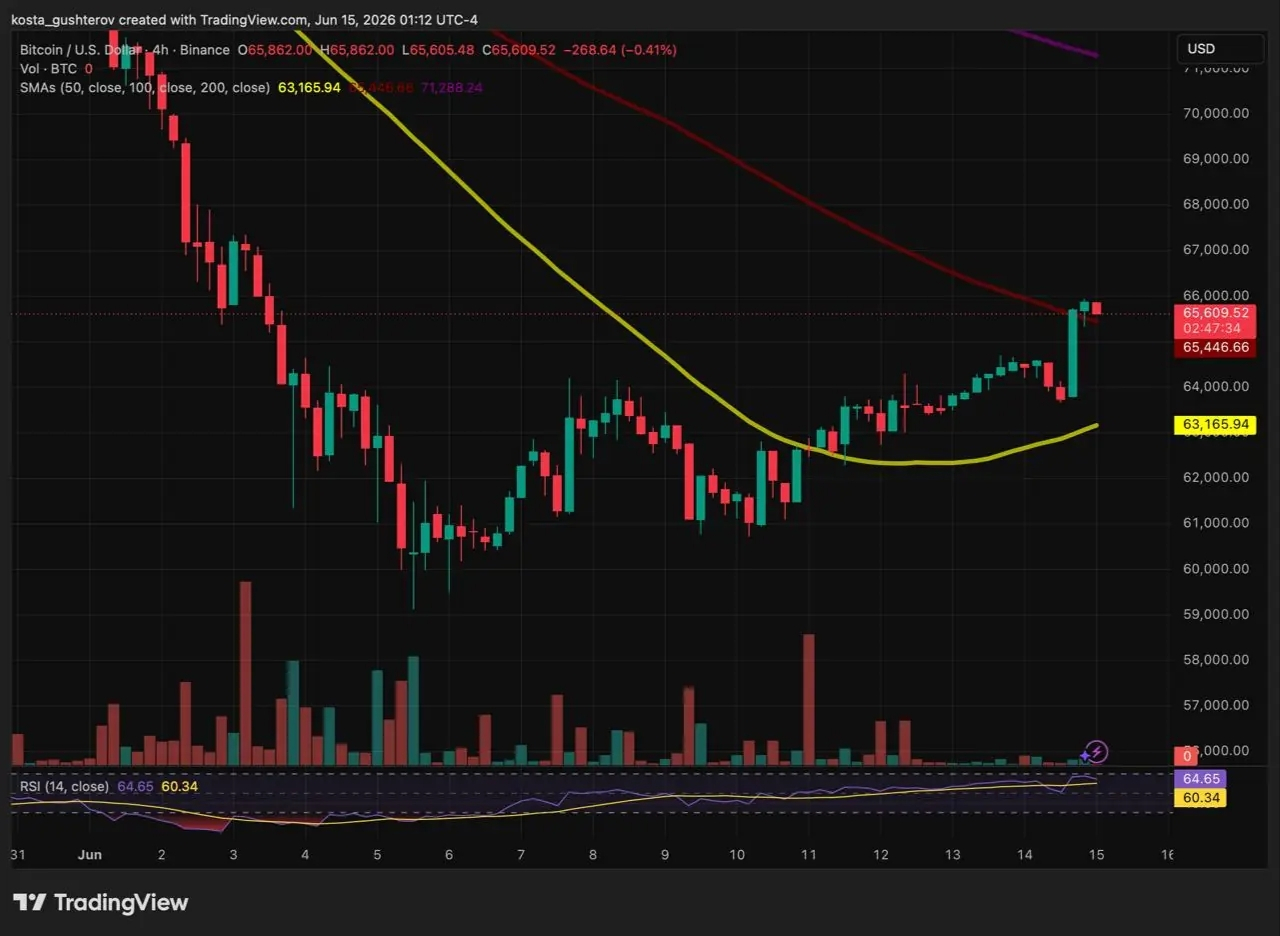
That transition signals the possibility of an early trend reversal rather than another temporary relief bounce.
The $65,000 level matters because it combines both psychological resistance and dynamic technical resistance in the same zone.
When a major round number aligns with an important moving average, the breakout becomes more meaningful if buyers can sustain control above it.
Momentum indicators also support the move, though short-term conditions are beginning to look extended.
A healthy consolidation above reclaimed support levels may ultimately strengthen the structure more than a vertical continuation higher.
The Rally Still Depends on One Major Unknown
Despite the optimism, markets are treating the agreement cautiously for one reason:
The deal is not finalized yet.
The formal signing ceremony remains scheduled for Friday, and several of the most difficult issues particularly Iran’s uranium enrichment limits and existing nuclear stockpile arrangements remain unresolved.
Those negotiations are expected to continue over the next 60 days.
That means the current market rally still depends heavily on whether the framework survives the next phase of diplomacy.
If the agreement proceeds smoothly and shipping flows normalize further, easing energy prices could continue supporting risk assets.
But any delays, breakdowns, or renewed tensions could quickly reverse sentiment.
Bitcoin’s Recovery Faces a Bigger Test Ahead
For now, Bitcoin’s rebound above $65,000 signals that macro conditions may finally be turning less hostile after months of pressure driven by inflation fears and geopolitical instability.
Still, the larger technical structure remains fragile.
The 200-day moving average near $71,000 continues trending downward, meaning Bitcoin has not yet fully escaped its broader corrective phase.
To transform this rebound into a sustainable recovery, the market likely needs more than one geopolitical breakthrough.
It needs confirmation that inflation pressures are genuinely easing, monetary policy conditions are stabilizing, and global liquidity can begin improving again.
The U.S.-Iran agreement may have provided the spark.
Whether it becomes the foundation for a larger market reversal depends on what happens next both diplomatically and economically.