
INJ (Injective Protocol) is a blockchain project focused on decentralized finance (DeFi), particularly in derivatives trading. Below is an overview of its technical team background, application scenarios, and current competitive advantages and challenges.
Technical Team and Background
The core team of Injective Protocol has a diverse background and rich industry experience. Core members have previously worked at notable companies such as Open Zeppelin, Amazon, and hedge funds, with several members graduating from world-renowned institutions like Stanford University and New York University.
The project has strong capital support and is one of the eight projects incubated in the first phase by Binance Labs. Additionally, it has secured funding from top investment institutions including Pantera Capital and Jump Crypto. The team also has a presence in the Asian market, with a dedicated developer relations lead focusing on ecosystem development.
Core application scenarios
The INJ token plays multiple key roles within its ecosystem, with specific application scenarios as follows:
• Protocol governance: INJ holders can participate in the community's decentralized autonomous organization (DAO) and vote on key decisions such as network upgrades and the launch of new assets.
• Network security: Injective adopts a Proof of Stake (PoS) consensus mechanism. Users can become validators or delegators by staking INJ tokens to maintain network security and receive staking rewards (annual yield of about 12%).
• Transactions and fees: INJ can be used to pay transaction fees on the platform and serve as collateral for derivative trading. The ecosystem adopts a unique burn auction mechanism: every week, a portion of the fees generated by dApps within the ecosystem (displayed as 60% in search results) is used to repurchase and burn INJ, injecting deflationary pressure into the token.
• Developer ecosystem: Some of the fees generated within the ecosystem are also used to incentivize developers building applications on Injective, promoting continuous innovation and prosperity within the ecosystem.
Competitive advantages and challenges
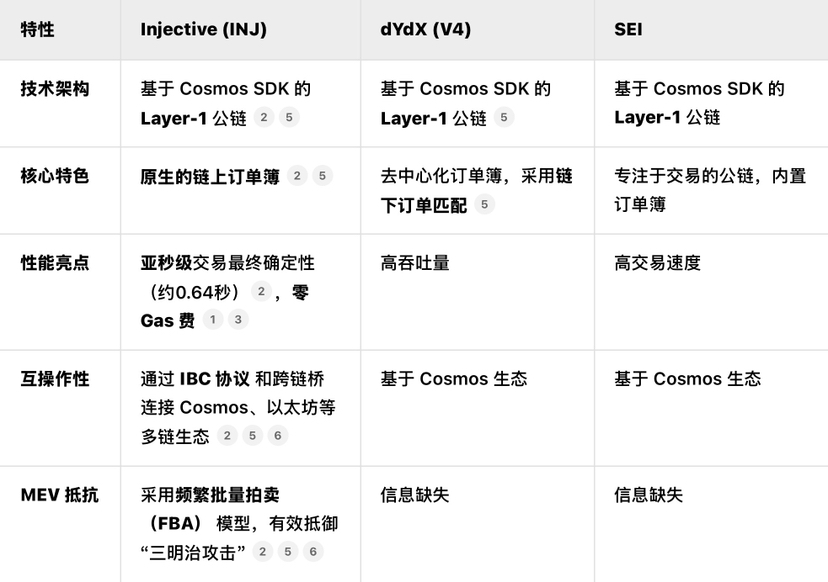
To visually demonstrate its position in the market, the following table compares some key features of Injective with similar projects.
The core advantages of INJ
1. Excellent performance experience: With its Layer-1 architecture, Injective can achieve sub-second transaction confirmation speeds, and users do not need to pay Gas fees when trading, ensuring a smooth experience.
2. Unique on-chain order book: It has built a native decentralized on-chain order book, providing professional traders with a familiar interface and trading depth similar to centralized exchanges, which is superior to traditional automated market maker models.
3. Powerful interoperability and modularity: Built on the Cosmos SDK, it easily connects to the vast Cosmos ecosystem. At the same time, it provides plug-and-play financial modules, significantly lowering the barriers for developers.
Challenges faced
1. Intense market competition: As a niche project, Injective faces strong competition from peers like dYdX, which also focuses on order books.
2. Liquidity and adoption: Despite advanced technology, its total locked value on-chain still has room for growth compared to some mature DeFi protocols, requiring continuous attraction of users and liquidity.
3. Market recognition: There are views that INJ is still a relatively emerging project, and its visibility and adoption in the broader cryptocurrency market have not yet reached the status of a 'mainstream coin.'
Summary and Outlook
Overall, Injective occupies a unique ecological niche in the competitive cryptocurrency field, thanks to its strong technical team, focus on high-performance DeFi infrastructure development, and innovative token economic model. Its long-term value will depend on the continuous development of its ecosystem, broad user adoption, and macro trends in the entire cryptocurrency market.
