
Master the moving averages, earn your first bucket of gold in life, and the subsequent N buckets....
No theory, just practical methods that can be used directly.
1. Moving averages are the market's average cost over different time periods.
Short Term (e.g., MA21): Recent cost, reacts quickly, represents short term sentiment.
Medium Term (e.g., MA55): Medium term cost, is the framework of the trend, prices often fluctuate around it.
Long Term (e.g., MA144): Long term cost, is the background of the trend, defines the big direction.
Moving average alignment is the language of trends:
Bullish Alignment: Price > MA21 > MA55 > MA144. Only consider going long.
Bearish Alignment: Price < MA21 < MA55 < MA144. Only consider going short.
Three-line entanglement: no trend, wait and see.
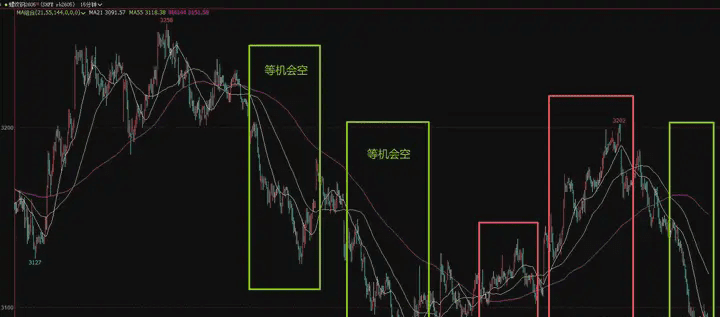 Two. A complete moving average trading strategy (taking long positions as an example)
Step 1: Trend filtering
Only trade when the MA21, 55, and 144 on the 15-minute chart clearly show a bullish arrangement. If not satisfied, do not trade.
Step 2: Timing for entry
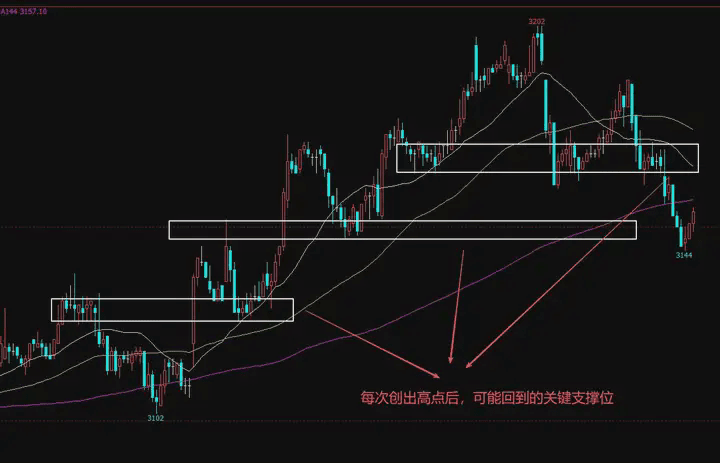
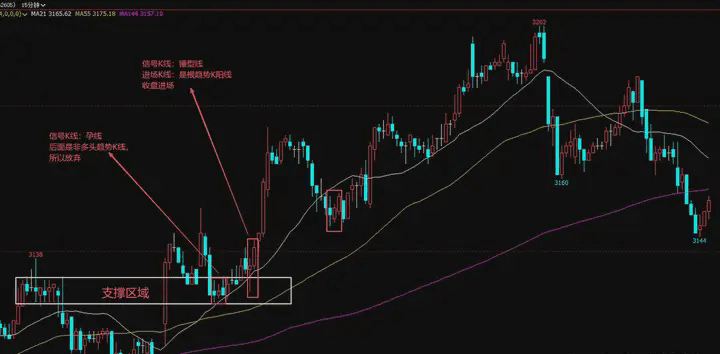
Wait for the price to retrace to near MA55 or MA144.
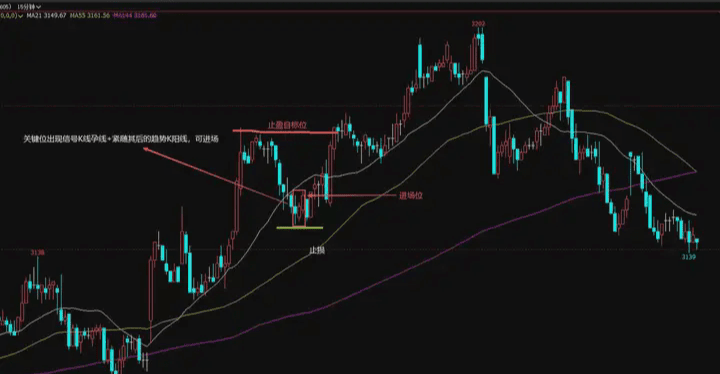
A bullish candlestick pattern (such as bullish engulfing, hammer) confirms as a signal candlestick.
If the next candlestick after the signal candlestick closes as a trend candlestick, enter at the close; if not, give up this opportunity.
 Step 3: Stop loss and take profit
Stop loss: place below the lowest point of the signal candlestick or below MA144.
Take profit: use a fixed risk-reward ratio of 1.5. Measure the distance from the entry point to the nearest recent high, and set the take profit 1.5 times that distance above the entry point. When a 1:1 risk-reward ratio is reached, you can reduce your position by half and move the remaining position's stop loss to hold.
 Step 4: Position management
Position size determined by loss: maximum single trade loss does not exceed 1%-2% of total capital. Open position size = predetermined maximum loss amount / stop loss points.
The core above is: only enter in the direction of the trend, at key levels, with a fixed risk-reward ratio, and position size determined by loss.
Three methods to solve the lagging problem of moving averages
1. Combine large and small time frames: determine direction on the 15-minute chart, find specific entry points on the 5-minute chart.
2. Look for resonance areas: when the price simultaneously retraces to key static support (such as previous lows) and important moving averages (like MA55), the success probability is higher.
3. Candlestick confirmation: moving averages indicate position, candlesticks give action signals. No rabbit seen, no eagle released.
In fact, moving averages are used to follow trends and filter out noise. Accept its lag and utilize its stability.
Whether you make money or not doesn't depend on solving its lag, but on strict execution to sustain profits, trading discipline for long-term probabilistic advantages. The rest is repetition.
I am Little Egg Tart, a professional analyst and educator, a mentor and friend on your investment journey! As an analyst, the most basic thing is to help everyone make money. I will help you solve confusion and being stuck, speaking with strength. When you are lost and don't know what to do, follow Little Egg Tart; Little Egg Tart will point you in the right direction#山寨季将至? $BTC

