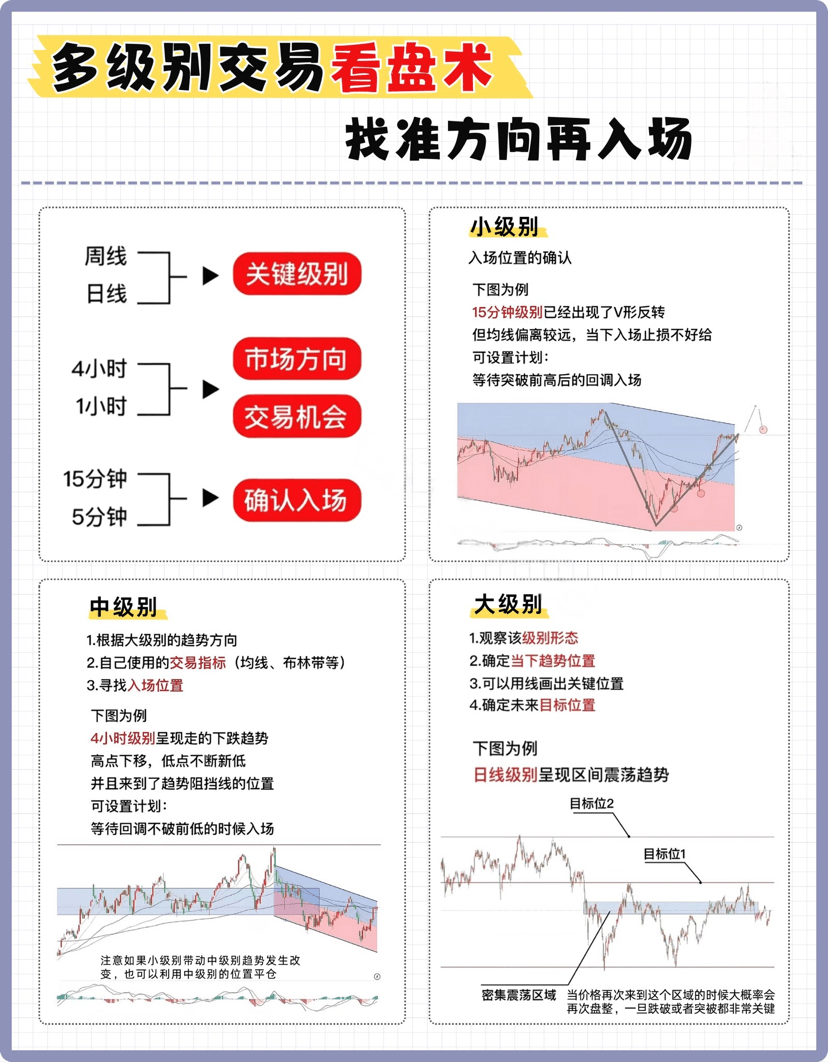
1. What is multi-level trading observation technique?
It is the core decision-making framework for professional traders, precisely breaking down different cycle candlesticks from top to bottom, effectively solving the two major trading pain points of 'seeing the trend but not making money' and 'being repeatedly stopped out by false breakouts', and is a proven profit tool validated by countless short-term experts.
2. Three core levels, layer by layer locking in trading opportunities
1. Weekly + Daily: defining the trend's life and death line
This is the anchor point of the macro direction, only taking trades in the same direction as the larger cycle trend, directly filtering out counter-trend trades.
2. 4 hours + 1 hour: seize the short-term main battlefield
Relying on the direction of the major trend, look for quality trading signals for pullback support or breakout resistance at this level.
3. 15-minute and 5-minute: pinpoint precise entry points.
The small cycle confirms the reversal pattern or indicator golden cross, precisely grasp the timing for entry to maximize the winning rate.
Three, core operating principles; just follow them to be effective.
1. Three-step approach: top-down, layer by layer filtering.
a. First determine the major direction: the weekly and daily charts clearly indicate a bullish trend, only then look for long opportunities; if clearly bearish, only filter for short signals, never go against the trend.
b. Then find the entry point: under the premise of following the trend, focus on the 4-hour and 1-hour levels, closely watch for pullbacks to support or breakpoints at key resistance levels.
c. Finally, strike accurately: wait for reversal patterns or indicator golden crosses to appear on the 15-minute and 5-minute levels before decisively entering the market.
2. Iron law: if critical levels are not broken, never trade.
a. The important support/resistance levels on the weekly and daily charts; once effectively broken or surpassed, the trend is likely to reverse, exit immediately to avoid risks.
b. The previous highs/lows of the 4-hour and 1-hour charts are the optimal reference for short-term trading in and out.
3. Trend-following techniques: go long on pullbacks, go short on rebounds.
a. When the major trend is upward, only layout long positions near support during pullbacks on the 4-hour and 1-hour charts, resolutely do not chase highs.
b. When the major trend is downward, only layout short positions near resistance during rebounds, resolutely do not try to catch a bottom.
Four, four key points for enhancing efficiency, taking the winning rate to the next level.
a. The most powerful in trending markets; during sideways consolidations, you must patiently wait for directional breakthroughs and not act impulsively.
b. Combine trading volume with MACD indicator resonance to further enhance the reliability of signals.
c. The trend direction on the weekly and daily charts is the most authoritative, never go against the larger cycle.
d. Avoid blindly focusing on 5-minute and 15-minute small cycles for "random trading"; this is a shortcut to rapid losses.