
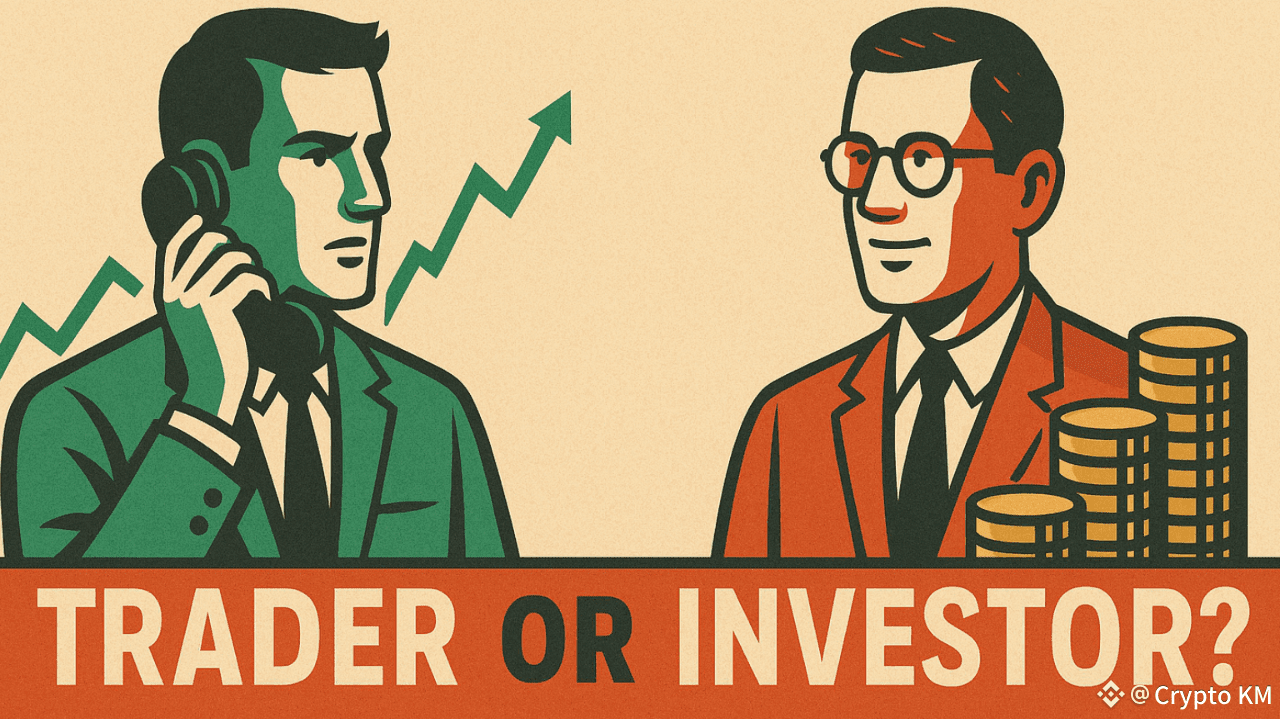
Almost every beginner confuses investing with trading.
The trader tries to predict short-term movements and is exposed to liquidations (even hundreds of millions of dollars in 24 hours is standard in crypto).
The investor builds a portfolio for years, ignores the noise, and uses dips to accumulate.
Understanding the paradox that one of the biggest news in BTC history (ETFs) caused a drop of 20% is key.
It was a trap for traders ("Sell the News"), and at the same time an opportunity for investors.
The "Sell the News" trap: A lesson from ETFs
In January 2024, ETFs for Bitcoin were approved.
It was a huge catalyst for growth.
What did the price do at the time of the announcement?
It dropped by 20%.
How is that possible?
It's the classic rule "Buy the rumor, sell the news."
Traders and institutions accumulated BTC for months before the news.
When the news became a fact, they sold their positions to the panicked "novice" who was buying at the peak to ''make quick money because it has been rising fast lately.''
These are not investors.
These are traders.
Trader: Risk of permanent loss (Liquidation)
If you are a trader, especially using leverage, you are a target.
Your biggest risk is LIQUIDATION.
Simply put: you borrow money from the exchange to play with a larger amount.
It only takes a small price movement in the wrong direction for your position to be forcefully closed.
Liquidation is a permanent loss.
Your money disappears and never comes back.
Statistics are brutal: over 90% of new people trading with leverage lose.
Other trader risks include:
Stress 24/7: You must follow charts, news, and tweets from Elon Musk and Trump.
Emotions: You fight against greed at peaks and panic during drops.
Guessing: You try to predict something that no one can predict – what will happen tomorrow.
Investor: Risk of temporary loss (Correction)
The investor acts differently.
He knew that ETFs would come, just as the trader knew.
But instead of "playing" the news, he treated a 20% drop as an opportunity for cheaper purchases according to his long-term plan (e.g., DCA), knowing that ETFs are a gateway for massive capital in the long term.
The biggest risk for investors is a CORRECTION (or bear market).
It's a situation where the value of their portfolio drops, sometimes by 50% or more.
What is the key difference?
This is a temporary drop.
This is a "paper" loss. If you had 1 BTC, during a correction you still have 1 BTC - it is just temporarily worth less.
As long as you don’t sell in panic, you are not losing money.
A patient investor waits out the drops.
If a trader bet 1 BTC on a scenario, and it doesn’t work out, their position gets liquidated, sold permanently.
Other investor risks include:
Project risk: Investment in a weak altcoin (like Kadena), which will fall to zero.
This is also a permanent loss.
Don't think that we only have pink unicorns and colorful rainbows here.
You must be good at selecting projects for your portfolio, so if I were starting today, I would still focus on BTC and ETH until I had learned my lessons. Besides, they are still the two largest positions in my portfolio after over 8 years in this market.
Lack of patience: The biggest sin. An investor who panics and sells at the bottom turns their temporary loss into a permanent one.
Or worse, selling during downturns to buy more, cheaper... – you become a trader at the worst moment.
Key Takeaways:
Traders "play", investors "build": Traders react to noise and take on liquidation risk (permanent loss). Investors execute a plan and take on correction risk (temporary loss).
"Sell the News" is the norm: Big, anticipated news (like ETFs) often causes short-term drops. Investors treat this as an opportunity.
Avoid leverage: The simplest way to avoid permanent loss (liquidation) is to buy assets "Spot" (without leverage) and hold them in your own wallet. If you want to test trading, do it with very small capital (e.g., 1% of the portfolio) and give yourself at least 12 months to learn.
If you want to buy your first cryptocurrencies, create a free account on Binance: CLICK HERE