A new report confirms the rise of digital payments with active cryptocurrency cards in the past year.
Visa and Mastercard dominate the sector offering rewards of up to 8% in bitcoin.
Adoption in Latin America grew by 63% with new options for Mexico, Brazil, and Argentina.
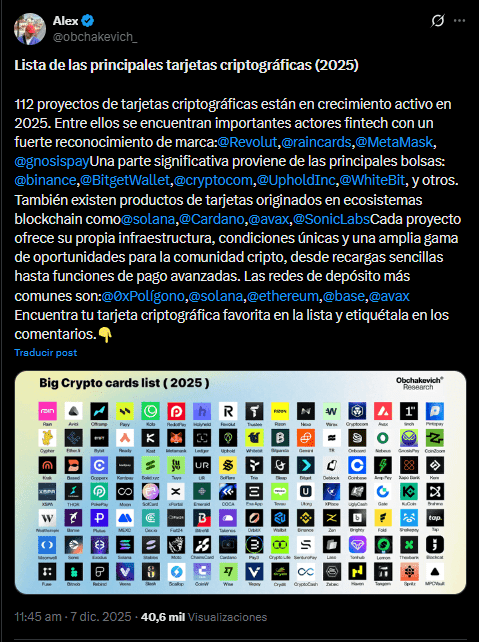
In 2025, at least 112 cryptocurrency cards will compete in the market, intensifying the battle for capturing users' daily spending. This is revealed by researcher Alex Obchakevich in his comprehensive list of active projects worldwide.
The boom driven by fintechs and cryptocurrency exchanges seeks to solve a classic dilemma for users. That is to facilitate the use of digital assets, such as bitcoin (BTC) or stablecoins, in everyday purchases.
Among the issuers of the cards, there are fintech players – such as the neobank Revolut and the crypto asset wallet MetaMask – to exchanges in the industry – Binance, Coinbase, among many others – and cryptocurrency ecosystems – such as Solana and Cardano.
Although the money is on-chain, the digital infrastructure that moves it still remains traditional. According to data from Obchakevich, the traditional duopoly continues to be the backbone of the sector. This is because 64% of these cards operate under the Visa network, while the remaining 36% do so with Mastercard.
However, the real battle is not in the network, but in the benefits. Companies have understood that custody and speed are no longer enough; now they must seduce the user with rewards.
Alex Obchakevich's list includes cryptocurrency cards focused on global accessibility, rewards, and support for stablecoins. Some examples include the following just to mention a few.
Revolut allows managing over 150 assets backed by Visa and Mastercard. In Brazil, for example, it offers accounts in reais with yields of 100% of the Interbank Deposit Certificate (CDI) and tax-free transfers (IOF).
Nexo offers a hybrid Mastercard that allows spending against the value of assets without the need to sell them. It is for those betting on the long term (holders). It offers up to 2% cashback in NEXO tokens (scalable to 6% at premium levels) and an annual yield of 14% on unused balances. Available in Latin America through its app, it also facilitates free withdrawals at ATMs of up to 2,000 euros monthly.
On the other hand, Wirex bets on massive diversity, supporting over 685 cryptocurrencies. Its most recent launch, the Cardano Card (November 2025), enables payments with ADA at 80 million Visa merchants without currency exchange fees. With cashback of up to 8% for elite users and staking options, it has positioned itself in Brazil and Mexico, integrating perfectly with Apple and Google Pay.
Crypto.com has its Visa card operational in 180 countries. Its proposal focuses on benefits with cashback of up to 5% (and 8% at higher tiers) and perks such as full reimbursement for subscriptions to services like Netflix. Although it requires staking to access the best rewards, its presence in places like Brazil and Mexico keeps it as a reference.
Among those that stand out in the first group is also RedotPay, which emerges as another practical solution for daily use. Focused on stablecoins like USDT and USDC, this Visa card prioritizes usability over rewards. It has no annual fees, with high limits of up to 50,000 dollars (USD) monthly. It is used in regions like Latin America for everyday payments and bills.#Binance #BinanceBlockchainWeek