

The search for reliable yield in crypto has always moved in cycles. Sometimes it’s loud and speculative, fueled by narratives that dissolve the moment the market shifts. Other times, it emerges quietly from mechanisms built with patience and a clear sense of design. The rise of OTFs within the @undefined belongs to the second category. They didn’t arrive with fanfare. They arrived with function, offering a way to capture yield that doesn’t depend on chasing volatile catalysts or timing the next liquidity rush. Instead, they create structure where the market usually offers chaos.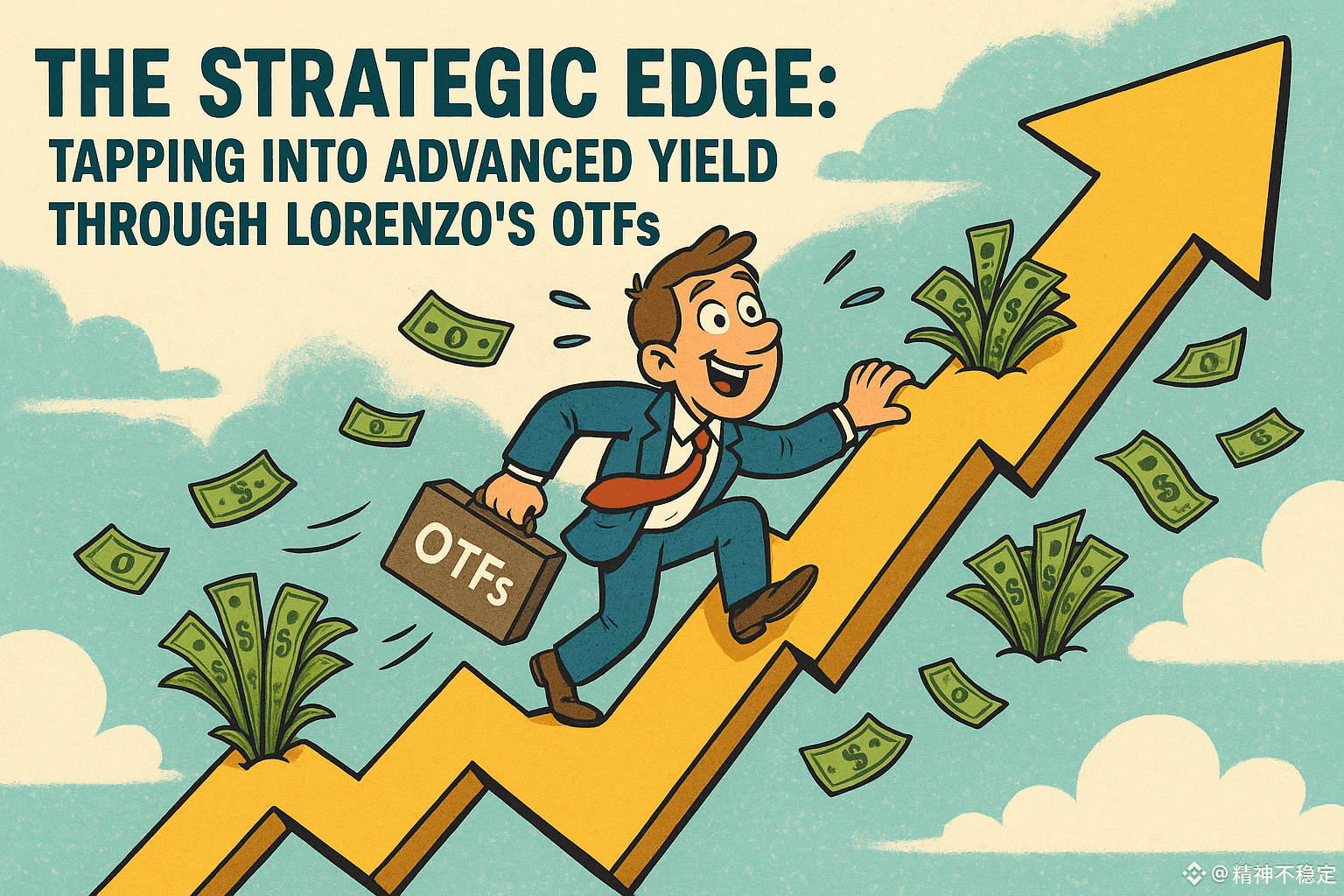
What makes OTFs interesting is how they reframe the idea of yield itself. In most systems, yield is something you wait for rewards that accumulate passively, shaped by conditions you can’t fully anticipate. Lorenzo’s approach treats yield more like a tool than a byproduct. OTFs aren’t passive containers. They’re designed to express a strategy, to hold a specific position within the broader dynamics of Bitcoin-based staking, and to make that position transferable. That shift—from passive accrual to strategic expression—changes how users think about participating in the protocol.
The appeal becomes clearer once you look at how fragmented yield opportunities tend to be. One pool pays well but locks you in. Another offers liquidity but dilutes rewards. Another relies on assumptions about validator performance or network growth that may or may not hold. Each choice involves trade-offs, and every trade-off limits the type of strategy you can build. The point of OTFs is to package those trade-offs in a way that becomes predictable enough to plan around. Instead of navigating dozens of variables, you engage with a position that has a defined role within the protocol’s architecture.
That sense of definition builds confidence.
Yield becomes predictable instead of a constant chase. And that’s especially valuable in Bitcoin ecosystems, where flexibility has always been limited. Staking, restaking, collateral usage—these are still maturing in the Bitcoin landscape. Lorenzo’s OTFs carve out a space where advanced strategies are not only possible but practical.
There’s also something subtle happening in how these instruments integrate with liquidity. Tokenizing a strategy isn’t new, but doing it in a way that carries the underlying economics forward without distorting incentives is rare. Many yield-bearing tokens drift over time. Their mechanics create gaps between what the token represents and what the protocol actually generates. OTFs attempt to close that gap, making the representation of yield feel direct rather than abstracted. When you hold one, you’re not holding a hope or a forecast. You’re holding a specific configuration of the protocol that continues to function regardless of market noise.
This structure allows certain behaviors that never quite worked in older systems. You can rotate between yield profiles without tearing down your entire setup.
You can combine OTFs for more advanced setups and better control of your exposure. What used to take multiple tools and constant oversight can now be done in one place. .
But the real significance of OTFs is that they make advanced yield accessible without turning it into a black box. Complexity exists, but it’s deliberate. The mechanisms behind the positions are transparent enough that users can understand how returns are generated, yet streamlined enough that you don’t have to engineer every detail yourself.
Most crypto protocols are either unclear or overly complicated. Lorenzo keeps things clear without losing depth..
As the ecosystem grows, these structures may end up doing more than just improving returns. They could redefine how users relate to yield in the Bitcoin economy. Instead of being passive beneficiaries of whatever the network offers, participants become managers of their own economic footprint. They choose not just whether to engage, but how deeply and in what shape. Yield becomes a design choice, not an accident of participation.
The strategic edge comes from this optionality. Not because OTFs guarantee outsized returns—nothing in crypto does—but because they introduce a disciplined way to express intent. They let you treat yield as part of a broader strategy rather than a standalone pursuit. And when the market inevitably shifts, having a position grounded in structure rather than speculation makes all the difference.
In a landscape that often rewards speed over understanding, OTFs are a reminder that the most durable innovations come from systems built with intention. They create room for nuance in a space that usually races toward extremes. And for users willing to think a bit deeper about how they participate, they open the door to yield that feels earned rather than hoped for.
@Lorenzo Protocol #lorenzoprotocol $BANK

