
Brothers, Mig stayed up until after five o'clock last night and just got up to bring you coffee while deeply analyzing Powell's speech from last night. I promise the analysis you requested will definitely be there!!
This analysis is relatively macro and contains personal subjective views. The article is long and mainly focuses on the economic outlook after the last interest rate cut this year.
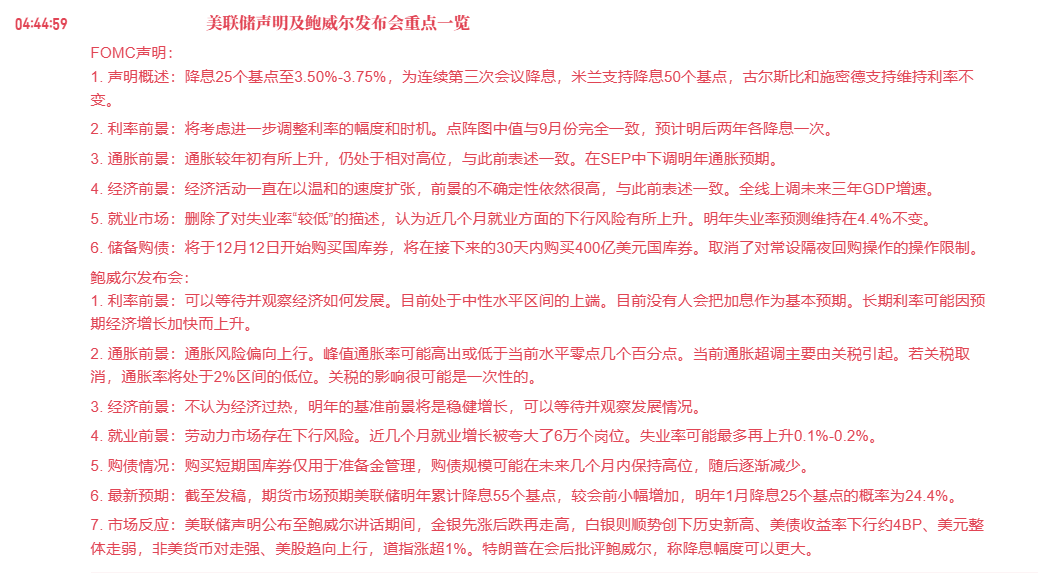
At 3:00 AM Beijing time on December 11, the Federal Reserve announced a rate cut of 25 basis points as expected, lowering the target range for the federal funds rate to 3.50%-3.75%, completing the third consecutive rate cut of the year, with a cumulative reduction of 75 basis points.
However, the real focus of the market is not on this established action, but on the subsequent economic forecasts and the key policy turning signals released at Powell's press conference.
As the 'ultimate price setter' in the financial market, the message conveyed by the Federal Reserve this time will directly affect the global capital flow environment and risk appetite for the next six months, including for crypto assets.
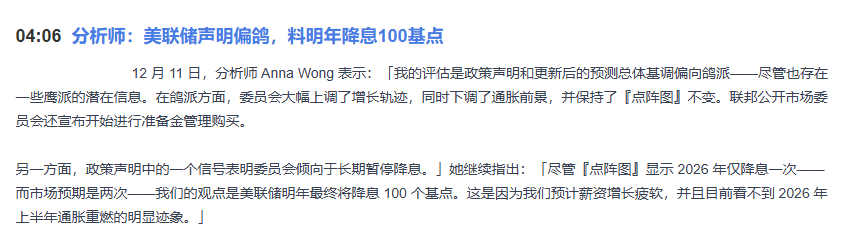
1. Rate cut but 'hitting the brakes': the dual hawkish stance of the dot plot and Powell
Although the rate cut has landed, the Fed has clearly slowed the pace of easing through two major channels:
The dot plot indicates that the rate cut cycle has entered the 'slow lane': compared to the market's previous expectations for multiple rate cuts in 2026, the latest dot plot shows only one rate cut in 2026 and another in 2027.
This means that the policy interest rate may stay within the range of 3.00%-3.25% for a longer time, significantly lower than the previously implied path by the market.
Powell stated bluntly that 'rate hikes are not the basic expectation, but rate cuts are also not imminent': during the press conference, Powell repeatedly emphasized that policy will 'heavily rely on subsequent data' and pointed out that 'inflation risks are tilted upward.' He clearly stated that the internal divisions within the Federal Reserve have shifted from 'the extent of rate cuts' to a debate between 'maintaining rates' and 'further rate cuts.'
This marks that the 'preventive rate cut' phase may have ended, and any future easing will require clear reasons from labor market or inflation data.

2. Key signal analysis: from the transition of 'forward guidance' to 'data dependence'
Several statements made by Powell are worth deep interpretation:
'The labor market is gradually cooling': the unemployment rate rose in September, and employment growth slowed, indicating that the economy is on a soft landing track, but it has not deteriorated to the point of needing emergency stimulus.
'Inflation levels remain significantly high': suggesting that the Fed is vigilant about inflation stickiness, especially whether service sector inflation and wage growth continue to slow down remains the focus.
'There is no risk-free path for policy': this statement highlights the Fed's increasing difficulty in balancing 'anti-inflation' and 'preventing recession', with future volatility likely stemming from any unexpected changes in economic data.
The market reacted quickly: according to CME's 'FedWatch', the probability of maintaining interest rates unchanged in January next year is priced at 73.4%, with the probability of remaining unchanged before March also exceeding 50%. This indicates that the market has accepted the Fed's 'wait-and-see' stance and has readjusted interest rate path expectations.

3. Direct impact on the crypto market: liquidity expectation adjustments and rising volatility
The crypto market, as a sensitive asset to macro liquidity, exhibited a typical 'buy the expectation, sell the fact' trend after the announcement: Bitcoin short-term broke above $94,000 before retreating to around $92,000. This trend reflects:
The landing of the rate cut temporarily boosts risk sentiment, but the 'hawkish shift' in the dot plot causes the market to reprice the extent of long-term liquidity easing.
High volatility will become the new normal: after the Fed clearly shifts to a 'data-dependent' mode, the release of monthly CPI, non-farm employment, and other data points may trigger volatility in the crypto market and link it with US stocks.
Structural opportunities lie in the 'expectation difference': if subsequent economic data indicates that the labor market is unexpectedly weak or inflation rapidly declines, the market may reprice the rate cut pace, leading to a phase of upward catalysis for crypto assets.
4. Investment strategy suggestion: Focus on core narratives amid uncertainty
For crypto investors, the current macro environment suggests:
Be vigilant about the pullback pressure brought by liquidity expectation adjustments in the short term, especially in high-leverage positions where risk management should be emphasized.
In the medium to long term, the easing cycle still exists: although the pace has slowed, the downward trend of interest rates has not changed, and crypto assets, as emerging high-beta targets, still have allocation value in the latter part of the cycle.
Pay attention to the dual attributes of 'safe-haven assets' and 'risk assets': Bitcoin may alternately reflect the dual logic of hedging inflation and risk appetite amid macro uncertainty, requiring dynamic assessment in conjunction with specific data.
The Fed's 'patience game' and the resilience test of the crypto market
The monetary policy path for 2026 has become clear: the Fed will take more time to verify the balance between inflation and employment, rather than rushing to cut rates. For the crypto market, this means that the bull market driven by liquidity surge is coming to a pause, and future trends will rely more on the resonance of endogenous technology narratives and macro data. Maintaining strategic composure amid volatility and seeking expected differences within data will be the key to navigating the cycle in the next half year.
Mig's personal view: Powell has given the market 'half a glass of water'—confirming that the rate cut cycle has not ended, but also clearly hitting the brakes. Crypto investors do not need to panic but should shift from 'lying back and thinking of profits' to 'dynamic allocation thinking'. Liquidity is still present, just with a more winding path.
