

“We can wait and observe the economic development.” Federal Reserve Chairman Powell made a cautious statement at the press conference, and this sentence quickly became a key note for interpreting the market trends after the interest rate cut.
At 12:00 AM Beijing time on December 11, the Federal Reserve announced a 25 basis point reduction in the target range for the federal funds rate to 3.50% to 3.75%. This is the third consecutive 25 basis point rate cut by the Federal Reserve since September of this year. After the consecutive rate cuts, the internal divisions within the Federal Reserve and Powell's cautious stance on future policies have instead triggered more complex fluctuations in the financial markets.
 1. Decision landed: Expected rate cut and internal divisions
Although the Fed's decision to cut rates was anticipated by the market, the decision-making process and the signals released afterward were filled with complexity. The following table summarizes the key information from this meeting:
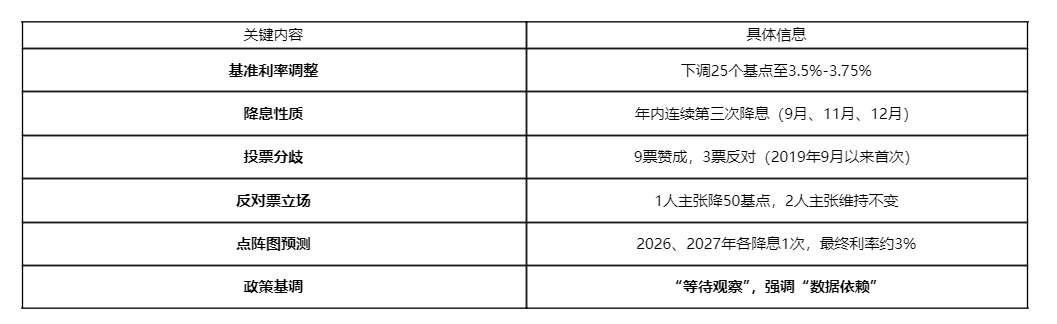
The meeting statement has reintroduced the wording that future policy adjustments will depend on subsequent data regarding 'magnitude and timing'. This is interpreted by the market as a clear signal from the Fed: any further easing policies in the future will set higher thresholds.
2. Divergence and volatility after the rate cut
After the resolution announcement, global financial markets showed an 'impulse' reaction, with different asset classes rapidly diverging.
● In terms of traditional assets, the US stock market reacted positively, with the Dow Jones index rising about 1%, and the region-sensitive bank index soaring by 3.3%. Meanwhile, bond prices rose, causing the yield on 10-year US Treasuries to fall.
● The foreign exchange and commodity markets, however, present a different picture: the dollar index fell about 0.6%, reaching a new low in over a month; precious metals strengthened, with silver hitting a new high; the oil market saw a V-shaped reversal.
● The most closely watched cryptocurrency market has shown a typical 'good news fully priced in' pattern. Taking Bitcoin as an example, the price surged immediately after the announcement but quickly fell by over 2.2%. Other major cryptocurrencies, including Ethereum, also displayed similar surge and fall trends.
3. Why do rate cuts trigger market fluctuations instead?
The market's emergence of such a divergent trend stems not from the rate cuts themselves, but from the deeper signals conveyed by this meeting.
● First, the market follows the rule of 'buying expectations, selling facts'. The 25 basis point rate cut has been fully priced and digested by the market. When the expectation was realized, some investors chose to take profits, leading to a correction in asset prices.
● Secondly, the policy path has shifted to 'cautious' and 'limited'. Goldman Sachs analysts clearly stated that the phase of 'preventive rate cuts has ended'. Whether to continue cutting rates in the future will completely depend on whether labor market data deteriorates further. Powell also emphasized that current rates are at the 'upper end of the neutral range', and the Fed can fully 'wait and observe'.
● Furthermore, the Federal Reserve is facing a dilemma. On one hand, signs of cooling in the job market have emerged, which is the core driver for this rate cut. Internal estimates within the Fed indicate that recent non-farm payroll data may have been overestimated, with actual monthly job additions possibly at a lower level of only 80,000 to 90,000.
● On the other hand, inflationary pressures still exist. The Fed's preferred inflation gauge (PCE) remains well above the 2% target. Powell partially blames inflation on the tariff policies of the Trump administration, arguing that they caused a 'one-time price shock'. This combination of 'employment downturn' and 'inflation stickiness' makes decision-making exceptionally difficult for the Fed.
4. The market will closely monitor employment data and political variables
Looking ahead, the direction of financial markets will largely depend on the evolution of two core variables.
● Core variable one: The 'thermometer' of the labor market. As analyzed by Goldman Sachs, the rationality of future easing policies will depend on whether labor market data can reach a 'higher threshold'. Market institutions generally believe that if non-farm employment remains below 100,000 and the unemployment rate exceeds 4.5% before spring 2026, it could trigger the Fed to restart rate cuts. Conversely, the Fed may only implement 1-2 more rate cuts throughout the year.
● Core variable two: Political challenges to policy independence. Political pressure from the White House has intensified market concerns about the continuity of future policies. President Trump criticized the magnitude of the rate cut as too small and revealed that he had identified Powell's successor. Analysts point out that the future selection of the Fed chair and their policy inclinations will become a significant variable affecting market expectations.
5. Cryptocurrency: The intertwining of independent logic and macro influences
For the cryptocurrency market, the Fed's policy impact mechanism is more complex. It is not simply a matter of 'rate cuts favoring risk assets'.
● The liquidity mechanism is more important than interest rate levels. Professional analysts point out that the market should pay more attention to whether the Fed supplements liquidity to the financial system through operations (such as Treasury purchases), as this directly affects market makers' willingness and ability to quote risk assets like cryptocurrencies. If there are only rate cuts without substantial liquidity improvements, the market may react lukewarmly.
● 'Expectation management' determines price trends. In the history of cryptocurrencies, there have been multiple instances of prices falling after rate cuts, as the market had already digested the positive news in advance, prompting traders to take profits. This aligns with the logic of Bitcoin's 'surge and fall' performance this time.
● Different cryptocurrencies have significantly different sensitivities. Due to shallower trading depth and typically higher leverage, altcoins are more sensitive to changes in funding costs than Bitcoin. During periods of tightening liquidity or increased market volatility, altcoins often experience larger percentage declines.
● In addition, the potential interest rate hike direction of the Bank of Japan, as another important macro variable, could exert short-term pressure on the cryptocurrency market by withdrawing global liquidity. Some analysts believe that the cryptocurrency market may enter a consolidation phase lasting until mid-2026, accumulating strength for the next cycle.
Global markets are digesting a key shift: the Fed's policy focus has shifted from 'preventing economic downturn' to 'struggling to balance inflation and employment'. The return of the wording 'magnitude and timing' in the meeting statement sets a higher data threshold for future rate cuts.
Powell has pointed the inflation issue towards tariffs, while Trump has expressed dissatisfaction with the magnitude of the rate cut. This subtle game between the central bank and the White House adds more uncertainty to the monetary policy outlook for 2026. For cryptocurrencies and other frontier risk assets, the expectation of an unrestricted liquidity easing era has ended, and the market will seek direction in a more complex macro environment that relies more on specific economic data.
Join our community to discuss and become stronger together!
Official Telegram community: https://t.me/aicoincn
AiCoin Chinese Twitter: https://x.com/AiCoinzh
OKX benefit group: https://aicoin.com/link/chat?cid=l61eM4owQ
Binance benefit group: https://aicoin.com/link/chat?cid=ynr7d1P6Z

