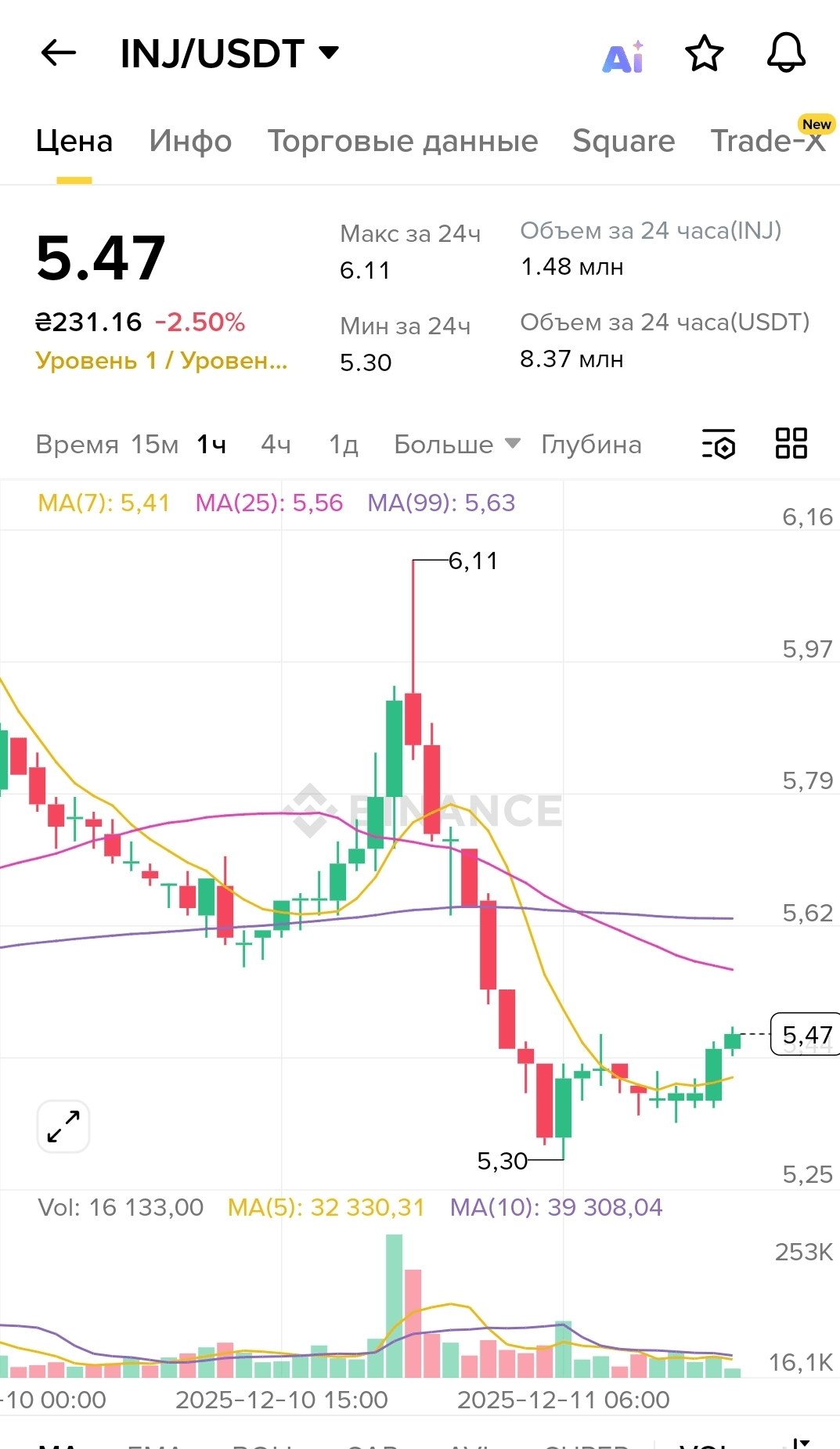
When my developer friend from Kyiv told me last week that he is moving his DeFi project from Solana to @Injective, I initially thought he was joking. I mean seriously, who turns down an ecosystem where everything is already working, where millions of users are, where liquidity flows like a river? But then he explained the details to me, and I realized that he is not crazy, he is just smarter than most. $INJ is currently trading around $5.47, far from its ATH of $52, which was in March 2024, but do you know what impresses me the most? The token price is the last thing to look at when you assess why developers are massively switching to this blockchain.
Let me tell you a story not as an analyst, but as a person who actually interacts with developers and understands what annoys them about Ethereum and Solana. My friend Oleg built a DEX on Ethereum, and when gas wars started during NFT drops, his users were paying $50-100 for a swap. Can you imagine? You want to exchange $200 in tokens, and the fee is $50; that's just terrible. He switched to Solana, thought the problem was solved, and yes, for the first few months everything was fine—fast, cheap, beautiful—but then those cursed downtimes started when the network just went down for several hours, and all the users sat there unable to do anything while he lost money, reputation, and his nerves.
And so he learned about #Injective and decided to give it a try, initially just to test it out, and then think about migration. And you know what impressed him the most? Not the speed, although 0.8 seconds per block is really fast, and not the fees, although less than one cent per transaction is just out of this world, but the fact that Injective is built specifically for financial applications. They have a ready-made decentralized order book module, which means you don't need to write all the order book logic from scratch; you just use what's already there, and it works perfectly. This saves months of development and tens of thousands of dollars.
I've been thinking more and more lately about how strange the crypto market is structured. Everyone is chasing speed, low fees, scaling, but few understand that different tasks require different tools. Ethereum is great for general-purpose smart contracts, but for high-frequency trading, it just doesn't fit. Solana is fast, but it's trying to be everything for everyone, and as a result, it suffers in terms of stability. And Injective? From the very beginning, they said, we're building a blockchain for finance, and everything else doesn't interest us. And you know, that's a smart approach because when you focus on one thing, you do it well.
Honestly, let me tell you why Solana, which seems so perfect on paper, actually has a ton of problems for serious projects. First, the downtimes, which everyone knows about, but everyone pretends are normal. The network has gone down so many times that I've lost count, and each time the team says they've fixed it, but then it happens again. I remember in September 2021, Solana was down for almost 17 hours, then again in January 2022, then in May, then in June. Second, gas fees, which, while low on average, can skyrocket during load, especially if you're doing complex transactions with a lot of computations. Third, and most importantly, Solana is a general-purpose blockchain trying to be everything for everyone, including gaming, NFTs, and DeFi, and when you try to be everything, you end up being nothing specific.
Ethereum is a separate story of pain altogether. Layer 2 solutions like Arbitrum and Optimism help a bit, but fundamentally the problem remains: the base layer is slow, expensive, and overloaded. I understand that Ethereum has the largest ecosystem, the largest community, and the most institutional money, but if you're a young developer looking to build a fast, cheap DEX or derivative platform, Ethereum is not your choice. You'll just lose all your money on gas before you even launch.
And now let's see what Injective offers and why it makes sense specifically for financial applications. Injective can process up to 100,000 transactions per second; compare this to Ethereum, which does about 15 TPS, and even Solana with its 50,000 TPS. But again, speed is not the main thing; the main thing is that the entire architecture is built around trading and finance. They have built-in support for derivatives, futures, spot trading, and all of it is completely decentralized. This means you, as a developer, can launch a full-fledged exchange in a matter of days, not months.
Another thing that few people understand is the permissionless nature of Injective. Anyone can create any market without permission, without KYC, without anything. Want to trade tokenized shares of Tesla? Create a market. Want futures on the price of avocados in Mexico? Create a market. No one will stop you or tell you that you can't. On Ethereum or Solana, for many things you need permissions, licenses, legal structures; here everything is much simpler.
I often think about how important this freedom is for crypto. The whole idea of decentralization is that no one can censor you, no one can stop you from doing what you want as long as it doesn't harm others. And Injective implements this idea in practice, not just in theory. You can create a market for anything, and the system will work automatically, without intermediaries, without gatekeepers, without bureaucracy.
My friend also mentioned that when he started to understand the tech stack, he liked that Injective is built on the Cosmos SDK with Tendermint consensus. This is a proven technology that has been working for years in dozens of other blockchains. Plus, integration with the entire Cosmos ecosystem via IBC means you can easily move assets between different chains without bridges that are constantly being hacked. Just native inter-chain communication that works.
And you know what's the most interesting? When you look at who invested in Injective, you realize that it's not some scam project with a pump and dump scheme. Through early funding rounds, Injective Labs raised over $57 million from the largest venture funds, including Binance Labs, Jump Crypto, Pantera Capital, and legendary businessman Mark Cuban. Then there were additional investments from Kraken Ventures, Delphi Labs, KuCoin Ventures, and in total they allocated over $150 million to the Injective Ecosystem Grant to support teams building applications in the ecosystem. When such players back a project, it means something.
Now let's talk honestly about what's wrong with Injective because I don't want to come across as some girl who's just promoting a project. First, the ecosystem is still quite small compared to Ethereum or Solana. There are simply fewer applications, fewer users, less liquidity; that's a fact. Secondly, on-chain metrics show that despite all the funding and hype, real usage is still not at the level one would like to see. TVL is lower than many other Cosmos chains like Osmosis or Kava. Third, competition in the Layer 1 space is tough, and it's not a given that Injective will be able to take a significant market share from Solana, which already has a huge first-mover advantage.
But you know what the catch is? All these problems are the problems of a young project that is just gaining momentum. The mainnet launched only in November 2021, support for smart contracts came in January 2022, it's all very fresh. And if you look at how quickly they release updates, like the Volan upgrade, which reduced latency by 90% and added an RWA module for institutional users, it becomes clear that the team is not sleeping and is not just raising investments, but is really building.
In general, when I think about why developers choose Injective over Solana or Ethereum, I realize that it's not just a matter of technology, but also philosophy. Ethereum is an old reliable ship that is going its own way but very slowly and expensively. Solana is a fast sports car, but it constantly breaks down at the most inconvenient moments. And Injective is a specialized tool designed for a specific purpose, for finance, and it does it very well.
I've been increasingly convinced lately that the future belongs to specialized blockchains, not general-purpose ones. Just like in the real world we don't use a Swiss army knife for everything, but have specialized tools for different tasks, in crypto we will see blockchains optimized for specific use cases. Injective for finance, Filecoin for data storage, Arweave for permanent storage, and so on.
The price $INJ is currently at $5.47, and I'm not going to say that tomorrow it will go to $50 because no one knows that. The market is unpredictable, especially in crypto. But if you look at the fundamentals, the technology, the team, the investors, and how quickly the ecosystem is developing, it becomes clear that the potential here is huge. And as more developers like my friend Oleg start to understand the advantages of Injective over competitors, it creates a snowball effect that is just gaining momentum.