

On November 13th, Lorenzo's BANK token was launched for spot trading on Binance. Logically, this should be a big day, as Binance is the largest exchange in the world. Being listed on Binance equates to receiving a ticket to traffic. Many projects experience a surge after being listed on Binance, with community excitement skyrocketing and TVL soaring, leading to discussions everywhere.
But Lorenzo is completely not this script
I carefully observed the data from Binance after it went live for a month and discovered a very strange phenomenon. Lorenzo not only did not become popular, but instead became increasingly quiet. There are basically no posts on Twitter, and there is not much activity on Discord. Community discussions are pitifully sparse. The only activity I can see is the whitelist giveaway on December 11th with a project called pieverse, giving away 5 slots.
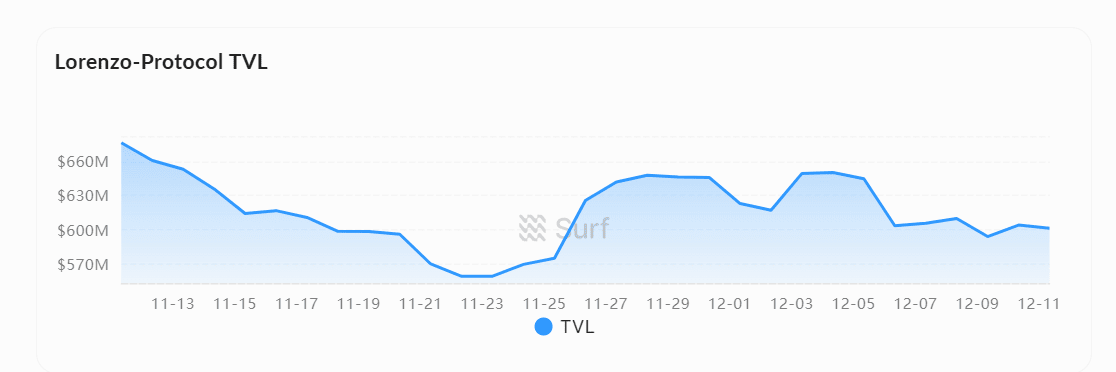
More critical data is the TVL. From $676 million on November 11, it has dropped to $601 million by December 11, evaporating 11.1% of the funds. This is not a good signal. Normally, after a project is listed on Binance, it should attract new funds, but Lorenzo is instead bleeding.
The most puzzling aspect is at the product level. I searched through Lorenzo's official website, Twitter, and Medium but found no new product releases, new feature launches, or new partnership announcements from mid-November to December. It was as if the entire team had suddenly disappeared, leaving only those old products like enzoBTC and stBTC USD1+ running automatically.
What exactly happened? The launch of Binance should have been Lorenzo's shining moment, but why has it instead become its low point?
The traffic from Binance is not the traffic that Lorenzo wants.
Let's first clarify one thing: the traffic brought by Binance and the users that Lorenzo needs may not be the same group at all.
Who are the majority of Binance's users? Traders, speculators, buying today and selling tomorrow, chasing up and down. They come to the exchange to trade coins for quick profits, not to lock BTC to participate in DeFi for long-term gains. This group of people might come in to speculate a bit after seeing BANK launch, but once they are done, they will leave and not study Lorenzo's products, let alone lock BTC in enzoBTC or stBTC.
What kind of users does Lorenzo's core product target? Long-term holders of Bitcoin, deep players in DeFi, and institutions seeking stable yields. These people are not in Binance's trading hall checking the market. They are doing research on-chain, deeply communicating with the team on Discord, and reading product analysis articles on Medium. They need time to understand Lorenzo's value proposition, not just look at price charts to decide whether to buy.
So while the launch on Binance has brought trading volume—$7.64 million in BANK trading volume in 24 hours—this trading volume has not converted into actual users for the protocol. Those buying BANK may not even know what enzoBTC is or how to use USD1+, and what the difference is between stBTC and regular BTC. They are just seeing a new coin listed on Binance and coming in to take a gamble.
Worse, Binance labeled BANK with a Seed Tag, a high-risk label. This label is like having 'toxic' printed on the product packaging. Although trading is possible, many conservative investors see this label and walk away. Lorenzo originally wanted to attract institutional funds and stable users through the Binance launch, but the Seed Tag scared them all away, leaving behind only high-risk preference speculators.
Therefore, the launch on Binance may be a mismatch for Lorenzo. The traffic it brings is not what Lorenzo needs; the users Lorenzo needs are not looking in Binance's trading hall. This leads to an awkward situation where Binance has given Lorenzo exposure, but this exposure has not converted into actual value.
A month without any product updates; what is the team doing?
What is even more concerning is Lorenzo's silence at the product level.
I carefully checked all of Lorenzo's channels—official website, Twitter, Medium, Discord. From mid-November to early December, there has not been any new product releases, no new features launched, no new partnership announcements, and not even small updates for product optimization.
enzoBTC is still that enzoBTC, with a TVL of $558 million, accounting for 92.8% of the total TVL. The functions haven't changed, the use cases haven't changed, and the supported chains haven't increased.
stBTC is in an even worse situation; its TVL is only $10.24 million, and from various signs, it seems that Lorenzo has basically given up on this product. Although the contract is still running, the team clearly is no longer investing resources into stBTC.
USD1+ is running on BNB Chain, but there have been no new developments. What are the yield rates? What is user feedback like? How much is the TVL? Lorenzo has not made this data public. It is as if this product just exists with no one caring for it.
CeDeFAI is even more of a mystery. Lorenzo claims to use AI to optimize asset management, but has this platform launched? Are there real users? How well does the AI algorithm perform? It is completely a black box. The official website only has a concept introduction and no actual progress.
A month without product updates is a very dangerous signal in the DeFi space. This industry changes too quickly. Competitors are iterating daily—Lombard's LBTC is expanding new chains, SolvBTC is optimizing yield strategies, and Bedrock is pushing new liquidity solutions—while Lorenzo seems to have hit the pause button and is doing nothing.
Either the team is holding back a big surprise, preparing to launch a major update all at once, or the team is facing difficulties, lacking resources and personnel, and unable to iterate quickly. Based on the current situation, the latter seems more likely.
The collective silence of social media.
Lorenzo's performance on social media is even more worrying.
Its Twitter account has 200,000 followers, which looks good, but if you take a closer look at the interaction rates of the tweets, you will find a big problem. Most tweets only have dozens of likes, a few dozen retweets, and the comment section is extremely quiet. This interaction rate is really too low for an account with 200,000 followers.
More critically, is the posting frequency. Lorenzo's Twitter has hardly posted anything since mid-November. Occasionally, they post a retweet of a partner's content or run a small event, but there are no substantive product updates, technical analyses, or market insights. It’s as if the entire marketing department of the team has collectively gone missing.
The situation in Discord is similar. Although there are 57,000 members, the activity level is very low. There are no in-depth discussions, no user feedback on product issues, and no community members sharing usage experiences. The entire Discord feels like a zombie group—people are there, but no one is talking.
Medium is even worse; the last article is still stuck before November 1st, and there have been no updates since. Medium was originally the best platform for project teams to create in-depth content, technical analysis, and product education, but Lorenzo has completely abandoned this front.
This collective silence on social media is very abnormal. A healthy DeFi project should maintain high-frequency community interactions, respond promptly to user questions, and regularly publish product progress updates. Lorenzo's current state is more like entering hibernation, maintaining only the bare minimum of existence.
TVL dropped 11.1%. Funds are voting with their feet.
Data doesn't lie. Lorenzo's TVL dropped from $676 million on November 11 to $601 million on December 11, evaporating $75 million in one month, a drop of 11.1%.
This drop is not caused by overall market fluctuations. During the same period, Bitcoin prices remained relatively stable. Other BTCFi projects' TVLs have risen and fallen, but none have dropped as dramatically as Lorenzo's, indicating that the outflow of funds is a unique problem for Lorenzo, not an industry-wide issue.
Where has all the money gone? I suspect there are several possibilities.
The first explanation is that early speculators have retreated. These individuals may have come for Lorenzo's launch on Binance, thinking that there would be a market surge after the Binance listing. As a result, after BANK's performance was mediocre post-launch, they lost patience and withdrew their funds to seek the next opportunity.
The second scenario is that competitors have attracted funds. The BTCFi track is highly competitive, with projects like Lombard, SolvBTC, and Bedrock actively expanding, possibly launching more attractive yield strategies or incentives, taking away Lorenzo's users.
The third explanation is that product issues have led to user loss. Although enzoBTC has a high TVL share, it does not generate yield itself. Users holding enzoBTC have to find opportunities in DeFi protocols on their own, which is too high a barrier for many. They might think it's better to just use WBTC or other more mature wrapped BTC.
The fourth explanation is a trust crisis. A month without product updates, social media silence, and the team appearing to have vanished. This state will cause users to have doubts about whether the project has issues or if the team is going to run away. Although it may not be the case, once doubts arise, users will choose to withdraw their funds to avoid risks.
Regardless of the reason, a TVL drop of 11.1% is a very serious signal. It indicates that Lorenzo is losing market confidence. If this trend continues, Lorenzo may fall into a vicious cycle: the lower the TVL, the poorer the liquidity; the poorer the liquidity, the worse the user experience; the worse the user experience, the more people leave, forming a death spiral.
The dilemma of a business model with zero protocol fees.
There is another more fatal problem: Lorenzo's 24-hour protocol fee is $0.
Zero income. What does this mean? It means that Lorenzo is completely relying on burning money to operate. Team salaries need to be paid, servers need to be rented, audits need to be done, and marketing needs to be invested. All these are costs, but the protocol itself does not generate any profit.
There may be several reasons why Lorenzo is not charging fees.
First, it wants to scale up first. Once the TVL increases, then consider charging fees. This is a common approach for many DeFi projects—early on, attract users for free and later monetize through fees.
Secondly, its products are not mature enough. enzoBTC is a 1:1 wrapped BTC that does not generate value itself, making it difficult to charge users. stBTC has basically been abandoned, and the data for USD1+ is not transparent, leaving us unsure if there are fees.
Third, market competition is too fierce. If Lorenzo charges fees, users might just go for the free competitors.
But the question is, how long can a zero-income model sustain itself? Lorenzo has only raised $200,000 in total. This amount of money is simply not enough to burn in the crypto space; it may not even cover a few months of team salaries. So how will Lorenzo survive?
There are several possibilities that come to my mind.
One is that the team is funding it out of their own pockets. The founders are using their own money or other income sources to support the project. This situation is quite common in early crypto projects but is unsustainable.
Secondly, there may be invisible investors supporting it. Although the public financing is only $200,000, there may be undisclosed funding sources, such as resource support from strategic partners.
Third, the team is waiting for the next round of financing. They are currently just maintaining basic operations, waiting for market conditions to improve or for product data to get better before seeking financing.
In any case, a zero-income business model is a time bomb. If Lorenzo cannot find a sustainable profit model within 6 to 12 months, it might really not be able to hold on.
What is Lorenzo really waiting for?
At this point, someone might ask: what is Lorenzo waiting for? Why did it enter a state of hibernation instead after launching on Binance?
I think there may be several explanations.
The first explanation is that it is a period of strategic adjustment. Lorenzo may have realized that its previous approach had issues—casting a wide net to support more than 20 chains and launching a bunch of products, but not going deep with each product. Now it might be rethinking its strategy, preparing to narrow its focus and concentrate resources on core business. This adjustment period takes time, so it appears to the outside world as stagnation.
The second explanation is resource depletion. $200,000 in financing is simply too little. The team may have already burned through most of the money and is now entering a cost-saving mode. Marketing has stopped, product iteration has slowed, and social media updates have decreased significantly, just waiting for the next round of financing.
The third explanation is that it is holding back a big move. Lorenzo may be secretly developing some heavyweight features or products and doesn't want to reveal them in advance. Once ready, it will release everything at once, giving the market a surprise. This approach is not without precedent, but it is very risky because during a quiet period, users and funds will inevitably be lost.
The fourth explanation is that there are problems within the team. There may be internal disagreements, technical bottlenecks, or other difficulties we do not know about that are hindering project progress.
I personally lean towards a combination of the first and second explanations: Lorenzo is both undergoing strategic adjustments and facing resource constraints. It needs time to think through its next steps while also needing to control expenses to survive this tough period.
Lorenzo's silence this past month is indeed concerning. TVL has dropped, products have stagnated, social media is quiet, and the protocol has zero income. None of these are good signals.
But silence is not necessarily a bad thing. Sometimes silence is for a better explosion. Lorenzo may be secretly doing many things; it just hasn't reached the point of making them public.
The crypto space has a characteristic: everyone loves excitement, likes daily news, and daily updates. But the projects that truly succeed are often not those that seek constant visibility, but those that focus on building products.
The dilemma that Lorenzo is currently facing is real, but it is not without solutions. If it can do a few things well in the coming months, the situation could be completely different.
First, focus on core products. Stop messing around with so many chains and products. Deepen enzoBTC on 2-3 core chains and build a real moat.
Second, finding a profit model. It cannot remain zero charge forever; it has to start charging users reasonable fees to prove the sustainability of the business model.
Third, restart community building. We cannot let social media continue to be quiet. We need to re-establish connections with users and let everyone know that Lorenzo is still alive and still working hard.
Fourth, seeking new financing. $200,000 is definitely not enough; Lorenzo needs more funds to support long-term development.
If Lorenzo can achieve these things, the month of silence after Binance's launch may just be a small interlude on its transformation road. But if Lorenzo continues to remain so quiet, then there might really be a problem.



