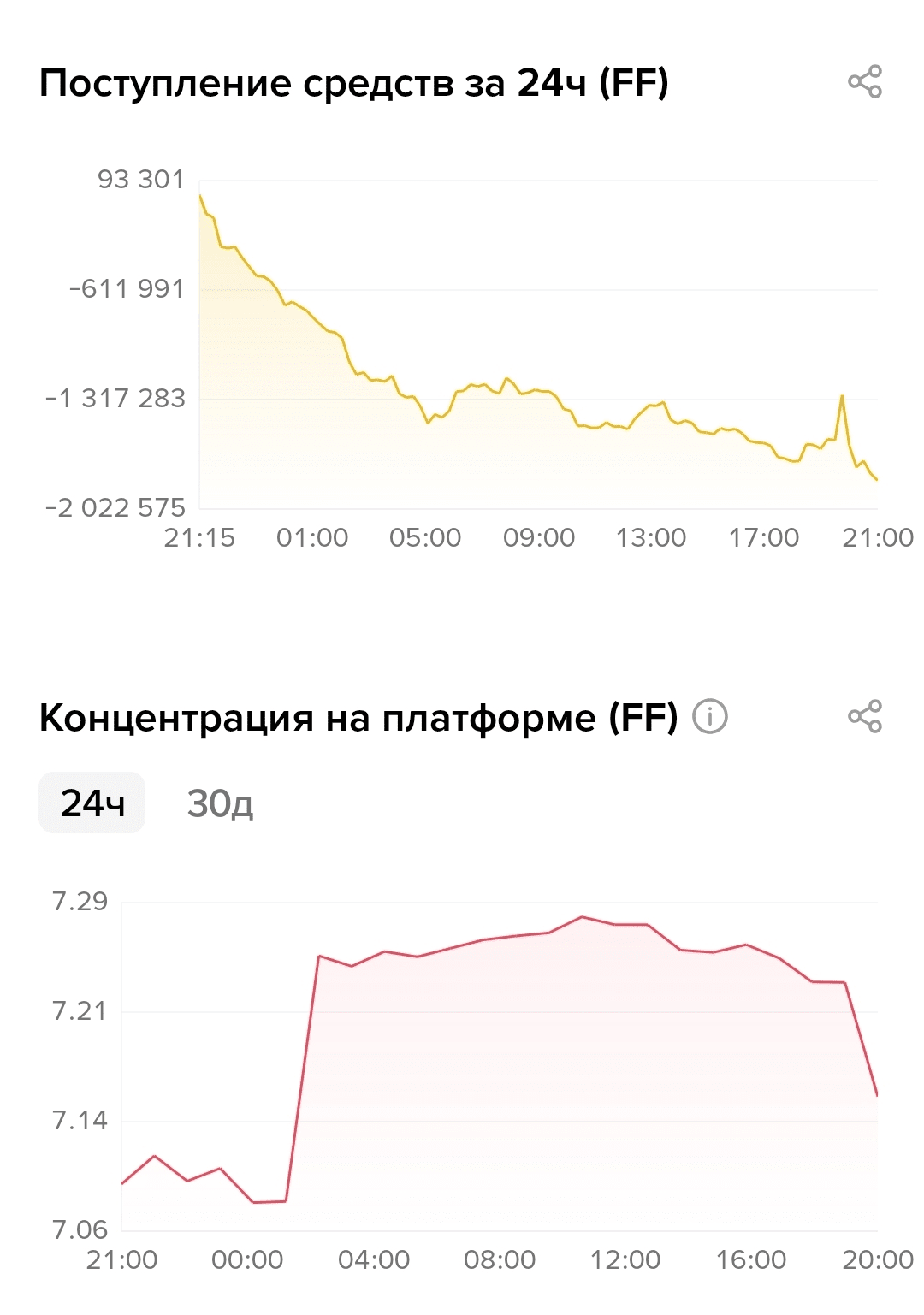
You know, when I first started getting into @falcon_finance, I had the feeling that I found something that could really change the entire logic of decentralized finance. Not just another platform for staking or farming, but a concept that unites two worlds – the traditional financial system and DeFi. And the key to this is the combination of real-world assets (RWA) with a synthetic dollar. This is what makes Falcon Finance such a special project.
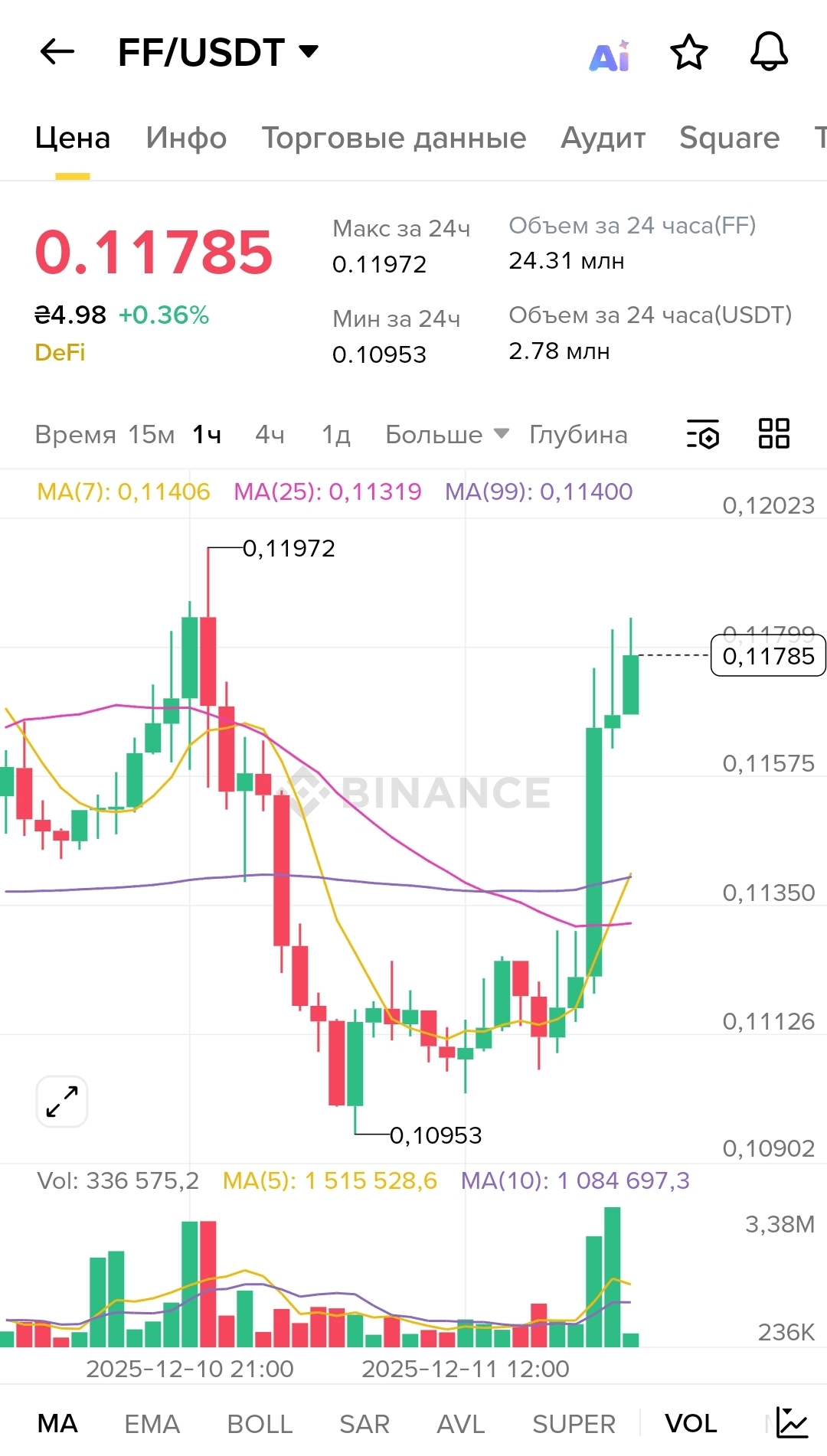
Look at the chart $FF – the price is currently hovering around 0.11785, showing a slight increase of 0.36%. After a sharp drop from a high of 0.11972 to a low of 0.10953, the token began to stabilize and even recover. This is typical behavior for a young project – first euphoria, then correction, and then a search for fair value. The moving averages show interesting dynamics: MA(7) at 0.11406, MA(25) slightly higher at 0.11319, and MA(99) practically at the same level of 0.11400. This indicates that the price is trying to consolidate and find support. Trading volumes are also decent – over 24 million in a day for FF, indicating a lively interest from the community.
But what truly excites me is not the technical analysis, but the very idea of the project. Falcon Finance is building a universal collateral infrastructure that transforms any liquid assets – cryptocurrency, tokens backed by real currencies, and even tokenized real assets – into liquidity tied to the dollar. Their synthetic dollar USDf is not just a stablecoin. It is an overcollateralized stable coin that can be created by pledging various assets, from USDT and BTC to tokenized bonds and gold. And then there is also sUSDf – a version that generates income when you stake it.
Why is this so important? Traditional stablecoins like USDT or USDC are tied to real dollars in bank accounts. This makes them stable but limited. Algorithmic stablecoins, like the former UST, tried to be decentralized but turned out to be unstable. Falcon Finance finds the golden mean – they create a synthetic dollar backed by real collateral, but this collateral can be anything. You can pledge your Bitcoin and receive USDf without selling BTC. Or you can use tokenized bonds, stocks, even private credit. This opens up incredible opportunities for capital that was previously locked.
And now add RWA – real assets. Falcon plans to launch its own engine for RWA tokenization in 2026. This means that corporate bonds, government securities, private credit – all of these can be tokenized and used as collateral to create USDf. Imagine an institutional investor with a bond portfolio worth millions of dollars. Instead of selling them for liquidity, they simply tokenize these bonds, pledge them in Falcon, and receive USDf which they can use in DeFi. It's like a bridge between Wall Street and DeFi – worlds that previously existed in parallel.
The $FF token is the heart of the entire ecosystem. It is not just a governance token, although voting is included. $FF holders who stake it receive preferential conditions: better capital efficiency when creating USDf, reduced fees, increased yield on staking USDf and sUSDf. Essentially, $FF is your VIP ticket into the Falcon ecosystem. The more the protocol grows, the more benefits token holders receive. And with plans for RWA integration that could attract trillions of dollars in institutional capital, the potential here is enormous.
Looking at their roadmap, I see real ambition. In the fourth quarter, they are expanding fiat gateways in Latin America, Turkey, the Middle East, North Africa, and the Eurozone. They are launching the ability to redeem physical gold in the UAE. They are integrating tokenized treasury bills and RWA as collateral. And by 2026, they are already developing a full-scale RWA engine that will allow tokenizing any institutional assets. This is not just a DeFi project; it's a true financial infrastructure of the future.
Fundamentally, everything looks solid. The team is led by Andriy Hrachov from DWF Labs – people with serious experience in institutional investments. They have raised $14 million in funding, have partnerships with BitGo for custody, DeXe Protocol for management, and integrations with Pendle, Curve, and Balancer. The total supply of tokens is 10 billion, with 2.34 billion currently in circulation. The TVL of the protocol has already exceeded $1.9 billion, and over $1.8 billion USDf is in circulation. This is not some experiment; this is a working product with real demand.
Speaking of forecasts, the key resistance is currently near 0.12, while support is at 0.109. If $FF can establish itself above 0.12 and break 0.12023, which is visible on the chart, it will open the way to test the psychologically important level of 0.15 and above. A drop below 0.109 could lead to a retest of the lows. However, in the long term, considering the planned RWA integrations and institutional focus, the growth potential looks serious. The team aims for a TVL of $5 billion, and if they can realize at least half of their plans with sovereign bonds and tokenized assets, it will radically change the demand for $FF.
What I particularly like about the RWA + synthetic dollar concept is that it solves a fundamental problem in DeFi. Currently, most protocols operate within a closed ecosystem of cryptocurrencies. You stake crypto, receive crypto, farm crypto. This creates a sort of bubble where all value circulates within the system. But the real world consists of trillions of dollars in real estate, bonds, stocks, commodities, and private equity. And all these assets are virtually unintegrated into DeFi. Falcon Finance is trying to change this by creating infrastructure that allows these traditional assets to enter the blockchain ecosystem through tokenization and use as collateral.
The synthetic dollar in this context becomes a universal means of exchange. Instead of selling your assets for liquidity, you create USDf against their collateral. This preserves exposure to these assets (if they appreciate in value, you remain in profit), but at the same time gives you a stable currency for use anywhere – in DeFi, for payments, for trading. And you can also stake this USDf in sUSDf and earn income from arbitrage funding rates and other protocol strategies. It's like having your cake and eating it too.
Of course, there are risks. I have seen criticism regarding the fact that part of the collateral for USDf consists of less liquid tokens like MOVE, which had listing issues on Coinbase. LlamaRisk in their report pointed out that the Falcon team has unilateral control over the management of reserve assets, and theoretically, more USDf could be created than the market capitalization of some collateral tokens. These are legitimate concerns, and they highlight the importance of transparency and audits. Falcon has responded by implementing weekly reserve attestations, integration with Chainlink Proof-of-Reserve, and a multi-level security system with Fireblocks and Ceffu. But risk is always present, especially in young protocols.
Another point is the token issuance. Out of a total supply of 10 billion, only 2.34 billion has been issued so far. The rest will be unlocked gradually, with 20% allocated to the team and contributors (with a one-year cliff and three-year vesting), 35% for ecosystem development, and 32.2% for the fund. This means that significant inflationary pressure is ahead, and the token price will depend on how quickly demand grows relative to supply. If the protocol truly attracts institutional capital and launches large-scale tokenization of RWA, demand may more than compensate for the issuance. But if development is slower, the price may stagnate or even decline.
For me as an investor, the most intriguing aspect is the intersection between RWA and synthetic stablecoins. It's not just a technological innovation; it's a potential paradigm shift. If Falcon Finance can create a working system where institutional investors comfortably use tokenized traditional assets as collateral to obtain stable cryptocurrency liquidity, it will open the gates for colossal capital. Imagine pension funds, hedge funds, family offices being able to effectively use their bond and equity portfolios in DeFi without selling these assets. This could increase the TVL of DeFi protocols by orders of magnitude.
Looking at the current state of the market and the position of $FF, I see a project in the early stages of its development. Technically, the token is trying to consolidate after a correction, and the next few weeks will show whether it can break resistance and continue to grow. Fundamentally, everything depends on the execution of the roadmap – the launch of the RWA engine, integration with institutional partners, geographic expansion. If these milestones are achieved, $FF has a chance to become one of the key tokens in the RWA and synthetic stablecoin segment. If not – it may remain just another interesting but unrealized project.
Personally, I am monitoring several indicators: first, the growth of TVL and the amount of USDf issued – this shows real demand for the product. Secondly, announcements of partnerships with institutional players and regulatory approvals – without them, large-scale tokenization of RWA is impossible. Thirdly, the launch of pilot projects with sovereign bonds in 2026 – if they happen, it will be serious validation of the model. And of course, the behavior of the token $FF itself – if it can hold support levels and show growth against the backdrop of protocol achievements, it will confirm that the market believes in the future of Falcon Finance.
In summary, RWA + synthetic dollar is a combination that could truly change DeFi forever. It merges the stability and liquidity of traditional finance with the flexibility and innovation of decentralized protocols. @falcon_finance is working to make this a reality, and if they succeed, $FF will not just be another token, but a key instrument in the new financial infrastructure. Will they succeed? Time will tell. But the potential is definitely there, and I will certainly be keeping a close eye on developments. #FalconFinance is a project worth keeping on your radar, because if they deliver on their promises, we could witness the birth of something truly significant in the world of DeFi.
#FalconFinance @Falcon Finance $FF