
Derivatives DEX is a specific category of decentralized exchange (Decentralized Exchange) designed for trading derivatives, rather than traditional spot assets (such as ETH exchanging for USDC).
In simple terms, Derivatives DEX = Derivatives + Decentralized Finance (DeFi).
What are derivatives?
Derivatives are a type of financial contract whose value is derived from an underlying asset.
Underlying Asset: It can be cryptocurrencies (such as BTC, ETH), stocks, indices, interest rates, etc.
Contract Content: The contract stipulates that both parties will trade or pay at a specific price or under specific conditions in the future.
The most common derivatives in DeFi are:
Perpetual contracts: A type of futures contract with no expiration date.
Options: Grant the holder the right (but not the obligation) to buy or sell an asset at a specific price at a specific time in the future.
What is a 'Decentralized Exchange' (DEX)?
DEX is a **non-custodial** trading platform.
Non-custodial: The assets of traders are managed by smart contracts rather than held by centralized entities. Users always control their private keys.
On-chain settlement: The execution and settlement of trades occur on the blockchain, providing high transparency and resistance to censorship.
Characteristics of Derivatives DEX
Derivatives DEX combines the complexity of derivatives with the decentralized features of DEX, forming the following core characteristics:
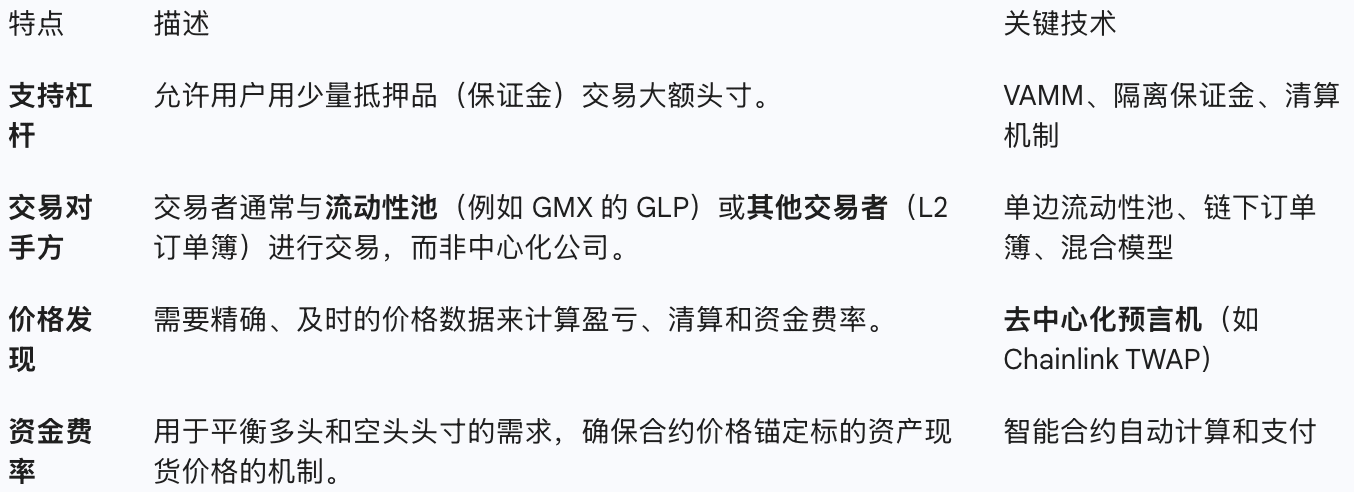
Mainstream mechanisms of Derivatives DEX
Due to the need for high frequency, low latency, and high capital efficiency in derivatives trading, they cannot simply run an AMM on L1 like Uniswap V2. Mainstream derivatives DEX typically adopt the following two innovative architectures:
Order Book Model
Representatives: dYdX v3, ApeX Pro
Operational methods: Adopt a hybrid architecture. Typically maintain a centralized order book on L2 sidechains or Rollups to achieve extremely high trading speed and low costs; however, the custody of funds and final settlement still occurs on L1/L2 smart contracts.
Advantages: The trading experience is close to that of centralized exchanges (CEX), with low slippage and high efficiency.
AMM/Liquidity Pool Model
Representatives: GMX, Perpetual Protocol
Operational methods:
VAMM (Virtual AMM): (e.g., Perpetual Protocol V1) uses a virtual pool for pricing, does not store real assets, thus supporting leverage.
One-sided LP pool (e.g., GMX's GLP): Liquidity providers deposit a basket of assets (such as ETH, BTC, stablecoins) as counter-parties for all traders. LPs earn trading fees but bear the risk of traders' net gains and losses.
Advantages: Purely on-chain or highly decentralized, providing simple liquidity provision, and LPs earn 'real returns.'
The emergence of derivatives DEX allows users to use leverage, hedge risks, or speculate on asset prices without trusting third parties. They are a key step for DeFi to mature and compete with traditional financial markets.


