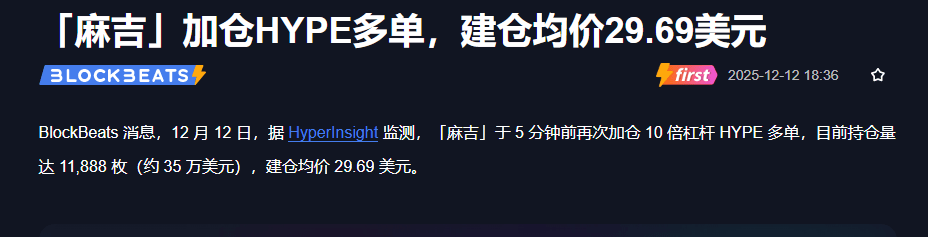
Seeing this news flash, I have some thoughts I want to share with you all.
'Maji' used 10x leverage to increase their position in HYPE, currently holding a value of about $350,000. This action itself is a signal from the market, indicating that funds chose this asset at a specific point in time and used a larger volatility leverage.
My thoughts are:
1. Focus on signals rather than blindly following. There are various operations in the market, some for long-term layout and some for short-term hype. When we see anyone's public operations, the first reaction should not be, 'I need to follow immediately,' but rather, 'What might be the possible reasons behind this?' Is it a long-term outlook on the project's development, or is it based on short-term technical games, or other market considerations? The information itself needs to be filtered.
2. Leverage is a double-edged sword, use it with caution. A 10x leverage means that fluctuations are amplified tenfold. In a highly volatile market, it is an extremely sharp tool that can expand profits when used well, but can accelerate losses if not. If there is no mature risk control system and strong psychological endurance, ordinary investors should be extremely cautious, even avoiding high leverage altogether. My personal experience is that the leverage ratio should never exceed the limit at which you can sleep soundly.
3. Focus on the project, rather than simply paying attention to 'who bought it.' Instead of asking 'What did my buddy buy?', we should ask: 'How is the HYPE project itself?' What about its core team, technical applications, ecological development, and community situation? Does it solve real needs? In-depth research of the fundamentals is the fundamental source of your holding confidence, not anyone else's trading actions.
What can be done next:
• Step one: Research. If you started paying attention to HYPE because of this information, please immediately add it to your watchlist and start doing your homework. Read its white paper, official website, project progress reports, and understand its core logic.
• Step two: Observation. Do not rush to enter the market. Observe its performance near the current price, and see how the overall market sentiment is. Large positions will affect short-term prices, but medium to long-term trends will ultimately return to value.
• Step three: Planning. If you have done your research and are optimistic, and decide to participate, make sure to prepare your trading plan: how much position you plan to invest (it must be an amount you can fully afford to lose), at what point you consider entering, where to set your stop-loss, and what your target range is. Plan your trade, and trade your plan.
• The most important step: Risk control. No matter how optimistic you are, do not bet everything at once. The market always has uncertainty. Setting stop-losses is the most important bottom line to protect your capital.
The market is never short of opportunities, but lacks patience and discipline. Others' operations can become one of our sources of information, but they can never replace our own independent thinking and decision-making.
Let's encourage each other.@俊哥说趋势