Hello everyone, I am Crypto Mubai
Referred to as 'Big White' by fans, he is hailed as 'the Buffett of rising markets and the Soros of falling markets.' As a leader in the crypto field, Big White primarily focuses on spot trading, supplemented by contract operations. With precise market judgment and a steady operating style, he has become a versatile trading expert.
Big White is also a senior analyst in the blockchain market for spot, contracts, and on-chain assets, with a win rate of over 96%!
Preface
The Federal Reserve has made a decisive move: cutting interest rates by 25 basis points and printing 40 billion to buy government bonds.
According to the 'textbook' narrative, this is definitely an epic positive signal, and the market should be celebrating with fireworks. But reality has slapped us in the face— the stock market hasn't picked up, and long-term government bonds are being crazily sold off, with yields rising instead of falling.
It feels like the doctor gave you a shot of adrenaline, but your heartbeat became even more chaotic.
Why? Because the market 'smells' something more terrifying than economic recession.
This interest rate cut does not seem to be aimed at rescuing the economy; it looks more like a 'performance' forced out by political pressure. The market votes with its feet, sending the sternest warning: We no longer believe in the 'independence' of the Federal Reserve.
What people are truly panicking about is that the central bank, the last 'stabilizing force', may be becoming a political tool. Once this bottom line is broken, long-term uncontrolled inflation and the collapse of the dollar's credit will no longer be a fantasy.
For us players in the crypto world, this scene is simply too familiar.
Isn't this precisely the core issue that Bitcoin was born to combat? When the credit of centralized institutions begins to crumble, decentralized, fixed-supply, and not controlled by any single party assets are fundamentally changing their 'safe haven' attributes.
It is no longer merely a 'high-risk asset', but an 'insurance policy' against the risks of traditional systems.
The market is re-pricing for the ultimate risk of 'politicization of the Federal Reserve'. And we should take this opportunity to re-examine the allocation in our wallets with a fresh perspective.
Historic turning points are often hidden in the most unusual signals.
One: An interest rate cut reveals the Federal Reserve's most vulnerable moment.
What you think of as interest rate cuts: The textbook's big move to rescue the market.
The actual interest rate cut: A political performance following a precise 'forecast'.
On the surface, a 25 basis point interest rate cut seems to be a routine response to economic slowdown. But during yesterday's decision, everyone sensed a different odor.
The timeline is really too coincidental.
Just a few days before the decision was announced, Trump's economic guru and a hot candidate for the next Federal Reserve chairman — Kevin Hassett, surprisingly 'predicted' in a public setting: This time, it will be a 25 basis point cut.
You taste it, you savor it.
What kind of prediction is this? This is basically like 'spoilers'.
What is even more unsettling is that over the past year, Trump's attacks on the current chairman Powell have not stopped, even openly threatening to 'take him down'. This kind of political pressure, which is almost a direct threat, has rarely occurred in the Federal Reserve's century-long history.
The market is not foolish.
When the script of 'independent central banks' is leaked in advance, and professional decisions are surrounded by political rhetoric, this interest rate cut has long ceased to be purely economic.
What is more 'stimulating' than interest rate cuts is the $40 billion of 'hidden liquidity'.
The Federal Reserve simultaneously announced it would purchase $40 billion in short-term government bonds within 30 days. The official reason is 'to maintain market liquidity', but anyone can hear — this is just a disguised form of money printing.
In a day when the U.S. fiscal deficit has already soared, any form of 'debt purchase' can easily be interpreted by the market as: The government is out of money, and the central bank is coming to clean up.
The market responds to all this with panic:
Short-term interest rates have fallen, but long-term government bond yields have risen instead of falling. What does this indicate?
It indicates that investors fundamentally do not trust the 'gentle market rescue' narrative; they are already pricing in the worst-case scenario — political intervention in the central bank, long-term uncontrolled inflation, and the quiet devaluation of the dollar's credit.
When the Federal Reserve transforms from a 'market stabilizer' into a 'political megaphone', the traditional safe haven logic is becoming ineffective.
And this is precisely why more and more people are looking towards the 'decentralized' option — when the old system begins to shake itself, a new narrative truly begins.
Two: If the Federal Reserve is no longer independent: What does it mean for your money?
Do you trust the Federal Reserve?
In the past, this question was as superfluous as asking 'Do you believe the sun will rise?' But now, the market is answering with panic: No, we don't believe anymore.
This interest rate cut is no longer a simple economic decision. Standard Chartered's latest report hits the nail on the head: The market is already pricing in the 'loss of independence' of the Federal Reserve in advance. When the central bank begins to take orders from politics, long-term interest rates rise instead of falling — this is not an overreaction by the market but investors demanding higher 'risk compensation'.
What could topple the dollar's hegemony might not be war, but a small domino.
Financial experts warn that the loss of the Federal Reserve's independence is equivalent to a 'nuclear bomb' directed at the dollar's credit. Once the market determines that the central bank has become a political puppet, the global status of the dollar will be fundamentally shaken.
Ironically, the current geopolitical tensions are still temporarily supporting the dollar's 'safe haven' status. But this support is precisely masking the rotting foundation within the dollar — can a currency that might be manipulated by politics still be called a 'safe haven asset'?
The traditional world is beginning to shake, and the narrative of the crypto world is being rewritten.
When the trust foundation of the old system shows cracks, we may need to revisit those options that were once seen as 'marginal'.
Bitcoin: When 'digital gold' meets a real currency crisis.
The core of this crisis is that 'trust' has become problematic. The entire system of Bitcoin is built on code that 'requires no trust'.
Against over-expansion, it is serious: 21 million coins, written into the founding code, forever unchangeable. In contrast, a Federal Reserve that might be politically hijacked will have its money printing decisions not determined by economic data, but perhaps by ballots. History has already played out: In 2020's massive liquidity injection, Bitcoin rose from $3,800 to $69,000. The market is voting with its funds, choosing that asset which cannot be diluted.
Against intervention, it is immune: No president can call to threaten Satoshi, and no parliament can vote to decide Bitcoin's interest rate. Its decentralization is precisely the ultimate antidote to a 'politicized central bank'.
Ethereum and DeFi: When distrust becomes the new normal.
If even the Federal Reserve is no longer credible, who can we trust?
DeFi (Decentralized Finance) provides a disruptive answer: Trust no one, only trust the code.
On Ethereum, lending and trading are automatically executed through smart contracts. Interest rates are set by algorithms, rules are open and transparent, and no one can change them due to political pressure. When the 'trust' of traditional finance becomes a luxury, this system of 'code is law' becomes the most reliable choice.
Of course, this path is not without challenges. Mainstream stablecoins are still pegged to the dollar, which will transmit the risks of the dollar. And the violent fluctuations in the crypto market also mean it is far from a gentle safe haven.
But a fundamental shift is happening: Bitcoin and crypto assets are transitioning from 'risk speculation' to 'sovereign credit hedging tools'. When interest rate cuts no longer boost confidence, but instead incite panic, the old script has already failed. A new narrative may be quietly opening in this crisis of trust in the dollar.
Three: Don't just look at interest rate cuts! The real crisis is still ahead.
This interest rate cut is not a purely 'market rescue action'.
It feels more like a public compromise: The Federal Reserve's professional judgment is beginning to bow to political pressure.
And the real test is actually still ahead.
Imagine: If inflation returns next year, will the Federal Reserve dare to decisively raise interest rates?
When politics needs to 'maintain the illusion of prosperity', can it still make painful but necessary decisions independently?
Once the market determines that 'the Federal Reserve is no longer credible', the foundation of the dollar's credit will show real cracks.
For crypto investors, the current excitement around this interest rate cut needs to be viewed calmly.
Short-term market fluctuations can be deceiving, but long-term structural changes will not.
When the core of the traditional financial system — trust — begins to shake, the logic of crypto assets has already been permanently rewritten.
It is no longer a simple 'speculative tool', but is becoming a structural choice for hedging sovereign credit risks.
When people begin to doubt the central bank and the dollar, a system without a central decision-maker, with rules written in code, is no longer a fantasy but a gradually clearer realistic option.
History never turns suddenly; it only quietly pushes down the first domino before everyone notices.
And now, we might be standing right before that domino.
Four: Review of Big White VIP code strategy
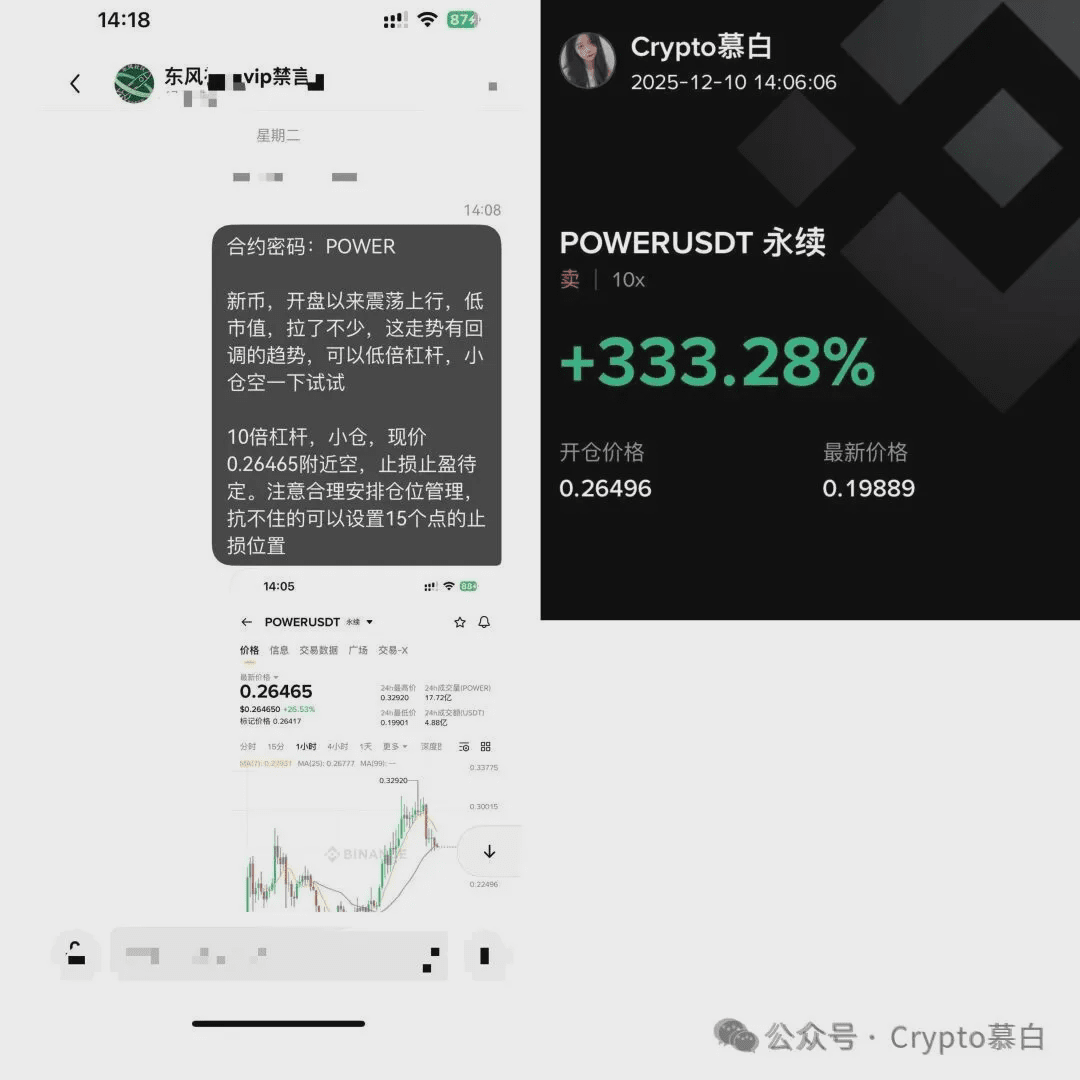
On December 9th, Tuesday, the big white VIP was short around 0.26465$POWER
10x leverage has resulted in more than 3x gains.
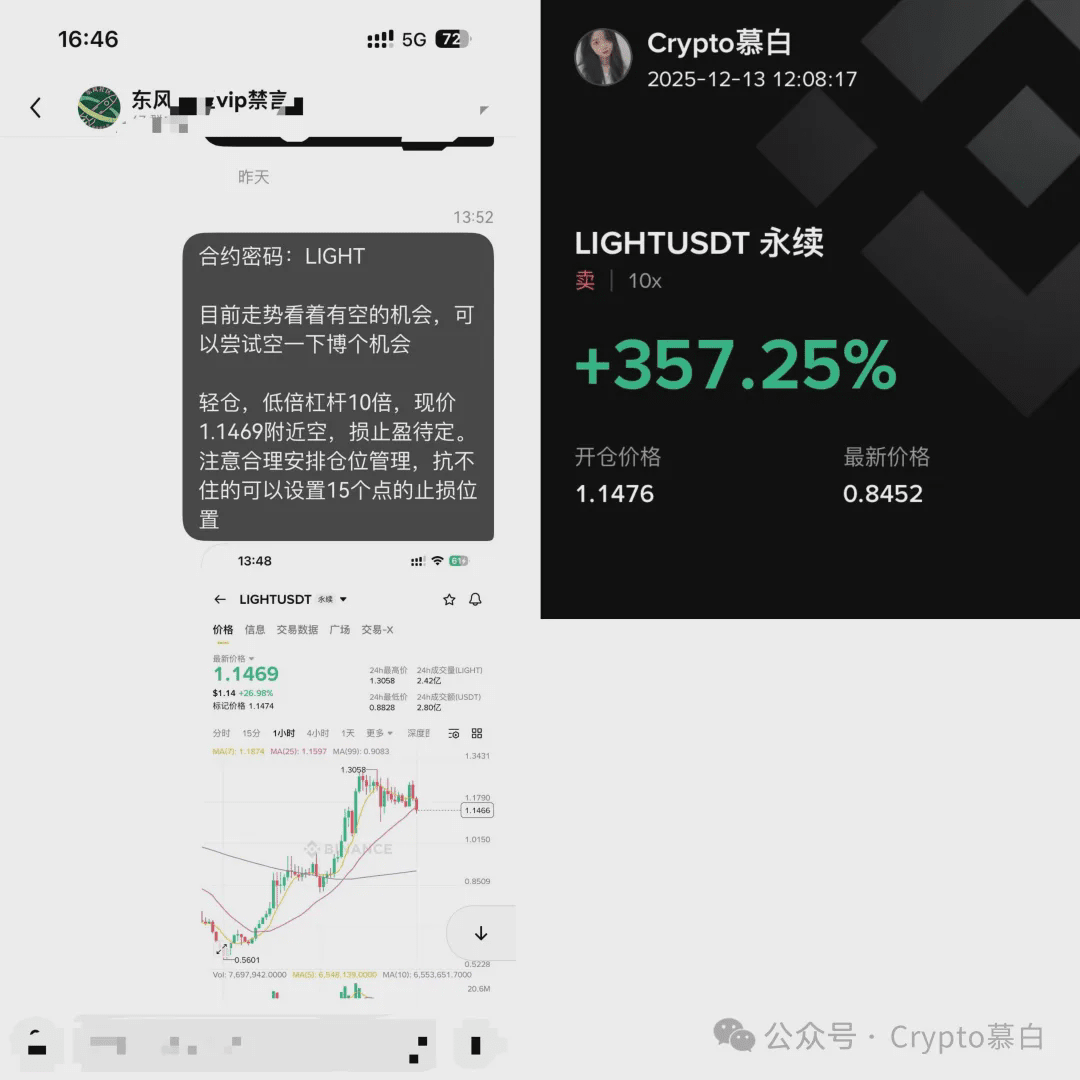
On December 12th, Friday, the big white VIP was short around 1.1469 $LIGHT
10x leverage has resulted in more than 3x gains.
Big White's strategic guidelines remain so strong; this is Big White's strength, evident to all, with clear signals publicly available, refusing to play the hindsight game!
For those who want to keep up with Big White's pace in real-time, Big White VIP still has more wealth passwords, the old rule, come to claim it!
Click the yellow text link below to enter the Binance official group, White Army:
White Army [Binance Official Group]
For those who want to consult the Big White wealth password strategy, feel free to add the official Binance chat ID of Big White: mubai369