

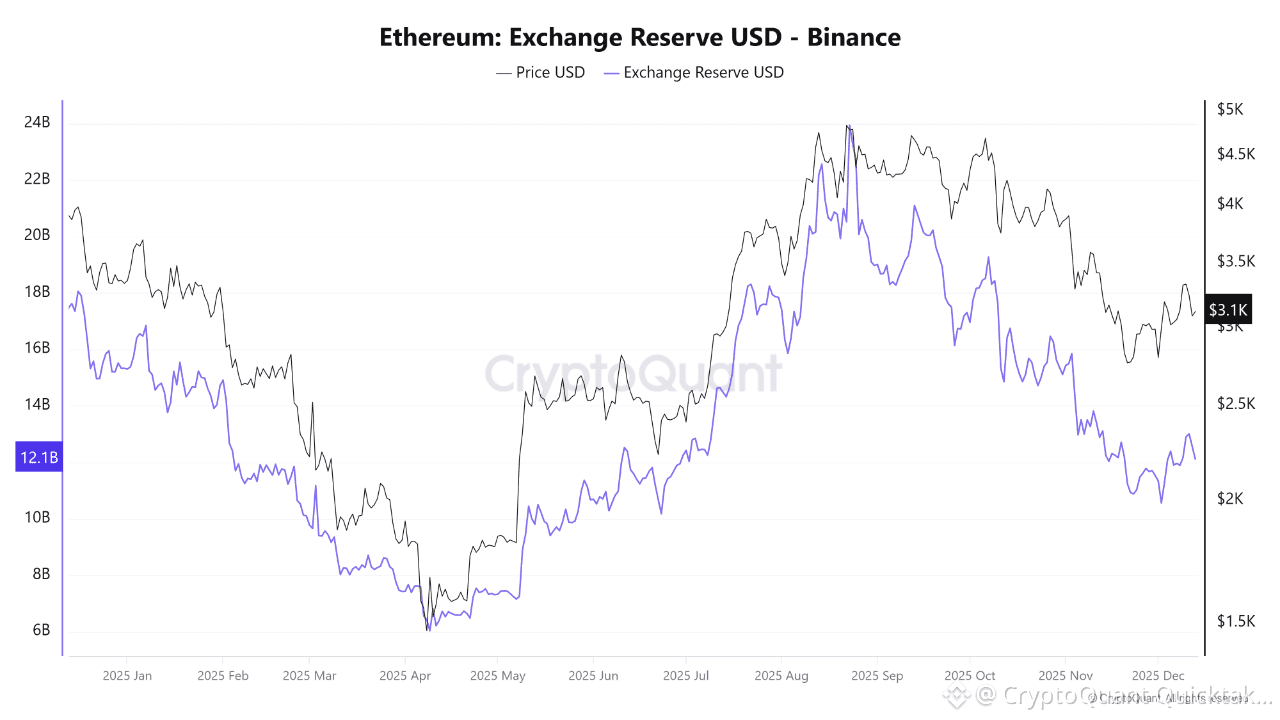
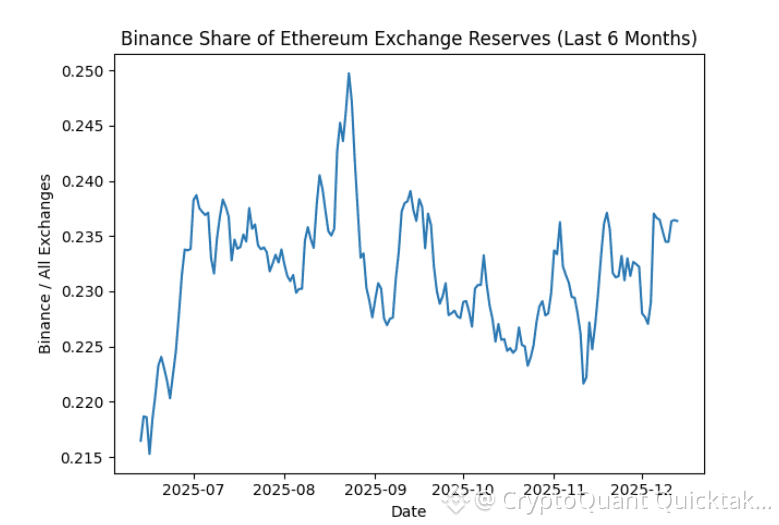
Over the past six months, Ethereum exchange reserves have been trending lower across the market, reflecting a broader shift toward self-custody and reduced sell-side pressure. When comparing total exchange reserves with Binance-only reserves, an important structural insight emerges: Binance’s share of Ethereum reserves has remained relatively stable.
The Binance-to-All-Exchanges ratio has fluctuated within a narrow range of roughly 22% to 25%. While there were periods during the summer when Binance’s share temporarily increased, the ratio later normalized and has recently shown mild stabilization. Crucially, there has been no sharp or sustained decline in Binance’s share.
This suggests that the ongoing reduction in Ethereum exchange reserves is a market-wide phenomenon rather than an exchange-specific issue. In other words, ETH is leaving exchanges broadly, not fleeing Binance in isolation. This distinction matters, as exchange-specific outflows often signal trust or liquidity concerns, while broad-based declines typically point to longer-term holding behavior and improved market structure.
From a market perspective, this stability implies healthier liquidity dynamics. With fewer ETH held on exchanges and no concentration risk emerging at a single venue, downside volatility driven by forced selling becomes less likely. If demand returns, this structural tightening could support stronger upside moves.
Overall, the Binance ratio data reinforces the view that Ethereum’s current phase is one of consolidation and structural normalization, rather than stress or fragmentation within the exchange ecosystem.
Written by XWIN Research Japan

