You know, I thought for a long time whether I should delve into DeFi, and the main question that held me back was the need to sell my assets every time I needed money. Imagine a situation: you have a portfolio of tokens, you believe in their long-term potential, but suddenly you need liquidity — for a new project, for living expenses, who knows. So what to do? Sell at a loss? Miss out on future growth? This has always been a painful dilemma until I learned about @falcon_finance.
Look at how this works in practice. Suppose I have $FF and other tokens that I do not want to sell. Previously, I would have gone to a centralized exchange, sold part of my position, paid commissions, then when the money reappeared, I would try to buy back — and of course, already at a different price. It’s like selling a favorite item to a pawn shop, knowing that you will get it back at three times the price or not at all. But now with #FalconFinance, I can simply pledge my assets and receive USDf — a synthetic stablecoin that remains stable regardless of market volatility.
What impressed me the most is the concept of over-collateralization. I know, it sounds complicated, but in practice, it’s quite simple. When you pledge your tokens, the platform requires that their value be higher than the amount of USDf you receive. For example, if I want to get stablecoins worth $1000, I need to pledge assets worth $1500 or more. Why? Here’s why: it’s protection against sharp price drops. Even if the market falls by 20-30%, my collateral still covers the debt, and I am not liquidated immediately, as happens in aggressive lending protocols.
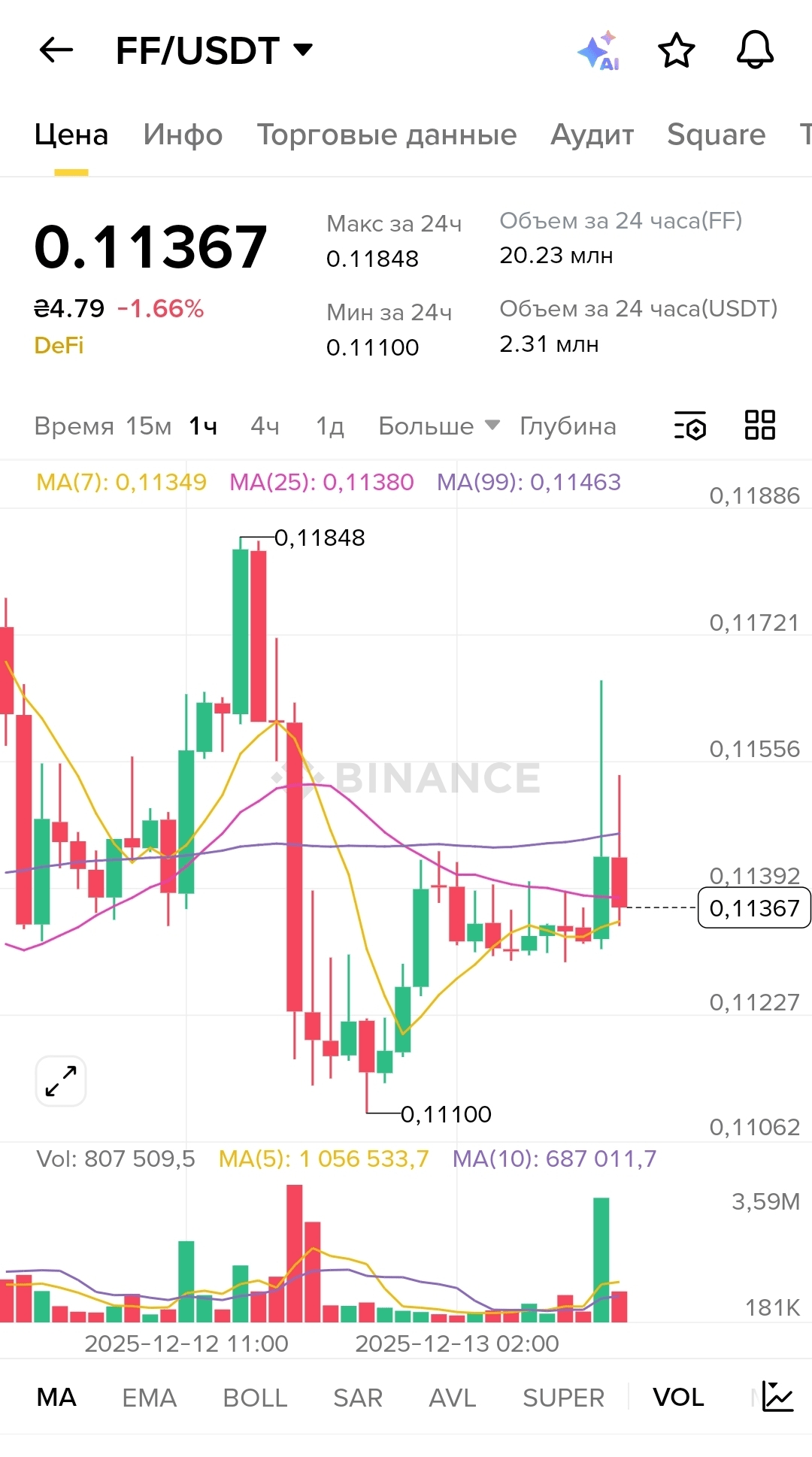
By the way, let's look at the real numbers. Right now, $FF is trading at 0.11367 USDT, and yes, over the last day the token has dropped by 1.66% — quite a normal correction for the crypto market. But pay attention to the volatility: in 24 hours, the price fluctuated from a low of 0.11100 to a high of 0.11848. That's a range of almost 7%, and this is where the charm of the collateral system comes into play. Imagine that you pledged $FF at a price of 0.11848 and received USDf. Even when the price fell to 0.11100, your collateral is still working because the over-collateralization covers these fluctuations. You did not lose your position, you were not liquidated, and when the price recovered to the current 0.11367, your assets are gaining value again.
I look at trading volumes — and this is a separate story. In 24 hours, the turnover was 20.23 million for the FF pair and only 2.31 million USDT. Such a difference in volumes indicates that interest in the token is growing; people are actively trading, looking for entry points. And the current volume of 807,509 units per hour shows stable activity. This is not some dead project with artificial inflation — there is real movement, real users.
I have noticed an interesting thing: many in crypto are afraid of the word "debt" because everyone has examples in mind of when people lost everything due to liquidations. I remember how during the crash in May 2021, entire positions burned in a matter of minutes. But this is a different story. USDf is not a loan in the classical sense; it is more of a way to unlock value that is "frozen" in your assets. And the coolest part is that your tokens still belong to you. They are collateralized, but they are yours. When you return USDf back to the protocol, you will get your assets back in full.
Looking at the chart and moving averages, I see an interesting picture: MA(7) is at 0.11349, MA(25) is 0.11380, and MA(99) is 0.11463. Do you know what that means? The short-term average is below the long-term average, which indicates a current correction, but the difference is minimal — only about 1%. For me, this is a signal that the token is in a consolidation phase after a rise, looking for a new support level. And if you look at the candlestick pattern, you can see that after a sharp jump to 0.11848, there is a healthy correction with gradual stabilization. This is normal; it is not a crash — the market is breathing.
Another thing that caught my attention is working with tokenized assets of the real world. You see, DeFi has long been an isolated space: yes, it’s cool, but cut off from reality. And @falcon_finance builds a bridge between traditional assets and the blockchain. Suppose you have tokenized real estate or precious metals — you can use them as collateral just like crypto. For me, this is a sign of the industry’s maturity when the digital and real worlds begin to truly interact.
Do you know what else is important? Accessibility. I am not a technical specialist, not a developer; I am an ordinary user who wants to manage their finances effectively. And this idea of a universal collateral infrastructure — it makes the process understandable. There is no need to figure out dozens of different protocols with different rules, limits, and percentages. One protocol, transparent terms, a wide selection of assets for collateral. For me, this is exactly what the market was lacking.
Look at the dynamics of $FF — the price of ₴4.79, considering the current exchange rate of the hryvnia, shows the token's accessibility for a wide audience. Yes, there is volatility; this is crypto, but the project is developing, trading volumes are growing, and most importantly — it solves a real problem. Not just another meme coin or speculative asset but a tool that changes the logic of capital use in the blockchain. Instead of choosing between "hold" and "sell", a third way appears — "use but not lose".
And the last thing I noted for myself: when you do not sell an asset, you do not pay capital gains taxes. In some jurisdictions, this makes a huge difference. Plus, psychologically it feels completely different — you are not parting with your tokens, you do not regret selling early, and you simply gain a tool for maneuvering. Even with the current correction of 1.66%, if you hold $FF as collateral for USDf, you have not realized a loss — you are just waiting for the market to turn around. And judging by the technical indicators and growing volumes, there is definitely potential for recovery and growth.
I think this is precisely the freedom that many come to crypto for — the freedom to manage your money as you need, without intermediaries, banks, and the rigid rules of the traditional financial system. #FalconFinance is not a revolution in the style of "tomorrow everything will change"; it is an evolution that makes DeFi more convenient, safer, and more logical. And honestly? I like being part of this process.
#FalconFinance @Falcon Finance $FF