

There is a harsh reality in the crypto space: no matter how advanced the technology, if developers are unwilling to use it, it’s pointless. I've seen too many so-called revolutionary oracle projects with documentation that is beautifully written and a technical architecture that sounds amazing. However, developers take one look at the documentation and close the page because it’s too complex.
@APRO-Oracle The thing that impresses me the most is not how much cutting-edge technology it has, but that it is genuinely focused on developer experience. From SDK design to documentation structure to testnet support, every detail is telling developers, 'Come on, I can get you up and running in three minutes.'
Let's talk about the SDK. The traditional oracle SDK is a hodgepodge. If you want to use price data, you have to import the entire library. In a few MB of dependencies, 90% of the features you don't even need. But there's no way around it; that's how it's designed. APRO is different. Its SDK is modular. Just import apro-price for price data, apro-ai for AI verification, and apro-bridge for cross-chain synchronization. Each module runs independently.
The benefits of this design are real. A developer in the community shared that he only needed the prices of BNB and USDT to create a lending protocol on BNB Chain. After compiling with Chainlink's SDK, the contract was 5KB. With APRO's modular SDK, it was only 2.3KB, saving more than half. Don't underestimate this 2.3KB; in a high-Gas environment, deployment costs can save hundreds of dollars.
More critically, the loading speed has improved. The smaller the contract, the faster the execution and the lower the Gas consumption, leading to a better user experience. This is not just a bonus; it is a real cost advantage.
Moreover, the documentation is a severely underestimated competitive advantage. I've seen too many project documents that start with a bunch of technical terms, causing confusion. APRO's documentation begins with a Quick Start on the first page—three lines of code, and your contract can call price data.
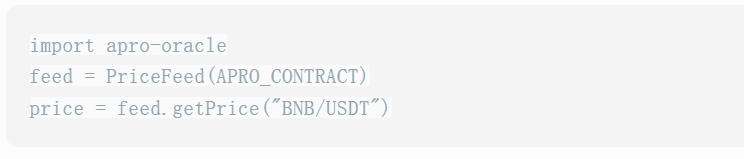
It's that simple. For developers who want to quickly validate ideas, this out-of-the-box experience is crucial. It's not too late to delve into advanced features once they actually adopt APRO. Letting people use it first is better than anything.
APRO has another ace up its sleeve: the testnet Faucet and Playground. Developers can freely call all of APRO's features in a test environment. Price data, AI verification, cross-chain synchronization—all available without spending real money to run the entire product logic. While Chainlink also has a testnet, the data sources are relatively singular. APRO's testnet almost completely simulates the production environment.
A game developer in the community said he ran the prediction market's entire logic on APRO's testnet for two weeks without spending a dime. When the mainnet launches, he just needs to change the contract address. This kind of development experience is indeed rare in the crypto space.
What impresses me the most is APRO's case library. There is a repo on GitHub dedicated to various scenario examples, including DeFi lending, NFT pricing, prediction markets, RWA validation, and AI Agent calls. Each case is a complete, runnable example that developers can fork, tweak parameters, and use.
This move is very clever. Many developers don't want to use new technologies; they just don't know how. You give them a pile of API documents, and they get overwhelmed. You give them a ready-made case, and they can tweak it to run. The learning curve drops sharply.
For example, APRO's RWA audit report verification case requires developers to simply provide a PDF link. APRO's AI nodes automatically parse the document, extract key data for authenticity verification, and return structured results. The entire process involves calling one API, with the underlying AI handling data verification entirely wrapped up. This kind of black-box design of complex logic is truly developer-friendly.
There's also a point that many people overlook. APRO provides 24-hour technical support. There are dedicated developer channels on Discord and Telegram, with technical team members online to answer questions. I've observed for several days, and the response speed is indeed fast. Developers' questions generally receive replies within half an hour, and they are technical answers, not just perfunctory.
Compared to Chainlink's community, which is large but relies mainly on volunteers for technical support, the official team rarely gets directly involved. For developers encountering bugs, the direct support from APRO's officials is more attractive.
However, APRO also has shortcomings. There are still too few ecological cases. Chainlink has endorsements from top DeFi protocols like Aave, Compound, and Synthetix. When developers see that even Aave is using it, they naturally feel reassured. Although APRO's partners are increasing, there are no truly killer applications yet.
This is a chicken-and-egg problem. Without major projects adopting it, developers hesitate, and with few developers, major projects are reluctant to use it. APRO's breakthrough strategy is to enter from vertical scenarios, first establishing a foothold in emerging fields like RWA, BTCfi, and AI Agents, then penetrating into mainstream DeFi.
According to the roadmap, APRO will launch a developer incentive program in Q1 2026. Projects integrating APRO can receive AT token rewards and technical support. This subsidy for developers will attract a batch of early adopters in the short term. Once these projects are up and running, creating a demonstration effect, subsequent adopters will naturally follow.
Another interesting point is that APRO's error handling mechanism is friendlier than traditional oracles. When data sources have issues or verification fails, it doesn't just return an error code; it provides detailed error information and suggestions. For instance, if data source A is temporarily unavailable, it switches to data source B, or if the price fluctuation exceeds the threshold, it suggests delaying execution. This humanized error prompt helps developers quickly locate the problem.
From a cost perspective, APRO's pricing strategy is also very competitive. It adopts a tiered charging model. Basic price data may be free or low-cost, but advanced AI services are charged according to the number of calls or complexity, and it supports monthly packages. For early-stage projects, using it for free initially and then paying as they scale up is more flexible than Chainlink's one-size-fits-all pricing.
Someone in the community calculated that a small to medium-sized DeFi protocol calling APRO data 10,000 times a month might only need a few dozen dollars for basic services. However, if they need AI risk assessments, it could cost several hundred dollars a month. This tiered pricing allows projects of different scales to find suitable solutions.
More critically, APRO's cross-chain advantage is highlighted here. If your protocol is deployed on multiple chains, traditional oracles require you to integrate separately on each chain, making configuration and maintenance a hassle. APRO, due to its unified data collection and processing layer, allows you to integrate once and use it across all supported chains, significantly reducing operational costs.
Imagine a cross-chain lending protocol deployed on Ethereum, Arbitrum, BNB Chain, and Solana. Using Chainlink, you need to configure four nodes. With APRO, you only need one integration, and then you can get consistent data across all four chains. This convenience is of immense value to developers.
APRO is also doing something very clever. They are very active at hackathons. BNB Hack Abu Dhabi is not only a sponsor but also has a dedicated APRO track. Projects participating that use APRO's oracle can receive extra bonuses and technical support. This scenario-based promotion is much more effective than advertising.
Because while most projects at hackathons will fail, some will grow into real products. If they use APRO from the start, the likelihood of switching later is very low. This is APRO investing in the seed stage, exchanging a small cost for long-term user stickiness.
From the current trend, APRO's investment in the developer ecosystem is serious. It's not just a slogan; they are genuinely lowering integration barriers, optimizing the development experience, and providing technical support. Such pragmatic approaches are actually rare in the crypto space. Many projects prefer to spend money on marketing rather than developer tools.
However, in the oracle track, it ultimately relies on the developer ecosystem. Why can Chainlink become the leader? Apart from technology, it is also due to the early accumulation of the developer community. Those developers using Chainlink promote it spontaneously, answer questions on Stack Overflow, and write tutorials to share experiences. This community-driven growth is the most sustainable.
What APRO is doing now is replicating this path, but the battlefield it chose is RWA and AI Agents, rather than traditional DeFi. Time will prove whether this strategy is right or wrong, but at least from a developer experience perspective, APRO has done better than many competitors.
For those still struggling to choose between Chainlink and APRO, why not try APRO's testnet? It won't cost you anything. You can experience which one is better suited for your project. You might discover that integrating an oracle can be this simple.

