
In the eyes of many, the charm of DeFi lies in 'leaving everything to smart contracts.'
But seasoned players who have gone through several extreme market conditions know: while code may not be emotional, it can still crash.
When designing the risk control system, FalconFinance did not take the extreme route of 'fully automated custody of fate,' but chose a more pragmatic approach:
Implementing a dual-layer defense mechanism of an automated system + manual monitoring.
Usually monitored by an automated system 7×24 hours, performing rebalancing;
In extreme market conditions, FalconFinance allows professional trading teams to take over within the framework and perform manual interventions.
This 'nuclear button written outside the code' is not to deny smart contracts, but to acknowledge a fact:
At certain extreme moments, relying solely on algorithms is not enough.
One, Automation vs. Human Intervention: How does FalconFinance delineate boundaries?
FalconFinance's philosophy is clear:
Normal Market: Letting machines do what they are good at—arbitrage, rebalancing, and monitoring positions;
Abnormal Market: When volatility, liquidity, and correlation are distorted simultaneously, introducing human judgment to prevent the protocol from becoming a 'zombie program'.
Specifically, the dual-layer structure of FalconFinance is roughly divided into two layers:
Automation System Layer
Continuously monitoring collateral prices, leverage ratios, hedge position health, and other indicators;
When volatility or certain preset indicators reach thresholds, issue warnings and attempt to automatically execute 'liquidation/scale down/rebalance'.
Manual Oversight Layer
When the system determines 'insufficient liquidity' or 'market conditions exceed model assumptions', it will no longer blindly execute according to the original logic;
The trading team at FalconFinance will intervene, conducting a manual evaluation of CEX depth, funding costs, and the trends of related assets, then decide on specific pacing and scale.
This design essentially aims to avoid two extremes:
Only trusting code: might step into the thinnest liquidity during a flash crash, accelerating self-destruction;
Only trusting humans: completely abandoning automation would lose real-time responsiveness and transparency.
Two, Crisis Scenario Breakdown: What does FalconFinance do when a black swan strikes?
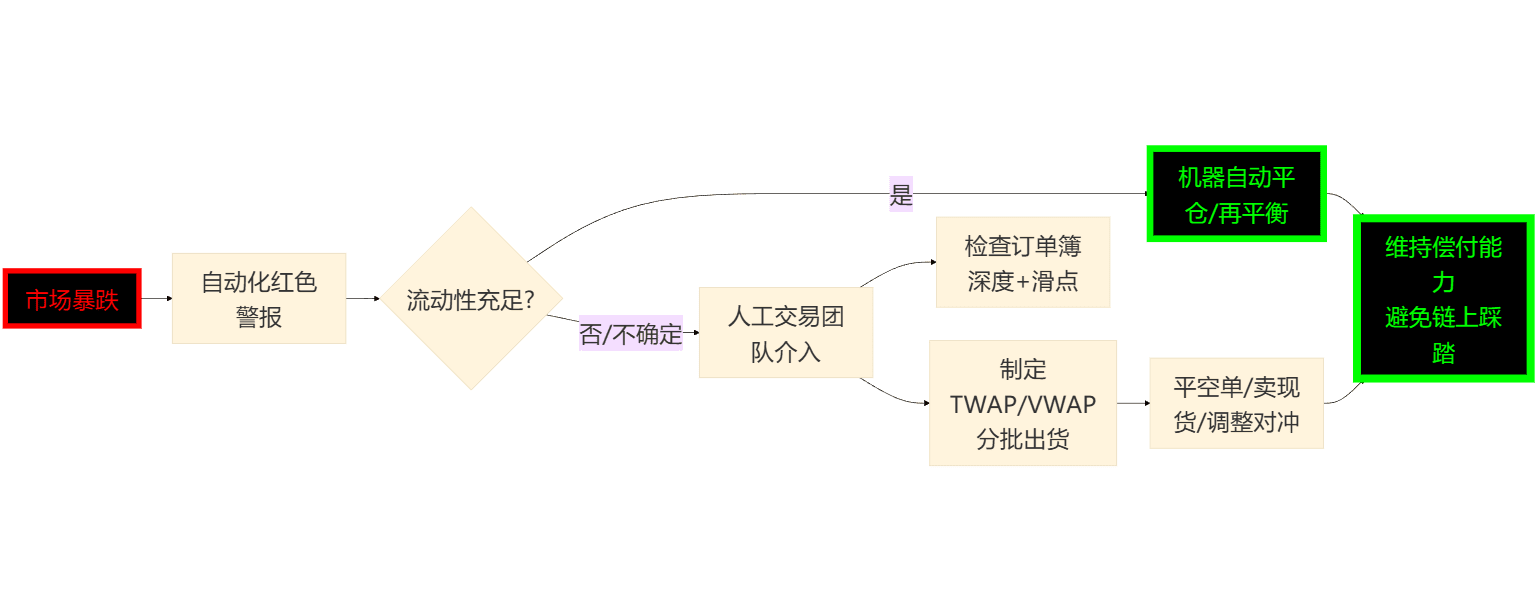
The key here is not the two words 'liquidation', but rather 'how to liquidate, how much to liquidate, and how long to take to liquidate':
When market depth is normal, the automation system can complete a large number of adjustments in one go;
When liquidity is tight, FalconFinance will adopt more cautious TWAP / VWAP strategies, spreading selling pressure over time to avoid stepping on its own toes.
Three, why does FalconFinance not act as a 'pure algorithm stability' idealist?
The lessons of the past few years are clear:
Many 'seemingly elegant' pure algorithm models can easily fall into several typical dilemmas once the market exceeds the assumed range:
Liquidation queue + front-running
All bots and arbitrageurs rush to sell the same basket of assets at the same time;
The result is slippage far exceeding expectations, and no one has done well.
Model failure yet still 'automatically trying hard'
Clearly, prices have entered the 'irrational range', but the algorithm continues to place orders according to old logic because it has never seen such data;
Sometimes, 'continuing to do the right thing' instead becomes the wrong behavior.
The dual-layer design of FalconFinance acknowledges one thing:
At this stage, relying entirely on automation is an idealistic assumption;
For protocols concerning the safety of a large number of user assets, moderate human intervention is actually a responsible practice.
This is also why many institutions pay special attention to whether there is an 'emergency human decision layer' when looking at DeFi protocols, rather than just looking at APY.
Four, Hybrid Intelligence: Connecting a 'human brain' to smart contracts
If we liken FalconFinance's risk control system to a car:
Sunny highway: The automated driving system is responsible for the vast majority of operations, with humans only monitoring;
Rainy mountain road + unusual road conditions: The steering wheel can be quickly handed back to an experienced driver.
What FalconFinance does is similar to:
Locking the 'ownership' of asset custody, settlement, and capital flow tightly in the on-chain contract;
At the same time, delegating strategies like 'how to adjust positions under extreme market conditions' to a constrained human team.
This structure of Hybrid Intelligence has several benefits:
Contracts are auditable, processes are traceable
The true flow of assets is written on-chain, with signatures and execution times traceable;
Human actions have boundaries
Humans are not 'gods with unlimited authority', but rather execute emergency operations within predetermined permissions and parameter ranges;
Scenarios are scalable
As historical data increases, the automation logic can gradually cover more scenarios, and the frequency of human layer intervention will gradually decrease.
Five, Execution Discipline: It's not 'having someone is safe', but 'having someone + rules is safe'
Introducing humans does not automatically make it safer.
The real key is: How does FalconFinance manage this layer of human intervention?
Common disciplines include:
Real-time Evaluation:
FalconFinance continuously updates position health, margin ratios, liquidity conditions, and other key indicators, rather than waiting until after a liquidation to address them;Tiered Response:
Slight fluctuations: completely handled by the automation system;
Moderate fluctuations: monitored jointly by the automation system and human team;
Extreme fluctuations: led by the human team within preset permissions, with the system responsible for execution and recording.
Post-event review and model iteration:
Every manual takeover serves as a sample for the next upgrade of automation logic.
In other words,FalconFinance is using human experience to feedback the next generation of algorithms.
Six, from 'trust code' to 'trust system': What exactly are users trusting?
For ordinary users and institutions, the real concern is:
What exactly are you trusting when putting funds into FalconFinance?
Under this dual-layer structure, what you believe in is no longer a single dimension of 'code', 'team', or 'model', but rather:
Auditable on-chain asset custody logic;
Real-time risk control capabilities of the automation system;
A human team capable of making calm decisions under extreme circumstances;
And the overall structure of mutual checks and balances among the three.
This design does not mean that FalconFinance has abandoned decentralization, but rather acknowledges:
In the face of uncertainty in the real world, combining human experience with machine speed is often more stable than solely worshipping one end.
Risk Warning
Even with dual-layer defenses, FalconFinance may still face extreme market volatility, liquidity depletion, counterparty risks, and other situations;
This article only discusses the risk control design ideas of FalconFinance and does not constitute investment advice or profit guarantees;
Any participation in DeFi protocols should be based on your own independent judgment and risk tolerance.
I am a sword seeker on a boat, an analyst who only looks at essence and does not chase noise.

