

Imagine paying pennies for transactions on a network that powers billions in decentralized finance, NFTs, and real-world assets—while the underlying blockchain remains secure and decentralized. That’s the promise Ethereum has been chasing since its inception. On December 3, 2025, the Ethereum network successfully activated its latest major upgrade: Fusaka (a blend of “Fulu” for the consensus layer and “Osaka” for the execution layer).
This upgrade, the second hard fork of 2025 following Pectra in May, isn’t about flashy new features for end-users. Instead, it’s a foundational improvement focused on scalability and efficiency for Layer 2 (L2) solutions. Fusaka builds on the rollup-centric roadmap, dramatically increasing data availability and reducing costs for the ecosystems built on Ethereum—like Arbitrum, Optimism, Base, and zkSync—that now handle the vast majority of daily activity.
For beginners: Ethereum’s base layer (Layer 1 or L1) is secure but historically slow and expensive during peak times. L2 networks bundle transactions off-chain and post compressed data back to L1 for security. Fusaka supercharges this process, paving the way for Ethereum to support millions more users without compromising its core principles.
 Historical Context: Ethereum’s Journey to Scalability
Ethereum’s scaling challenges date back to its early days. In 2017, CryptoKitties—a simple NFT game—nearly brought the network to a halt, with transaction fees soaring and blocks filling up.
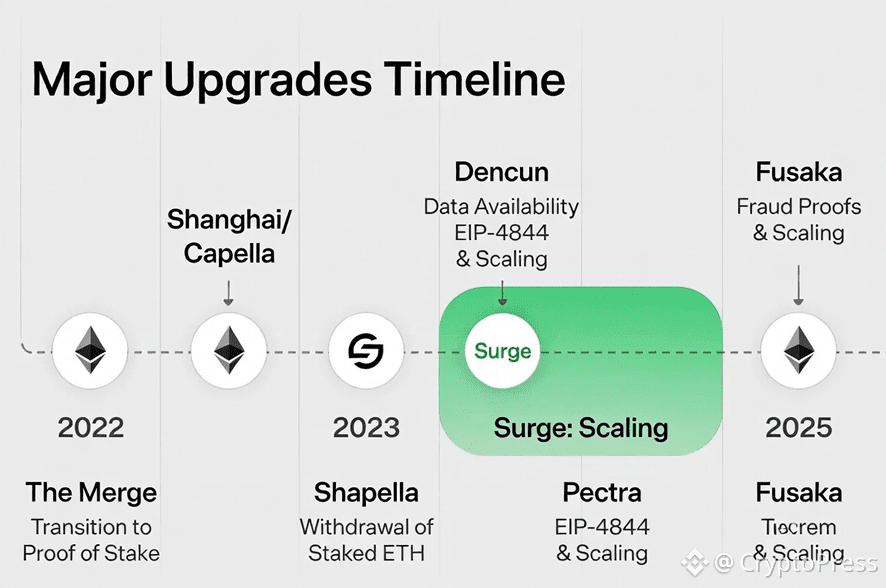
Vitalik Buterin and the community outlined a long-term roadmap: The Merge (2022) shifted to Proof-of-Stake for energy efficiency; Shanghai/Shapella (2023) enabled staking withdrawals; Dencun (March 2024) introduced “blobs” via EIP-4844, slashing L2 fees by over 90%; and Pectra (May 2025) refined staking and increased blob capacity to 6-9 per block.
Fusaka continues this evolution during the “Surge” phase of the roadmap, aiming for 100,000+ transactions per second (TPS) across L2s. It reflects Ethereum’s shift to a twice-yearly upgrade cadence, allowing faster iteration without rushing risky changes.
Key predecessors:
Dencun’s blobs: Temporary data packets for L2s, replacing expensive calldata.
Pectra’s tweaks: Improved validator economics and minor blob boosts.
Fusaka takes these further, addressing the growing demand as L2 TVL (total value locked) surpasses hundreds of billions and real-world assets (RWAs) tokenize trillions.
Core Explanations: How Fusaka Works
At its heart, Fusaka introduces Peer Data Availability Sampling (PeerDAS), the headline feature enabling massive blob scaling.
What Are Blobs, and Why Do They Matter?
Introduced in Dencun, blobs are ephemeral data attachments to blocks—cheap, temporary storage for L2 rollups. Pre-Fusaka, nodes had to download and store every full blob to verify availability, limiting safe increases.
PeerDAS changes this:
Blobs are erasure-coded (split with redundancy).
Nodes sample small portions via peer-to-peer networking.
Cryptographic guarantees ensure full data availability without everyone downloading everything.
This reduces bandwidth needs dramatically, allowing blob capacity to scale from ~9 per block to targets of 15, 21, or even higher via future adjustments.
Blob Parameter Only (BPO) Forks
A clever innovation: Post-Fusaka, blob limits can increase through lightweight “config-only” forks—no full client upgrades needed. Planned BPOs started shortly after activation, gradually ramping capacity.
Other Key EIPs in Fusaka
Higher gas limits: Default raised to ~60 million per block, boosting L1 throughput.
DoS protections: Tighter limits on resource-intensive operations.
History expiry support: Nodes can prune old data, reducing storage bloat.
Developer tools: Precompiles and optimizations for better EVM efficiency.
Analogy: Think of Ethereum as a highway. Dencun added express lanes (blobs) for L2 traffic. Fusaka widens those lanes and installs smart tolls (sampling) so more cars flow without gridlock.
Upgrade Blobs per Block (Target/Max) Approx. L2 Cost Impact TPS Potential (Across L2s) Dencun (2024) 3/6 Fees drop 90%+ ~10,000-20,000 Pectra (2025) 6/9 Moderate reductions ~50,000 Fusaka (2025+) 9+ (scaling to 21+) 40-90% further drops post-activation 100,000+
(Data approximated from ethereum.org and post-upgrade analyses.) Applications and Real-World Examples
Fusaka’s benefits shine in L2 ecosystems:
DeFi: Protocols on Base or Arbitrum saw transaction costs dip further post-activation, enabling micro-transactions and higher volume.
RWAs and Stablecoins: Ethereum leads with $166B+ in stablecoins and $12B+ tokenized assets—lower DA costs attract more institutional flows.
Gaming and Social: High-throughput L2s like zkSync can now support complex on-chain games without prohibitive fees.
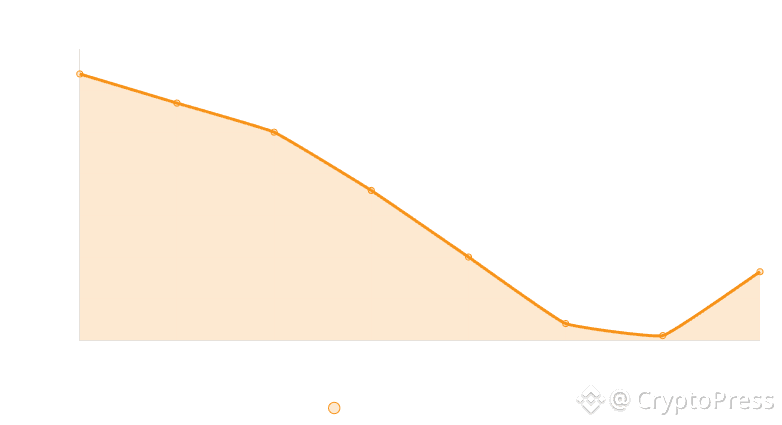
Case study: Post-Dencun, Base TVL exploded from billions to tens of billions. Fusaka amplified this, with early data showing 27%+ weekly transaction growth on rollups and blob fees compressing sharply.
Comparisons:
Pros vs. Competitors: Unlike monolithic chains, Ethereum’s rollups inherit L1 security. Fusaka makes dedicated DA layers (e.g., Celestia) less necessary, as Ethereum’s capacity now rivals or exceeds them (up to 16MB/block potential).
Cons: Still modular—users interact via L2 bridges, adding minor complexity.
Challenges and Risks
No upgrade is risk-free:
Activation Risks: Though successful, hard forks require node operators to update—delays or bugs could cause temporary issues (mitigated by extensive testnets).
Centralization Concerns: Higher capacity helps solo stakers, but liquid staking dominance persists.
Adoption Lag: Fee reductions take time to reflect fully; some L2s adjusted slowly post-launch.
Competition: Faster rivals push innovation, but Ethereum’s developer ecosystem and security remain unmatched.
Solutions: Community governance, bug bounties ($2M+ for Fusaka), and incremental BPOs ensure safe scaling.
Societal Impact: Cheaper, scalable Ethereum democratizes finance—emerging markets access DeFi, creators monetize directly, and institutions tokenize assets securely.
Future Outlook
Fusaka bridges to full danksharding and beyond:
Short-term: Ongoing BPOs push blobs higher, targeting sub-cent L2 transactions.
2026: Glamsterdam: Potential block time reductions, parallel execution.
Long-term: 1M+ TPS, Verkle trees for stateless clients, ultimate “Purge” for efficiency.
Ethereum’s maturity—decade-old, battle-tested—positions it as Web3’s settlement layer. Fusaka reinforces this without hype: steady, infrastructure-focused progress.
Conclusion
The Fusaka upgrade, activated smoothly on December 3, 2025, marks Ethereum’s continued commitment to scalable, decentralized innovation. By enhancing data availability for L2s, it lowers barriers for users and builders alike, fostering broader adoption in DeFi, RWAs, and beyond.
Whether you’re a beginner exploring crypto or an intermediate user staking ETH, Fusaka’s improvements make the ecosystem more accessible and efficient.
Practical advice: Use L2 wallets like those on Base or Arbitrum for everyday transactions. Monitor blob fees on sites like dune.com for optimal timing.
Subscribe to Cryptopress.site for more deep dives into blockchain fundamentals. Explore related articles on the Ethereum roadmap or Layer 2 solutions.
The post Ethereum’s Fusaka Upgrade appeared first on Cryptopress.
