

Successfully solved a block with a probability that only occurs once in 82 years.

A single Bitcoin miner has surpassed the probability of 1/82 years to successfully mine a block.
According to data from the Mempool, the miner mentioned successfully solved block number 927,474 at the end of Thursday, using CKpool's solo mining software. The total reward the miner received was 3,133 BTC, equivalent to about 284,633 USD at that time.
Of this, the majority comes from the fixed block subsidy of Bitcoin with 3.125 BTC, valued at approximately 283,944 USD, while the remainder is 0.008 BTC in transaction fees, equivalent to nearly 700 USD. This is the total reward that would typically be shared among thousands of miners in a large mining pool.
Kolivas, the developer of CKpool, confirmed this event on social media X and stated that the miner has a capacity of about 270 TH/s. With this scale, the probability of solving an average Bitcoin block is only about once every 30,000 days, equivalent to nearly 82 years.
Just a few common mining machines, but fortunately surpassing all statistics.
According to Kolivas's sharing, the total hashrate of the miner is distributed across three Bitcoin mining machines, each with a capacity of about 90 TH/s. This figure is equivalent to the performance of popular ASIC models like Bitmain Antminer S19 air-cooled, which are used by many individual miners.
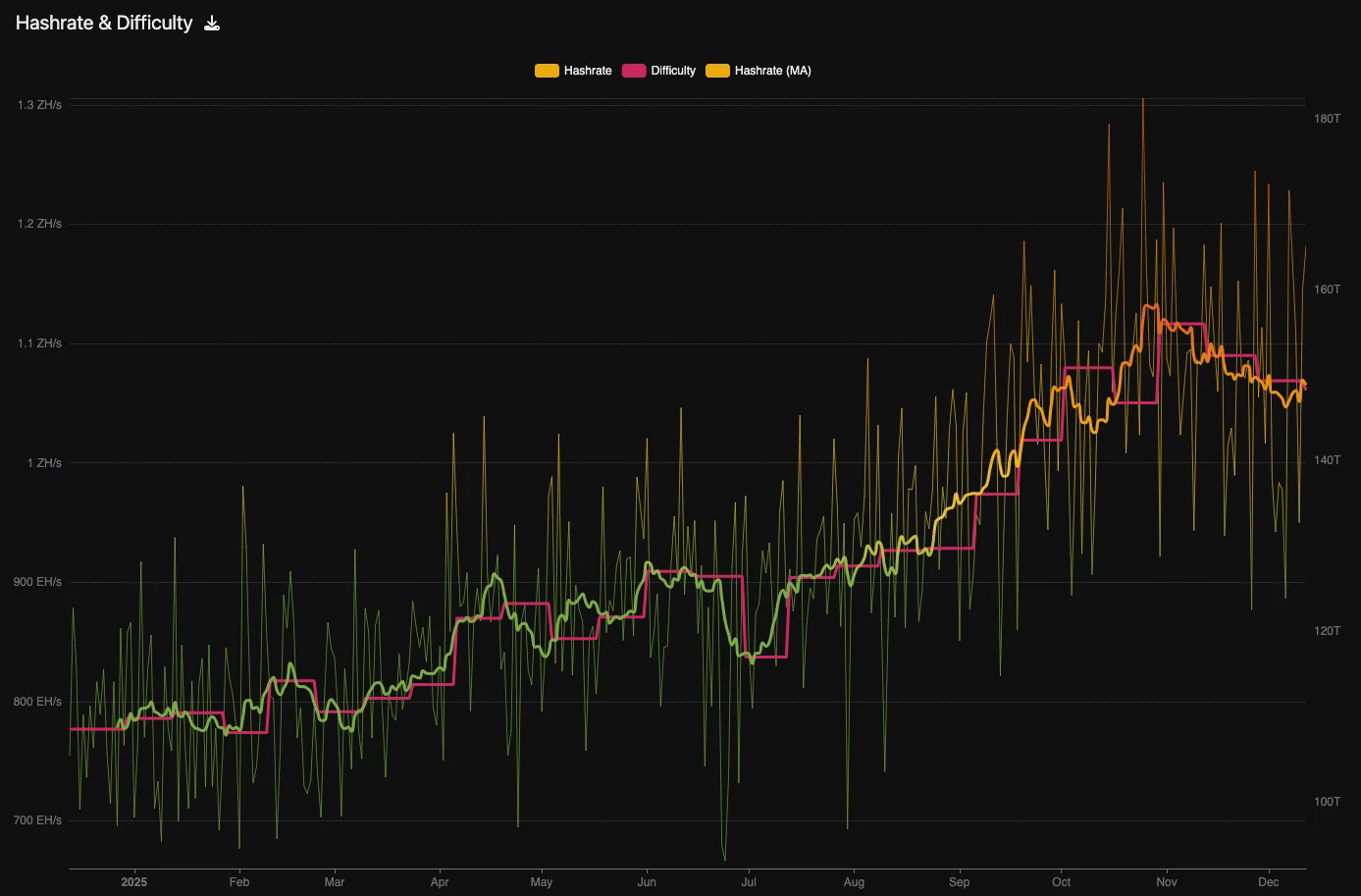
Compared to the entire Bitcoin network, this hashrate is extremely small. As of December 11, the estimated total hashrate of the Bitcoin network reached around 1.15 zettahash/second. Thus, the capacity of this single miner only accounts for about 0.00002% of the total computational power of the entire network.
To make it easier to visualize, large publicly listed Bitcoin mining companies like Marathon Digital (MARA) or IREN are currently operating systems with hashrates of approximately 59.4 EH/s and 50 EH/s, hundreds of thousands of times higher than the aforementioned lucky miner.
Why do solo miners still accept to 'bet' with extremely low probabilities?
In reality, most small-scale Bitcoin miners choose to join mining pools to receive stable rewards, distributed according to their hashrate contribution. Solo mining is almost not an optimal choice in terms of probability, as the chance of solving a block is extremely low, especially in the context of continuously increasing mining difficulty.
However, precisely because of the large total reward, some miners are still willing to try their luck. For them, solo mining is like buying a lottery ticket: operational costs still exist, but if they 'hit', the reward can completely change their financial situation after just one block.
In fact, this is not the first time a single miner has won the entire Bitcoin block reward. Just last month, another solo miner with a hashrate of only about 6 TH/s exceeded the probability of 1 in 180 million to successfully mine a block, bringing in approximately 265,000 USD in rewards at that time. Additionally, solo miners with higher hashrates or using rented hashrates have also found several blocks in recent months.
The Bitcoin market still maintains its heat.
The story of this single miner winning big once again shows: although the probability is extremely low, the Bitcoin network is always open to anyone who participates, as long as they accept the trade-off between harsh mathematics and a bit of rare luck.
