

In recent days, on social media X, the crypto community has continuously discussed the possibility of the Bank of Japan (BOJ) continuing to raise interest rates in the upcoming meeting scheduled for December 19. The question raised is not only whether the BOJ will actually take action but, more importantly: if the scenario of rising interest rates occurs, will Bitcoin face another strong correction like before?
The BOJ and its special role in the global macro picture.
For decades, Japan has been seen as the economy that has maintained the longest period of ultra-loose monetary policy in the world. Prolonged low interest rates have turned the yen into a source of capital for carry trade strategies, where cheap money borrowed from Japan flows into higher-risk markets, including stocks, commodities, and even crypto.
Therefore, every pivot move by the BOJ not only impacts the domestic market in Japan but also creates a ripple effect globally. When the BOJ raises interest rates, capital costs increase, carry trade narrows, and money tends to flow back to safer assets. This is why Bitcoin and the crypto market often face strong pressure during periods when the BOJ changes policy.
Looking back at history: Every time the BOJ raises interest rates, Bitcoin plunges.
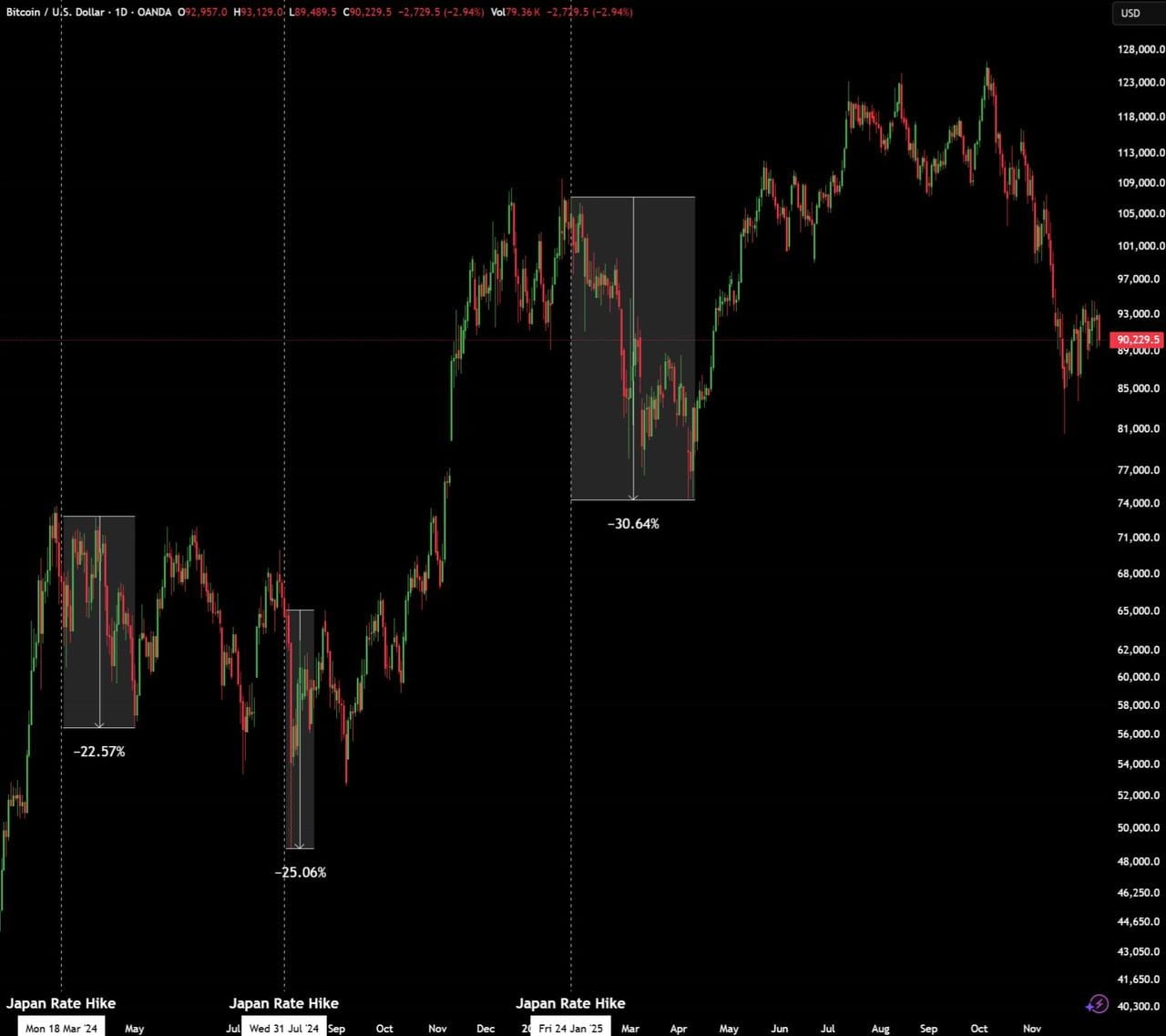
Data from the past two years shows a notable correlation between the BOJ's interest rate decisions and Bitcoin price volatility. Specifically:
The first time, on March 18, 2024, the BOJ officially raised interest rates after a long period of maintaining a near-zero level. Immediately afterwards, Bitcoin recorded a drop of about 22%, reflecting a widespread risk-averse sentiment in the market.
The second time, on July 31, 2024, the BOJ continued to raise interest rates. The crypto market reacted more negatively, with Bitcoin falling approximately 25% in a short time, pulling many altcoins down even further.
The third time, on January 24, 2025, the next tightening move by the BOJ caused Bitcoin to lose about 30% of its value. This is considered one of the strongest corrections in the crypto market during that period.
This series of events raises many questions for investors: is history repeating itself too clearly?
December 19: What scenario for Bitcoin?
The BOJ meeting on December 19 is being closely watched by investors. If the BOJ continues to raise interest rates, short-term selling pressure on Bitcoin is inevitable, especially in the context that the market has somewhat reflected this expectation in the price.
However, the current context also has some differences compared to previous instances. Bitcoin today has a wider acceptance level, strong participation from major financial institutions, along with ETF products and long-term capital flows. This may help the market absorb macro shocks better than in the 2024–early 2025 period.
Another scenario mentioned is that the BOJ maintains interest rates or signals a more dovish stance than expected. In that case, Bitcoin could see an opposite reaction, as macro pressures are temporarily relieved and money flows back into riskier assets.
History does not repeat itself, but it often rhymes.
Although past numbers show a clear relationship between the BOJ raising interest rates and deep declines in Bitcoin, this does not mean the market will always react the same way. Each cycle has its own factors, from global liquidity, investor sentiment to market structure.
What is certain is that the BOJ's decisions will continue to be an important variable that crypto investors cannot ignore. In the sensitive period leading up to December 19, risk management, closely monitoring macro signals, and avoiding FOMO or panic mentality is more essential than ever.


