

December 13, 2010 marks a special milestone in the history of cryptocurrency. It was the last day Satoshi Nakamoto – the creator of Bitcoin – left a public trace on social media and discussion forums. Since that moment, Satoshi has completely disappeared, with no additional posts, emails, or any validating signals for the past 15 years. This absolute silence has become one of the greatest mysteries of the Internet age.
The day Satoshi left and the void he left behind
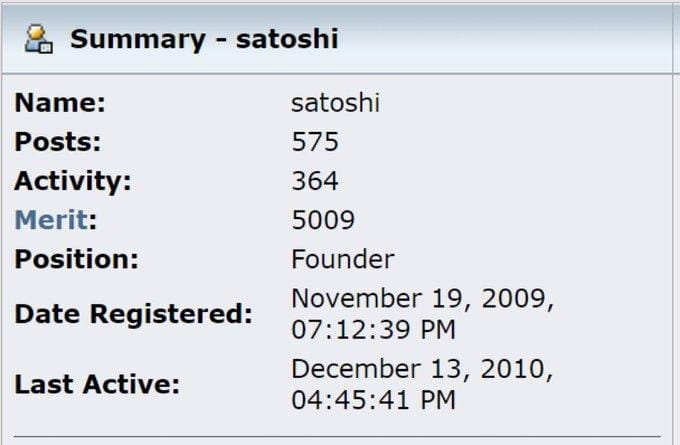
Satoshi Nakamoto's last post appeared at the end of 2010, when Bitcoin was still a small experimental project in the tech and cryptography community. At that time, the network was sparse, the price of Bitcoin hovered around a few cents, and hardly anyone outside of programming understood its potential.
Satoshi's disappearance without explanation has led many to feel skeptical, even anxious. However, looking back after 15 years, this withdrawal has become a factor that helps Bitcoin develop true to the spirit of decentralization. Without a founder to lead, without a 'CEO of Bitcoin', the network had to operate based on the consensus of the global community.
Bitcoin: from a small experiment to a trillion-dollar asset
If Satoshi Nakamoto could see the current picture, he might find it hard to imagine the speed of Bitcoin's development. From a digital currency that was almost worthless, Bitcoin has repeatedly surpassed historical price milestones, from a few USD, a few hundred USD, to tens of thousands of USD for each BTC.
At the same time, the scale of the crypto market has also grown exponentially. From a figure almost close to zero, the total market capitalization at one point approached 4,000 billion USD, surpassing the value of many traditional financial markets. Bitcoin has become a pillar, playing the role of a leading asset and a measure of trust for the entire ecosystem.
From 'scam' to recognized asset
In the early years, Bitcoin was often labeled as a scam model, a tool of the underground, or an early experiment that would soon fail. However, time has proven the opposite. Today, Bitcoin is being studied, held, or integrated into long-term strategies by major financial institutions, investment funds, banks, and even governments of many countries.
The emergence of products like Bitcoin ETFs, clearer regulatory frameworks in many countries, along with listed corporations incorporating BTC into their balance sheets, shows that the level of acceptance has completely changed. Bitcoin is no longer 'the game of tech people,' but has become a part of the global financial system.
Satoshi's Bitcoin stash and the lesson of trust
Estimates suggest that Satoshi Nakamoto holds about 1 million BTC, equivalent to nearly 100 billion USD at current price levels. Notably, this amount of Bitcoin has never been moved. Throughout 15 years, there have been no transactions indicating that Satoshi has sold even a small portion.
In a market where greed and profit pressure are always present, holding a vast amount of assets without touching them is almost inconceivable. This leads many to believe that, for Satoshi, Bitcoin has never been a tool for personal enrichment, but rather an economic-social experiment aimed at empowering the community with control over currency.
The greatest legacy after 15 years of silence
Fifteen years after Satoshi disappeared, the greatest legacy he left behind is not just Bitcoin, but also a new model of trust and financial freedom. A system that can operate, evolve, and adapt without the founder controlling it from behind.
Satoshi's silence, over time, has become a symbol of true decentralization. And perhaps, this is the final message that Satoshi Nakamoto left for the world.
