Do you know what has always annoyed me about DeFi? The closed nature of protocols from each other. You invest money in one project, and it's locked up like in a safe. Want to use those same assets somewhere else — sorry, withdraw, pay fees, wait, then deposit again. It's infuriating. But then I learned about composability in @LorenzoProtocol, and I realized — this is it, the future of DeFi. Now I'll explain why the ability to use OTF tokens across different protocols simultaneously changes the whole game.
First, let's understand what composability actually is. Imagine a Lego constructor — you have blocks, and you can build anything you want, combining them in different ways. The same block can be part of a castle, then you move it to a car, then to a ship. In DeFi, composability works the same way — your tokens can be used simultaneously in several protocols, creating complex financial constructs. Lorenzo Protocol creates OTF tokens (On-Chain Tradable Funds), which represent shares in various trading strategies. And these tokens don't just sit in your wallet — they can be used anywhere standard tokens are accepted.
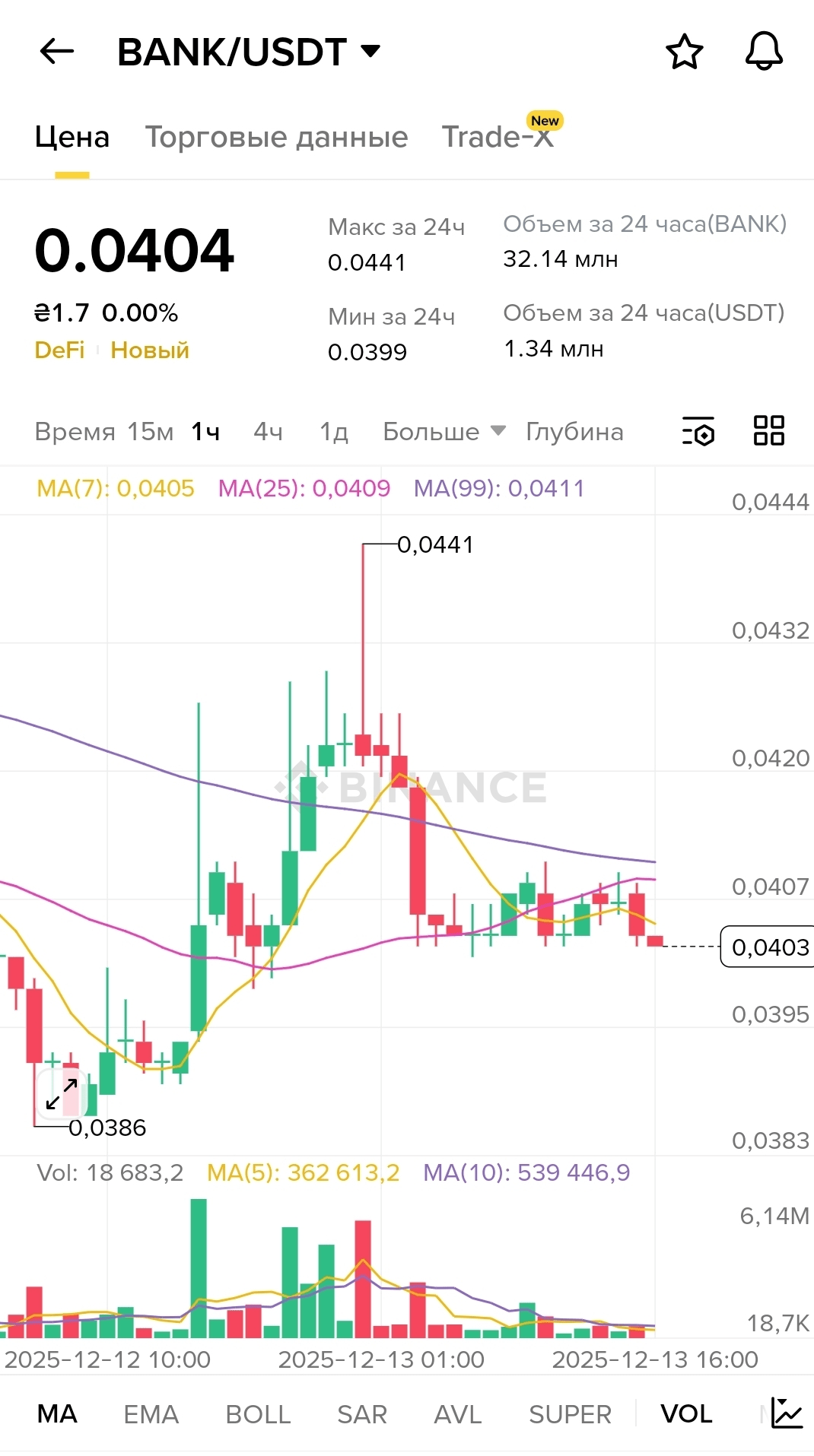
I'm currently looking at the chart $BANK and see a perfect illustration of liquidity and activity that make composability possible. The price is trading around $0.0404, staying virtually the same over the day — 0.00%. But don't let this stability fool you, because the history of recent days shows serious volatility. On December twelfth, there was a sharp spike to a maximum of $0.0441, followed by a pullback. Now the price is consolidating in a narrow range between $0.0399 (the minimum for 24 hours) and $0.0441 (the maximum). Do you see those small candles on the right of the chart? They form a tight sideways consolidation — the market is building strength before the next move.
Look at the technical indicators. MA(7) at $0.0405, MA(25) — $0.0409, MA(99) — $0.0411. An interesting picture — all three moving averages have converged in a very narrow range, literally $0.0006 between the fastest and slowest. This is called the convergence of averages, and usually after this, a sharp movement occurs in one direction. So far, the price of $0.0404 is trading slightly below all the averages, which is technically a bearish signal, but given how close all these levels are, the slightest impulse can turn the situation around. This liquidity and trading activity create the conditions for composability — the token is easy to exchange, use in other protocols, and take as collateral.
Trading volumes remain healthy — 32.14 million BANK and 1.34 million USDT per day. Look at the volume chart below — after those huge spikes on December twelfth (do you see those high green bars over 6 million?), the volumes have now normalized and are trading in the range of 18-300 thousand over the period. MA(5) by volume shows 362 thousand, MA(10) — 539 thousand. This is a sign of stable interest without panic movements. Such stable liquidity is just what is needed for OTF tokens to work in composable strategies — you can always quickly exchange them without large slippages.
Now specifically about how the composability of OTF tokens from Lorenzo works. Suppose you invested $10,000 in a CTA strategy on Lorenzo and received in return OTF tokens, let's call them ltCTA (Lorenzo Trend-Following). These tokens represent your share in the fund and automatically increase in value as the strategy earns. But here’s the magic — these ltCTA tokens are full-fledged ERC-20 tokens (or their equivalent on another blockchain) that you can use further. You can take these ltCTA and use them as collateral on Aave or Compound, obtaining a loan in stablecoins. Now you have liquidity for other investments while your original position in the CTA strategy continues to work and earn. It's like having your cake and eating it too.
Or another scenario — you can add ltCTA tokens to liquidity pools on Uniswap or Curve. Now you earn not only from the CTA strategy but also from swap fees from other traders. Double income from the same money. Or you can use ltCTA as collateral for minting synthetic assets on Synthetix. The possibilities are limited only by your imagination and the protocols that support these tokens. This is composability — one asset works simultaneously in several places.
In the past, when I invested in traditional investment funds or even in simple DeFi protocols, my money was locked up. Want to withdraw — wait for the unlocking period, lose on fees, miss opportunities. With composable OTF tokens, everything is different. My assets are liquid and flexible. If I urgently need money, I don't withdraw them from the Lorenzo strategy (losing future profits), I just take a loan against the OTF tokens. Or sell part of them on the secondary market instantly. This liquidity and flexibility are worth a lot in the investment world.
But composability is not just about using tokens in other protocols. It's also about combining different strategies within Lorenzo. For example, you can hold tokens from three different OTFs: one focuses on CTA strategies, the second on structured products, and the third on volatility strategies. Each of these tokens can be further used separately or combined into meta-strategies. You can create your own index fund from several OTFs, add it to a liquidity pool, and then use that LP token somewhere else. A matryoshka of possibilities.
The token $BANK also plays a role in the composability of the ecosystem. You can stake $BANK in veBANK to earn more rewards from all OTF funds. Or use $BANK as one of the assets in multi-token strategies. Or provide liquidity in $BANK/USDT pairs on DEX, earning from trading fees. Meanwhile, your staked veBANK gives you voting rights in protocol governance. One token, three or four ways to use it simultaneously.
If you look at the price pattern on the chart, an interesting dynamic is visible. After a sharp rise and fall, the price forms what traders call a "flag" or narrow consolidation. The yellow MA(7) is almost horizontal, crossing the price back and forth — a classic sign of market uncertainty. The pink MA(25) has started to turn upward after reaching a minimum, showing an attempt to form an upward trend. The purple MA(99) is still on a downward slope on the left, but on the right, it starts to level out. This technical picture shows a transition from trend to consolidation — the perfect time to accumulate positions before the next big move.
The coolest thing about Lorenzo's composability is risk management. Imagine: you have a position in an aggressive CTA strategy with high volatility. You can hedge this risk by taking OTF tokens and using them to create an opposite position in another protocol. Or you can diversify by adding ltCTA to a liquidity pool with stablecoins, reducing the overall volatility of the portfolio. Flexibility in risk management that is absent in traditional funds.
Of course, composability brings not only opportunities but also risks. The main one is the risk of complexity. The more protocols you use simultaneously, the more points of failure there are. A bug in any of the smart contracts can affect the entire chain. It's like building a tall tower out of the same Lego — the higher it is, the less stable it becomes. Therefore, it is important to use only proven, audited protocols and to understand every step of your strategy. Don't create composable structures out of ten protocols if you don't understand how at least half of them work.
Another risk is collateral liquidation. If you use OTF tokens as collateral for a loan, you need to monitor the collateralization level. If the value of your ltCTA tokens drops (due to a strategy drawdown), you may be liquidated. This is especially relevant for volatile strategies. You should always maintain a safety buffer and not borrow the maximum possible — I usually use no more than 50-60% of the available credit limit.
Another aspect of composability that caught my attention is cross-chain capabilities. Lorenzo can deploy its OTF on different blockchains: Ethereum, Arbitrum, Optimism, Base, and so on. This means that the same asset can be used in different ecosystems simultaneously. For example, on Ethereum you use OTF in Aave, and on Arbitrum in GMX for leverage trading. This opens access to the best protocols in each network without forcing you to choose just one.
I started experimenting with composability a few months ago, starting with something simple. I took OTF tokens from a structured product by Lorenzo and added them to a liquidity pool on Curve. The yield from the product itself was about 12% per annum, plus I received about 8% APR from Curve's fees and incentives in CRV tokens. That's about 20% from the same money. Then I complicated things — I took LP tokens from Curve and staked them in Convex for additional rewards. Another plus 5% in CVX tokens. A matryoshka of yields, and this is just the beginning.
The volume picture on the chart shows a healthy dynamic. After the peaks of activity on December twelfth, the market did not die but transitioned to a calm trading mode with consistent volumes. Do you see those small but regular volume bars on the right of the chart? This is a sign that the token is actively used, with a steady demand and supply. For composability, this is critically important — you need the ability to quickly enter and exit a position at any moment without dramatic price movements. The moving averages by volume (362k and 539k) show a stable baseline trading level.
For those who want to start using Lorenzo's composability, a few tips from personal experience. First — start with one additional protocol, don't try to build a complex structure with five levels right away. For example, just add OTF tokens to a liquidity pool on one DEX. Get familiar with it, understand the mechanics, watch the yields for a couple of weeks. Second — always keep a liquidity reserve. Don't invest 100% of your capital in composable strategies, leave 20-30% in stablecoins in case you need to top up collateral or close a position. Third — use calculators and simulators to assess potential liquidation risks. Many DeFi protocols provide such tools.
The composability of Lorenzo's OTF tokens is what transforms them from mere investment instruments into building blocks for creating personal financial strategies. You are not limited to what one protocol offers — you can combine the best from different ecosystems, creating unique constructs tailored to your goals and risk tolerance. For me, this is true DeFi — not just a replacement for banks but the creation of fundamentally new opportunities that didn't exist in traditional finance. Do you want to earn on a CTA strategy while simultaneously providing liquidity and also getting a loan against the same asset? In traditional finance, this is impossible, but in DeFi with Lorenzo — absolutely. Have you tried composable strategies or are you still holding assets in one place? Share your experience!
#LorenzoProtocol @Lorenzo Protocol $BANK