You know, one of the things that always fascinates me about crypto projects is their tokenomics. You can have the coolest technology, the most talented team, the most ambitious vision, but if the economic model of the token is poorly designed, the project is doomed. So when I started studying @GoKiteA and their approach to the $KITE token, I was immediately intrigued by their two-phase launch model. This is not just a marketing move or a way to stretch the hype — it’s a well-thought-out strategy that shows the team thinks long-term and understands how to build a sustainable crypto economy.
Let's start with what tokenomics is in general and why it is so critical. Essentially, tokenomics is the economic model that defines how a token is created, distributed, used, and retains value in the ecosystem. It's like a constitution for cryptocurrency - it establishes the rules of the game, incentives for participants, mechanisms for balancing supply and demand. Poor tokenomics can kill even the best project, creating hyperinflation, concentration of power in the hands of a few whales, or a lack of real utility for the token.
I have seen dozens of projects that launch with a bang, promise unrealistic APYs for staking, distribute tokens to everyone through airdrops, and then the price crashes by 90% because there is actually no real demand for the token. Or conversely — projects that hold most of the tokens with the team and early investors, and when the time for unlocks comes, they dump them on the market, leaving retail investors with empty pockets.
KITE is taking a different path, and this is evident from the very beginning. They have clearly divided development into two phases, each with its own goal and set of features for the token. The first phase is about forming the ecosystem and attracting early participants. In this phase, the $KITE token enables participation in the ecosystem and earning rewards. It sounds simple, but there is a deep logic behind it.
In the first phase, the main goal is to create a critical mass of users, developers, and agents in the network. This is the discovery phase, when people become familiar with the technology, test capabilities, and build the first applications. The token in this phase serves as a tool for bootstrapping the ecosystem. Early participants who believe in the project and are willing to take risks receive rewards - possibly through liquidity mining, possibly through participation in testing, possibly through launching the first agents in the network.
This is a smart approach because it addresses the classic chicken-and-egg problem. For the platform to be valuable, it needs many users. But to attract users, the platform must be valuable. Rewards for early participation break this cycle, creating incentives to join the ecosystem before it becomes mainstream.
At the same time, it is important that the team does not launch all possible token features at once. There is no staking, no governance, no complex mechanisms. This might seem strange - why not give people more opportunities right away? But there is wisdom in this. When you launch too many features simultaneously, you do not have time to test each one, find bugs, and understand how users actually interact with the system.
I remember projects that launched complex DeFi mechanisms from day one, only to find out that there were exploits allowing millions of dollars to be withdrawn. Or governance where five whales voted and made decisions in their own interests, ignoring the community. KITE avoids these mistakes by launching a simple yet effective model in the first phase.
Now let's talk about the second phase, which promises to be much more interesting in terms of tokenomics. In the second phase, staking, governance functions, and fee payments in the network are added to the ecosystem. This transforms $KITE from a utility token for early adopters into a full-fledged tool of the economic ecosystem with multiple levels of utility.
Let's start with staking. When you can stake your $KITE tokens and receive rewards for it, it creates several important economic effects. Firstly, it reduces the circulating supply. The more tokens are staked, the fewer are available for trading, which increases the price under unchanged demand. Secondly, it creates a class of long-term holders who are interested in the project's success rather than a quick flip. Thirdly, if staking is tied to ensuring network security or providing services for AI agents, it makes the ecosystem more decentralized and resilient.
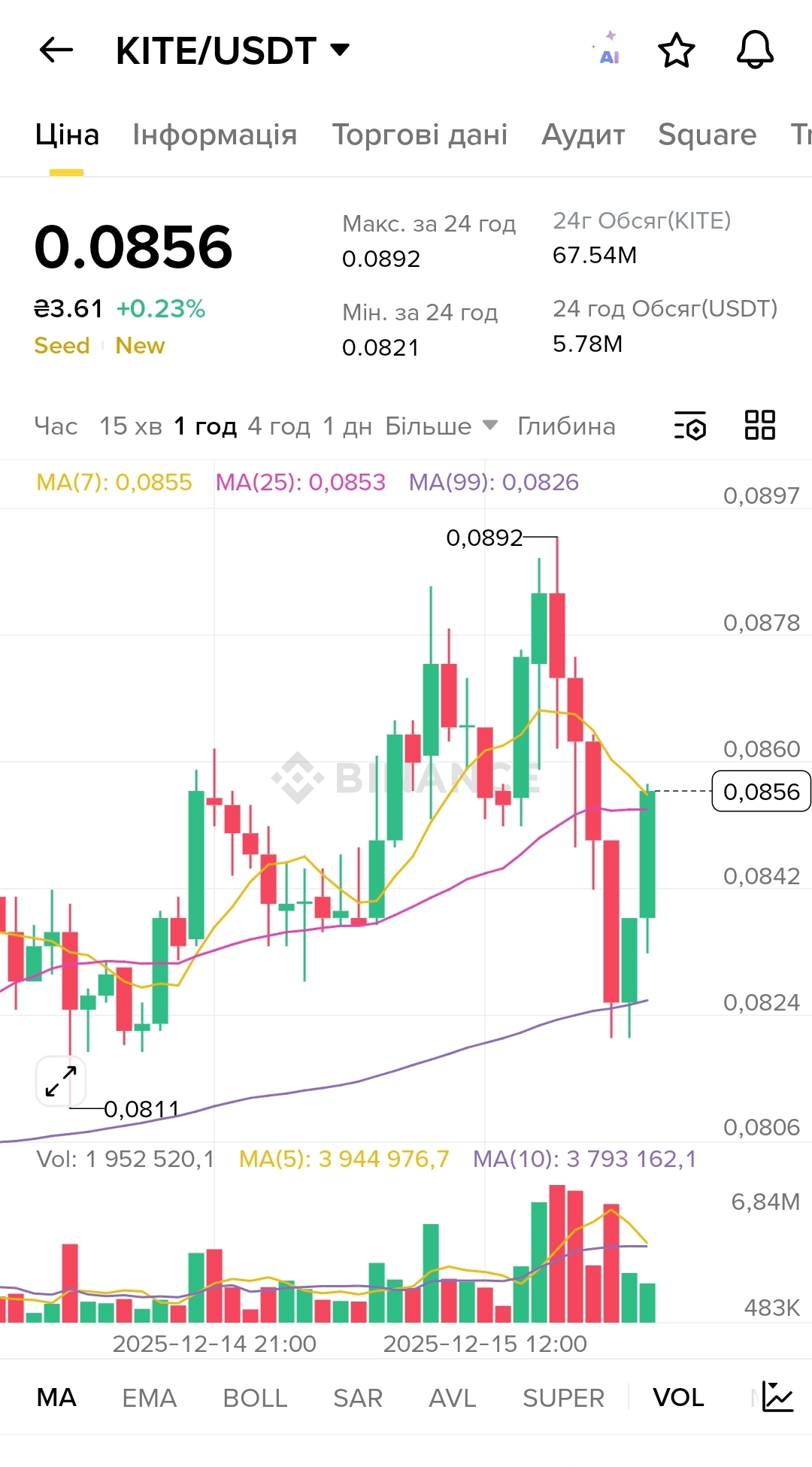
I look at the $KITE chart at 0.0856 and imagine what will happen when staking is launched. Let's assume 30-40% of tokens will be staked — this is a typical figure for successful PoS networks. This means the effective supply for trading will decrease by almost half. If real network usage grows at the same time, the demand for tokens for transactions, for participation in governance, the price could rise significantly simply due to the math of supply and demand.
Governance is the second important element of the second phase. When token holders gain the right to vote on protocol development, the token becomes not just an asset but a tool of power and influence. This fundamentally changes its value. Previously, you held the token as an investment or for utility. Now you hold a stake in a decentralized organization that governs the entire ecosystem.
Of course, governance is complex. You need to design the system so that it is fair, so that the votes of small holders also matter, and that there is no possibility for manipulation. I have seen DAOs where three whales made all the decisions, and it turned into a theater of decentralization. I hope that @GoKiteA considers these points — perhaps through quadratic voting, perhaps through delegation, perhaps through a multi-level decision-making system.
The third element of the second phase is fee payments in $KITE. This creates a constant, organic demand for the token. Every user of the network, every AI agent that conducts transactions, must pay fees in $KITE. The more activity in the network, the higher the demand for the token. This is not speculative demand that can disappear overnight, but real utility demand that grows along with the ecosystem.
Here it is important to find a balance. If fees are too high, it deters users, especially for microtransactions between AI agents. If too low, the network does not generate enough revenue for validators and stakers, undermining the incentives to maintain the infrastructure. KITE has the advantage of specialization - they are building a network specifically for AI agents, allowing for the architecture to be optimized for low fees at high speed.
When I think about the long-term tokenomics of KITE, I also ponder the burn mechanisms. Many successful projects use a portion of fees to burn tokens, creating deflationary pressure. Ethereum after EIP-1559 burns a portion of the gas, making ETH a deflationary asset under high network load. BNB from Binance has quarterly burns. If KITE implements something similar in the second phase, it could significantly enhance the token's value in the long run.
Another aspect of tokenomics that interests me is the distribution of tokens. Who owns how many? What share is with the team, early investors, and the community? What are the vesting periods? When will unlocks occur that could create selling pressure? Unfortunately, I could not find detailed information on this in the public domain, but these are critical questions for any investor. I hope the team acts honestly, with reasonable vesting periods for themselves and investors, to avoid sudden dumps.
When I compare KITE's approach to other projects, I appreciate their honesty about the timeline. They do not promise everything at once. They say: here is the first phase, here is what we are doing now, and here is the second phase, this is what will come later. This creates realistic expectations and allows the team to focus on quality implementation of each phase, instead of scattering themselves across dozens of features at once.
I also think about how the two-phase model affects the investment strategy. If you buy $KITE in the first phase, you are essentially betting that the second phase will be successful, that staking and governance will add value, that the network will attract enough users to generate real demand for the token through fees. This is a riskier bet than buying into an already established project, but the potential reward is also higher. Early investors always receive a premium for risk.
On the other hand, if you wait for the second phase, you get more certainty - you see that staking works, that governance functions, that there is real use of the network. But then the entry price will also be higher, as the market will have already valued this added value. The classic dilemma of early vs late stage investing.
Looking at the current price of 0.0856 and the trading volume of over 67 million KITE per day, I see that there is interest in the project. Liquidity is not bad for such a young token. But the real test of tokenomics will happen in the second phase. Will staking be able to attract enough participants? Will governance be active and effective? Will the bet that the AI agent ecosystem will generate enough demand for the token to sustain its value pay off?
Time will tell. But what I definitely like is that the team @GoKiteA thinks systematically about tokenomics, rather than just copying the model from another project. They are adapting the economic model to the specifics of their use case, to the needs of AI agents, to the reality that building an ecosystem is a marathon, not a sprint. And the two-phase approach is an acknowledgment of this reality, an attempt to break a complex task into manageable parts, each with its own goal and metrics for success.
So when I am asked why I invest in $KITE, I do not talk about quick profits or moon shots. I talk about thoughtful tokenomics, about a long-term strategy, about a team that understands that real value is created gradually, through fulfilling promises and building real utility. And if the second phase is implemented as skillfully as the first is planned, $KITE could become one of the defining tokens in the new economy of AI agents.