Do you know what the most disappointing thing about crypto is? When you have a brilliant idea for a DeFi application, you've calculated everything, thought it all through, and then you find out the cost of oracles and realize that your economics just don't add up. It's like opening a cafe and discovering that the rent eats up all the profit. Technically, everything works, but financially — a failure.
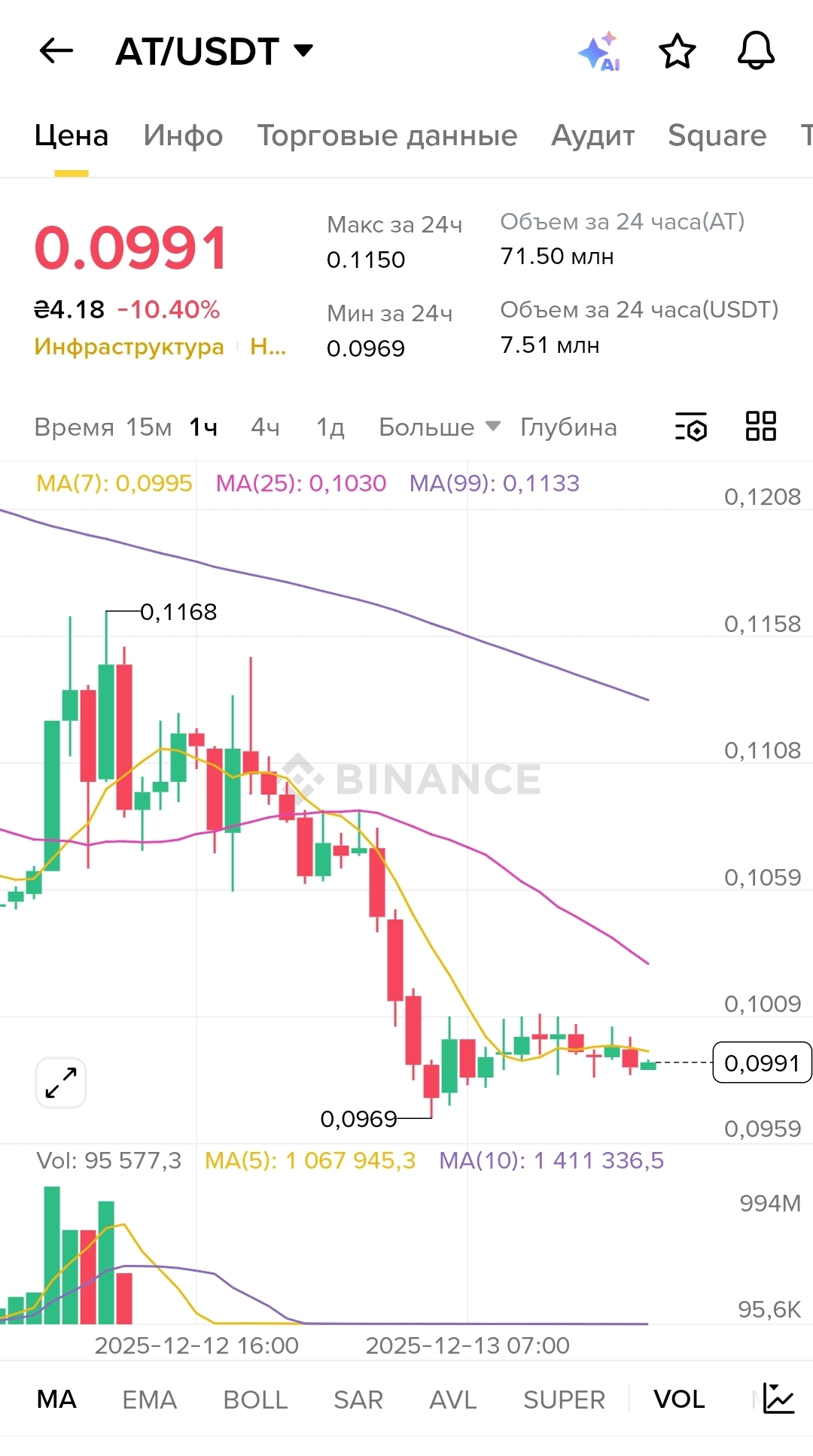
I look at the chart of $AT, which is currently trading around 0.0991 with a drop of 10.40%, and think about how many projects die not due to poor technology or lack of users, but due to plain economics. Because data in the blockchain is expensive. Very expensive. And @APRO-Oracle promises to solve this problem by reducing costs by 70%. Sounds too good to be true, right? Let’s figure out where these numbers come from and why it’s even important.
I’ll start from the very beginning. Why do data in the blockchain cost money? In the regular internet, you just make an API request, get data, everything is free (well, almost). In the blockchain, every action is a transaction. Each transaction costs gas. And gas, especially on Ethereum, can be incredibly expensive. I remember periods when a simple transaction cost $50-100. Imagine your application updates prices every 10 minutes. That’s 144 updates a day. Multiply by $50 — you get $7,200 a day just for data updates. In a month, that’s more than $200,000. What startup can afford that?
Of course, gas is cheaper now, but the problem remains. And it’s not just about transaction costs. It’s about how traditional oracles are structured. Let’s take the most popular one — Chainlink. A great project, I won’t argue, but their operating model is quite costly. They have nodes that aggregate data from different sources, verify it, reach a consensus on decisions, and only then record it on the blockchain. Every step costs money. Nodes want to be rewarded for their work, which is logical. But in the end, these costs are passed on to the projects using the oracle.
There’s another problem: many oracles charge not only for data updates but also for each request. It’s like if Netflix charged not only for the subscription but also for every minute of viewing separately. Formally fair, but in practice, a successful project with a large number of users pays disproportionately more. The more success — the higher the costs. And at some point, the economy breaks.
I spoke with the founder of a lending protocol on Polygon. The guy is smart, the team is good, the product works. But he told me directly: "You know, we spend more on oracles than we earn from fees. We are essentially subsidizing our protocol out of our own pocket because we can’t raise fees for users — competitors will crush us." Here’s a real problem. Oracles make many business models unviable.
#APRO approaches this differently. First, they have two methods of data transmission: Data Push and Data Pull. Push is when data is automatically updated at a certain frequency or with significant changes. Pull is when data is requested only when it is really needed. Most oracles operate in Push mode, constantly updating data even when no one is using it. It’s like leaving the TV on 24/7 even when no one is watching. You’re paying for electricity for nothing.
With the Pull model of @APRO-Oracle, you only pay for the data you actually use. Did you request the price of BTC once a day? You paid for one request. No need to pay for hundreds of updates that you didn’t need. This is a huge savings for projects with irregular data usage.
But that’s not all. Look at what happens with traditional oracles on multi-chain projects. You have an application running on Ethereum, Polygon, and Avalanche. You need data on each network. And you pay three times — for each network separately. Essentially, you’re buying the same data three times because each blockchain is a separate environment.
$AT with a trading volume of 7.51 million USDT shows that the market understands the value of a multi-chain approach. Because #APRO works with 40+ blockchains, but you don’t pay 40 times. The infrastructure is built in such a way that data is aggregated once and then distributed across all networks with minimal additional costs. It’s like buying food in bulk instead of going to the store every day for one product. Economies of scale.
Another factor in savings is the two-tier architecture of the network. I won’t go into technical details, but the essence is that not all nodes do the same work. There is a division of responsibilities: some collect data, others verify it, and others record it on the blockchain. This is more efficient than having every node do everything. Less duplication of work — less cost for paying for that work.
Plus AI verification. It sounds like a buzzword, but in reality, it’s pragmatic. Artificial intelligence can check data faster and cheaper than complex cryptographic schemes or voting by nodes. Machine learning can detect anomalies and fake data almost instantly. Less time for processing — less computational power — less cost.
I recently calculated how much it would cost to launch a simple DeFi aggregator. Prices from ten different DEXs on three blockchains are needed, updated every 5 minutes. With a traditional oracle, this came to about $1,200 per month just for data. With @APRO-Oracle, according to their calculator, it’s about $400. A threefold difference. Over a year, the savings exceed $9,000. For a startup, this can be the difference between life and death for the project.
But do you know what is the most important thing? This savings does not mean that the quality is worse. This is not the case where you buy cheap and get junk. Here, it’s just a more efficient architecture. It’s like electric cars — they are cheaper to operate not because they are worse, but because they are technologically more efficient. Fewer moving parts, less energy loss.
I look at the chart as $AT falls from a maximum of 0.1168 to the current 0.0991, and I understand: the market is currently in the red zone, all assets are struggling. But fundamentally, the project’s economy hasn’t changed. The need for cheap oracles is only growing. Because crypto is striving for mass adoption, and mass adoption is impossible with the current infrastructure costs. Imagine a Web2 startup that would have to pay $200K a month just for access to the API. Absurd. But this is often how Web3 looks.
Another point that is rarely mentioned: predictability of costs. With traditional oracles, your expenses can suddenly skyrocket. Gas prices on Ethereum rise — your oracle costs increase fivefold. More users appear — expenses rise proportionally. This is a nightmare for any business. You can’t plan because you don’t know how much you’ll be spending in a month.
#APRO offers a more predictable pricing model. This is not a guarantee of a fixed price (which doesn’t exist in crypto), but the cost structure is clearer and more stable. You can forecast expenses, include them in your budget, and not fear sudden surprises.
Here’s a real case: there was a project on Ethereum that did automatic portfolio rebalancing. A cool idea, users were happy. But in the summer of 2021, when gas on Ethereum skyrocketed due to the NFT boom, their costs for oracles increased eightfold. EIGHTFOLD! The project simply couldn’t withstand it and shut down. All developments, all efforts — down the drain because the economy collapsed.
If they had access to cheaper oracles like @APRO-Oracle, they might have survived. They could have weathered the storm, switched to cheaper networks, adapted. But when 80% of your expenses are data, maneuvering is impossible.
Another thing: the barrier to entry for new projects. Right now, if you are a young developer with an idea but without big money, it’s hard to compete. Because large projects with funding can afford expensive oracles, while you can’t. This creates inequality. Cheaper, but quality solutions like #APRO democratize access. More people can launch their projects, more innovations, more competition. This is great for the entire ecosystem.
The trading volume of $AT at 71.50 million AT per day indicates that the token is liquid and of interest. And it makes sense: the project addresses a real, painful problem. Not some abstract 'optimization of blockchain infrastructure', but a specific one — how to stop wasting money on oracles and start earning.
I generally believe that the next wave of growth in DeFi will be related precisely to cost optimization. The first wave was about proving the concept: 'Look, it works!'. The second was about growth: 'Look, how many users!'. The third will be about efficiency: 'Look, we finally make money!'. And oracles are a critical part of this efficiency.
Imagine a DeFi protocol as a restaurant. You have a chef (smart contracts), waiters (interface), and customers (users). But if the rent (oracles) costs as much as a wing of an airplane, the restaurant won’t survive, no matter how good the food is. @APRO-Oracle is an opportunity to reduce rent to reasonable limits.
Of course, 70% savings is a marketing figure. In reality, it all depends on the specific use case. Somewhere the savings will be 50%, somewhere 80%, and somewhere only 20%. But even 20% is significant when it comes to monthly expenses in the thousands of dollars.
The main thing to understand: cheapness does not equal low quality. This is not a Chinese counterfeit that will fall apart in a week. This is a more efficient architecture that allows you to do the same work with lower costs. Like LED bulbs — they shine just as brightly, but consume electricity many times less.
The drop in the price of $AT by 10.40% today doesn’t scare me. The whole market is red, that’s normal. Bitcoin sneezed — altcoins caught a cold. But in the long term, projects with a strong economy and real utility survive and grow. And #APRO offers exactly that: a strong economy for developers that allows them to build viable businesses instead of burning investor money on infrastructure costs.
In crypto, it’s easy to get carried away with technology and forget about economics. But in the end, it’s the economy that decides what survives and what dies. You can have the coolest technology in the world, but if your business model doesn’t work, the project is doomed. And conversely, even with mediocre technology, but with a strong economy, you can build a successful business.
@APRO-Oracle is betting precisely on the economy. To make oracles accessible, efficient, and viable. And if they can indeed reduce costs significantly while maintaining quality, it changes everything. Because suddenly, a mass of projects that were economically unviable become real. A mass of ideas that remained in the head because "too expensive" get a chance to live.
That’s why the economics of oracles are important. And why projects like #APRO, which aim to optimize this economy, deserve attention.