Do you know what has always scared me the most about crypto? Not hacks, not scams, but my own greed and fear. You buy on emotion at the peak, sell in panic at the bottom. Sound familiar? I've been through this dozens of times until I discovered volatility strategies at @LorenzoProtocol. It turned out that you can actually make money from the market fluctuations that used to drive me crazy. Now I'll explain how it works and why volatility is not an enemy, but an opportunity.
First, let's figure out what volatility strategies actually are. Simply put, they are ways to earn from the very fact of price movement, regardless of direction. Is the market jumping up and down by 10-20% a day? Great, the strategy earns. Is the price flying like a rocket? It earns. Is it falling like a stone? It also earns. The magic is that you sell the risk of fluctuations to other market participants who want to protect themselves from it. It's like an insurance company — you receive a premium for taking on someone else's risk.
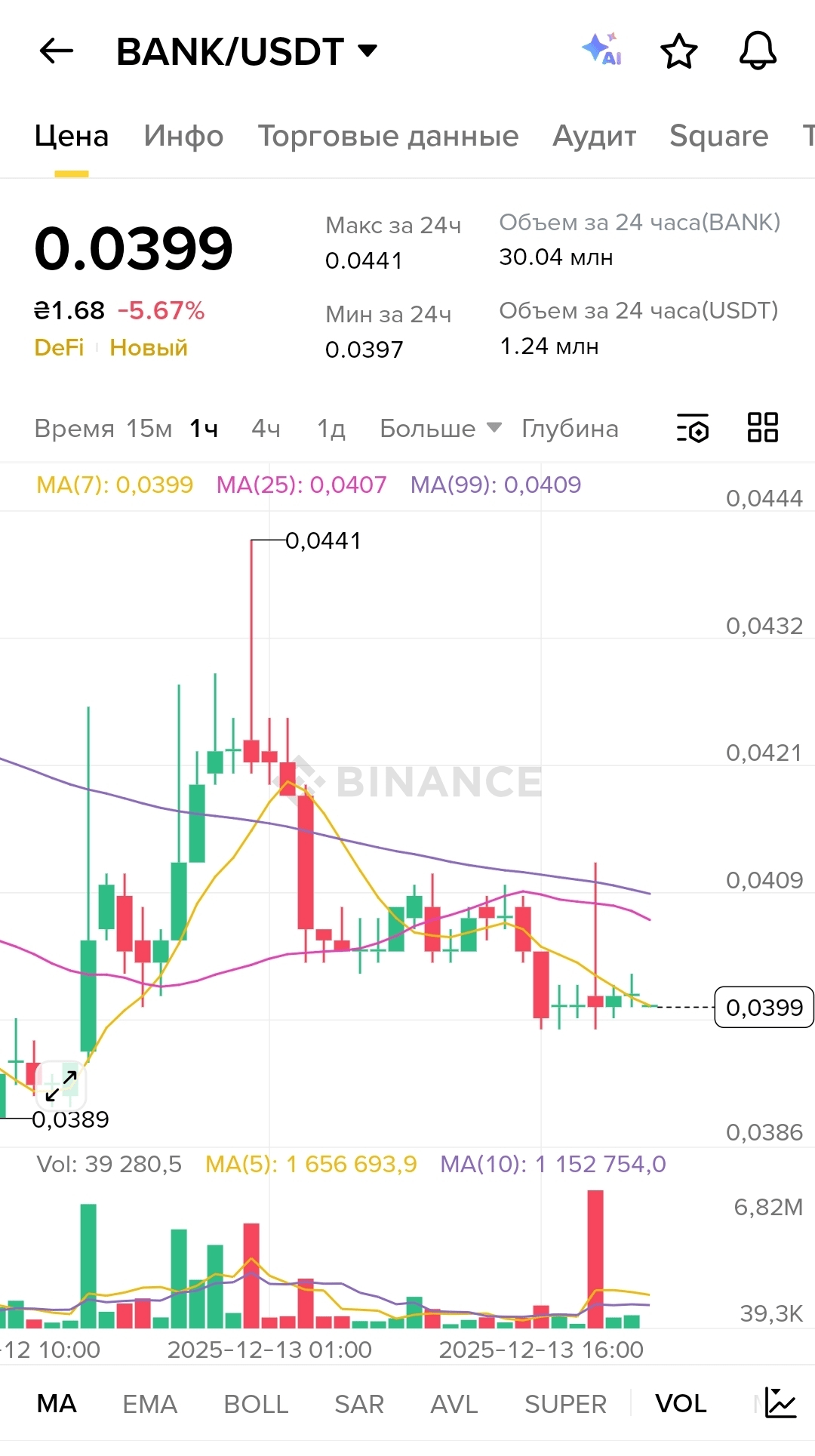
I'm currently looking at the chart $BANK and seeing a textbook on volatility in real time. The price is now $0.0399, down 5.67% over the day. But look at the picture of the last days — it's like a roller coaster! The maximum in 24 hours was $0.0441, the minimum $0.0397 — the difference is more than 11%. On December twelfth, there was a sharp spike to $0.0441, then a correction, followed by an attempt to recover, and now a downward trend. Do you see that large red candle on the right of the chart? It indicates serious selling pressure in the last hour. For a regular holder, this is stress and losses. For volatility strategies, this is the perfect environment for earning.
Look at the technical indicators. MA(7) is at $0.0399 — right at the current price. MA(25) — $0.0407, MA(99) — $0.0409. The price is trading below all moving averages, which is technically a bearish signal. The yellow MA(7) began to curve down after being above the price, indicating a strengthening downward momentum. The pink MA(25) also turned downward after a recent rise. The purple MA(99) continues its downward trend. A classic bearish configuration. But you know what? For volatility strategies, this is not important at all — bears, bulls, sideways — everything works as long as there is movement.
The volumes show an interesting dynamic. Over the day, 30.04 million BANK and 1.24 million USDT. Look at the volume chart below — do you see that huge red bar on the right? That's about 6.82 million in volume over the last hour when the price sharply fell. MA(5) by volume shows 1.65 million, MA(10) — 1.15 million. These volume spikes during sharp movements are exactly what creates opportunities for volatile strategies. High activity means high implied volatility, which means more expensive option premiums.
How do volatility strategies work in practice on Lorenzo? Let’s break down a few basic approaches. The first and most popular is options selling. Imagine: the price of $BANK is currently $0.0399. You sell a call option with a strike of $0.045 and a put with a strike of $0.035, which expire in a week. For each option, you receive a premium — say, $50. In total, that’s $100 income for the week with a capital of $1000. If in a week the price stays between $0.035 and $0.045 (which is quite likely), both options expire worthless, and you keep the entire premium. That’s about 10% for a week or more than 500% annually. Sounds crazy? Yes, but remember the risks.
The risk is that if the price flies far beyond the strike boundaries, your losses may exceed the premium. Therefore, professional strategies use complex constructions — straddles, strangles, iron condors, butterflies. The names sound like from a movie about insects, but the essence is simple — these are combinations of options that limit maximum losses while allowing you to earn on volatility. Lorenzo automates all this through smart contracts, so you don't have to build these constructions yourself and monitor them 24/7.
The second type of strategies is trading volatility itself (volatility trading). There are volatility indices in the market, similar to VIX in traditional finance. When the market is calm, volatility is low and cheap — you can buy. When panic starts (like now on the $BANK chart with this sharp drop), volatility soars — you can sell. You are literally trading the market's fear and greed. When everyone panics and buys protection (put options), you sell them this protection at an inflated price. When everyone is relaxed, you buy cheap protection in case of a future storm.
The third approach is variance swaps and volatility arbitrage. Sounds complicated, but the idea is simple. You earn from the difference between expected volatility (which is embedded in option prices) and actual volatility (which will occur in reality). If the market expects large fluctuations, but in reality, the price remains stable — you earn. If the market is calm, but suddenly movement starts — you can also earn if you positioned yourself correctly. It’s a game between expectations and reality.
Earlier, I just held tokens and prayed for them to grow. When there was a drop like now on the chart (minus 5.67% for the day), I panicked: should I sell or hold? Should I lock in losses or wait for a bounce? This mental stress consumed me from within. With volatility strategies, everything changed. Now when I see such movements, I see an opportunity, not a threat. A drop of 5-10% means that implied volatility has risen, options have become more expensive, and premiums for their sale have increased. You can enter a strategy and earn from the market calming down.
Look at the price pattern. From the minimum of $0.0389 (the left bottom corner of the chart), the price made a sharp rise to $0.0441 — that's almost 13.4% in a short time. Then a pullback and consolidation around $0.041. Then a new wave of decline to the current $0.0399. Each of these movements created opportunities for earning. During the rise, calls were sold, during the drop, puts were sold, during consolidation, strangles were sold. The market pays those who are willing to accept the risk of fluctuations. Most people want stability — that’s what they pay premiums for to those who are ready to live with volatility.
The $BANK token is interesting in this context for several reasons. First, as the native token of Lorenzo, it is directly tied to the success of the protocol. When more people use volatility strategies on Lorenzo, more fees are generated, and more value accumulates in the ecosystem. Second, $BANK holders can stake in veBANK and receive a share of the income from all strategies, including volatile ones. Third, the $BANK itself is quite volatile (as seen on the chart), making it a good underlying asset for options strategies. You can build strategies on $BANK itself, earning from its fluctuations.
The coolest thing about volatile strategies is their uncorrelatedness with the market. When Bitcoin falls and your entire holding portfolio turns red, volatile strategies can earn, because the drop increases volatility. When the market rises, they also earn, because the rise creates movement. The only thing that is bad for such strategies is a complete calm, when the price stagnates for weeks. But in crypto, this rarely happens. Look at the chart — there is not a single period of complete calm, there is always some movement.
Of course, there are risks, and we need to talk about them honestly. The main risk of volatility strategies is so-called "tail events" or black swans. When the market makes a sharp move of 30-50% in a short time, your sold options can incur serious losses. That’s why you can't sell "naked" options without protection. You need to use spreads, limits on position sizes, hedging. Lorenzo understands this and builds its strategies with risk management in mind — it doesn't chase maximum profitability but focuses on stability.
The second risk is misestimating volatility. If you think volatility is high and sell options, but then it turns out to be even higher — you will incur losses. Or conversely, you buy volatility in anticipation of a storm, but the market falls asleep — you lose on the time decay of options. Therefore, it is important to use not intuition, but mathematical models, which Lorenzo applies in his strategies. The algorithms analyze historical volatility, implied volatility, correlations between assets, and build optimal positions.
If you look at the dynamics of moving averages, an interesting picture emerges. All three averages converged in a narrow range yesterday, and today they began to diverge down. This is a classic sign of the beginning of a new trend — in this case, downward. The yellow MA(7) is the fastest, already sharply turned down. The pink MA(25) follows it with a delay. The purple MA(99) is the slowest, but also starts to bend. For trend strategies, these are important signals. For volatile strategies, it is more important that the distance between the averages is increasing, indicating a rise in volatility and opportunities for earning.
I started using volatile strategies on Lorenzo about six months ago. I allocated 20% of my portfolio for experimentation. The first months were nerve-wracking — it felt unusual to earn from market declines when the rest of the portfolio is down. But then I got used to it and appreciated this stability. On average, the volatile part of the portfolio brings me 3-5% a month, regardless of what happens with the overall market. There were months with 8-10%, some with 1-2%, but not a single month in serious negative. This predictability is the main value.
The volumes on the chart tell their own story. Do you see those huge spikes in volumes on December twelfth and now on the right? These are moments of high activity when the market is making important decisions. After the spike on the twelfth, the volumes were huge at the peak — this is distribution, large players were selling in euphoria. Now there's another spike in volume on the drop — this is capitulation, weak hands are exiting in panic. Between these extremes, the volumes were low — the market was consolidating. Volatile strategies earn the most during these transitions between calm and panic.
For those who want to try volatility strategies on Lorenzo, here are some tips from personal experience. First — do not start with aggressive strategies. There are conservative approaches like selling far out-of-the-money options (far from the current price), which give less premium but have lower risks. Start with them, feel the mechanics. Second — diversify over time. Do not sell all options with one expiration date. Distribute between weekly, monthly, quarterly — this will smooth out results. Third — monitor the level of volatility. When implied volatility is high (like now after the drop) — it's a good time to sell. When it's low — it's better to wait or buy options in anticipation of a rise in volatility.
Volatility strategies on the Lorenzo Protocol are not a path to quick riches, but a tool for creating a more stable and predictable income in the chaotic world of cryptocurrencies. It’s a way to turn an enemy (volatility) into an ally. Previously, every price fluctuation of 5-10% caused me stress. Now I see this as an opportunity to earn. Psychologically, this changes everything — instead of being a victim of the market, you become its partner. The market pays those who are willing to take on the risk that others want to offload. Are you ready to earn from what scares others? Or do you still prefer to just hold and hope? Share your thoughts!
#LorenzoProtocol @Lorenzo Protocol $BANK