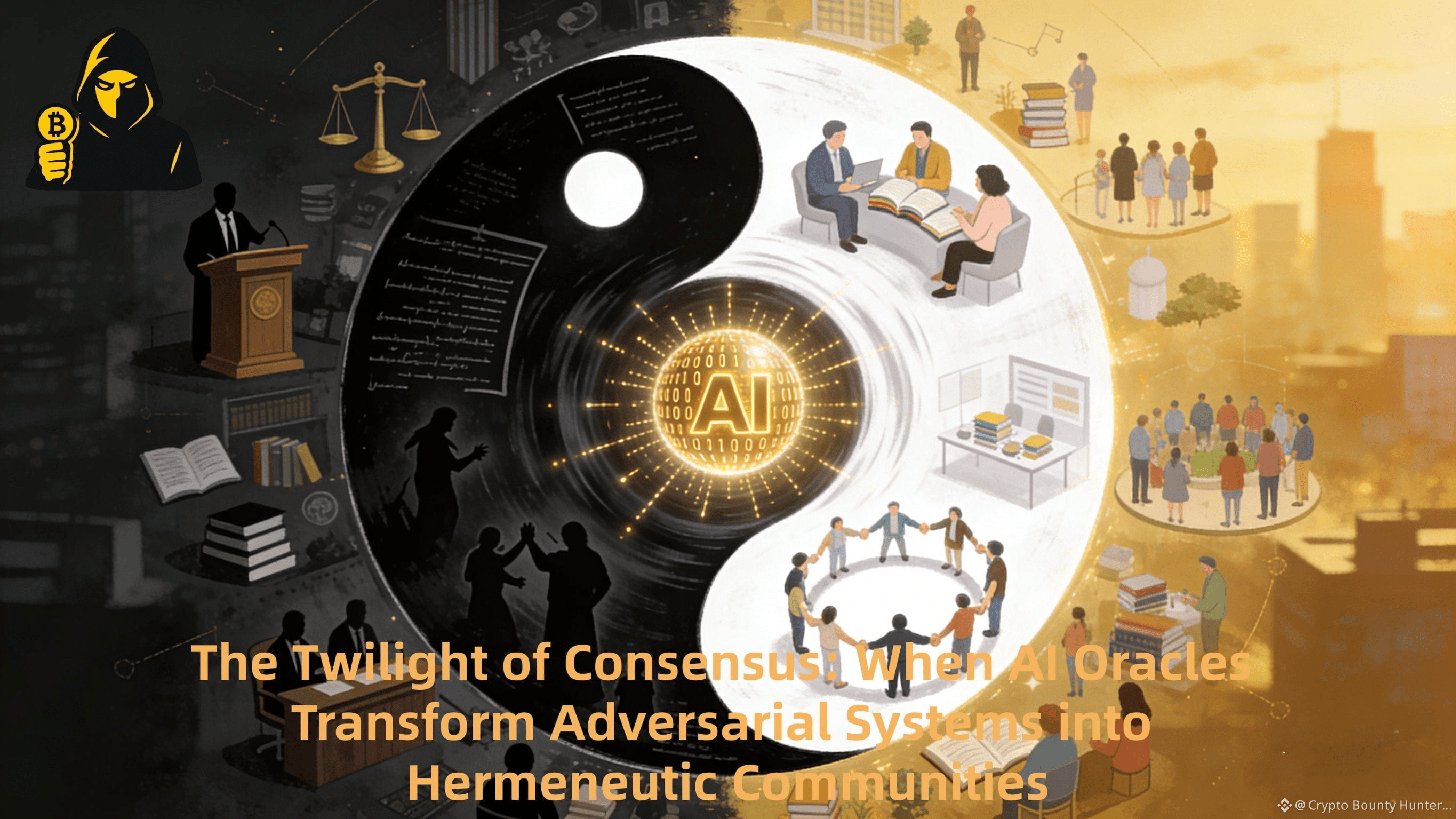
The Twilight of Consensus: When AI Oracles Transform Adversarial Systems into Hermeneutic Communities
The foundation of blockchain is not cryptography, but the adversarial assumption—we design systems on the premise that every participant may act maliciously. AI oracles are quietly replacing this foundation with “intelligent understanding,” turning the cryptographic world from a mathematical battlefield into a salon of semantic negotiation.
Satoshi Nakamoto’s most profound insight in the white paper was not Proof of Work, but the idea that adversarial consensus can create spontaneous order. The Bitcoin network does not require nodes to trust one another; it assumes mutual hostility, yet still achieves agreement on the ledger state. This adversarial design is what fundamentally distinguishes blockchains from all prior digital coordination systems.
APRO Oracle’s promise of being “AI-enhanced” appears, on the surface, to be a technical upgrade for handling unstructured data. In essence, however, it represents an epistemological betrayal. When it begins to verify the intent of legal documents rather than their text, assess the value of artworks rather than their authenticity, and interpret the policy inclination of regulatory statements rather than their literal wording, it shifts the system from an adversarial mathematical game into a hermeneutic game that requires shared understanding, cultural background, and interpretive frameworks.
01 From “State Consensus” to “Meaning Consensus”: An Irreversible Paradigm Collapse
Traditional oracles address relatively simple questions: what is the value of data X at time T? This is a state consensus problem. Nodes can verify one another’s submissions and punish incorrect ones through economic games. Even if nodes do not trust each other—or even know who the others are—the system still functions.
APRO, by contrast, deals with entirely different questions: What is the actual enforceability of this legal contract? How culturally significant is this digital artwork? What is the policy stance of this central bank statement? These are meaning consensus problems.
The differences are fundamental:
Differences in verification methods
State consensus: repeatable, independently verifiable mathematical computation
Meaning consensus: interpretive processes dependent on context, background knowledge, and interpretive frameworks
Reachability of consensus
State consensus: forcibly achievable through majority voting or economic incentives
Meaning consensus: potentially never fully achievable, only asymptotically approachable
Nature of error
State consensus: binary errors (right/wrong), attributable to malice or failure
Meaning consensus: continuous and fuzzy errors, often reflecting “reasonable disagreement”
When APRO attempts to verify the “validity” of property title documents for RWA assets, it is not merely performing OCR and template matching—it is engaging in legal interpretation. The same complex document involving traditional land rights may receive completely different “validity scores” from an AI model trained in a common law context, one trained in a civil law tradition, or one incorporating local customary law.
More fundamentally, these scores cannot be reconciled through simple node voting. If five nodes output 0.9, three output 0.7, and two output 0.5, producing a final output of “0.8” is merely a mathematical average, not a semantic consensus. An average is not consensus; it is a substitute for consensus.
APRO’s technical architecture attempts to mask this dilemma with a two-layer design (L1 AI interpretation, L2 node consensus), but this is illusory comfort. If the AI understanding at L1 is inherently interpretive, context-dependent, and value-laden, then consensus at L2 over AI outputs merely reflects agreement on one particular interpretive framework, not agreement on reality itself.
02 The Algorithmization of Cultural Colonialism: When the Power to Define “Reasonableness” Is Encoded
One of the original ideals of the crypto movement was to transcend geographic and cultural boundaries and create global, permissionless systems. Yet interpretive AI systems inevitably carry cultural bias—because understanding itself is a cultural product.
APRO’s training data largely derives from English-language legal documents, Western art-historical evaluation systems, and mainstream financial analysis frameworks. When it is used to evaluate:
Land claims rooted in African oral traditions
The compliance of Islamic financial contracts
The cultural value of Indigenous art
its evaluation framework is, in essence, cultural translation—translating concepts, values, and practices from other cultures into categories intelligible to the dominant culture embedded in its training data. All translation is inevitably distorted, reductive, and asymmetrical in power.
In APRO’s economic model, this manifests as implicit cultural premia or cultural discounts:
RWA assets aligned with Euro-American legal frameworks receive “interpretive fluency premiums”
Contracts using standardized financial terminology score higher on “comprehensibility”
Works conforming to Western modern art paradigms more easily achieve “value consensus”
The danger of such cultural bias lies not in its being “wrong,” but in its systematic reshaping of reality to fit its own framework. Developers will gradually optimize their RWA structures, legal phrasing, and value narratives to align with APRO AI’s “interpretive preferences.” Over time, global on-chain asset markets may become homogenized into replicas of a few dominant cultural templates.
More subtly, this bias is masked by the veneer of technical neutrality. APRO can claim: “Our models perform optimally on F1 scores and recall metrics.” But these metrics themselves are defined within specific cultural frameworks. Optimizing technical metrics is, in effect, the reinforcement of cultural bias.
AT token governance faces an unsolvable dilemma: either acknowledge and attempt to correct cultural bias (requiring “non-technical” mechanisms such as representational quotas and value pluralism clauses), or feign neutrality and allow bias to systematize. The former renders governance deeply complex and politicized; the latter betrays crypto’s inclusive ideals.
03 The Recentralization of Interpretive Authority: From Node Count to Cognitive Monopoly
The decentralization of traditional oracles can be measured by node count, geographic distribution, and client diversity. APRO introduces a new dimension of centralization: the diversity of interpretive frameworks.
Even if 1,000 nodes run APRO software, if they all use the same AI model, the same training data, and the same parameters, the system is highly centralized at the interpretive level. Nodes are decentralized only in the sense of redundant computation; in how they understand the world, they are monolithic.
This form of power is more hidden and more fundamental than node centralization:
Layer 1: Model architecture selection
Transformer, CNN, GNN—different neural architectures attend to data differently. Choosing an architecture is choosing how to see the world. This power resides with APRO’s core development team.
Layer 2: Training data curation
Which legal cases are included? Which artworks are labeled? Which economic reports are ingested? Data selection is reality selection. Curation determines what is seen and what is ignored.
Layer 3: Loss function design
AI learns by minimizing “loss.” The loss function defines what counts as a “good outcome.” In verification tasks, should the system prioritize recall (avoiding false negatives) or precision (avoiding false positives)? This is fundamentally a value ranking.
These powers are absent or weak in traditional oracles. Chainlink nodes can choose their own data sources, naturally generating diversity. In APRO, by contrast, the interpretive framework is unified at the source, and nodes merely instantiate that same framework.
The result is systemic cognitive fragility. If APRO’s interpretive framework contains a blind spot or faulty assumption, the entire network shares it, unable to correct through node diversity. When confronted with out-of-framework anomalies, the system may fail collectively or generate systemic bias.
The “challenge windows” and “slashing mechanisms” described in APRO’s documentation address malicious data submission, but not the risk of “all nodes being honest yet sharing the same mistaken understanding.” Adversarial design fails here—because the adversaries operate within the same rules and worldview.
04 The Ultimate Death of Composability: When API Calls Become Declarations of Cultural Allegiance
In traditional DeFi, composability depends on semantic stability. getPrice(ETH) means the same thing in any context. In APRO’s interpretive world, however, every API call carries an entire set of implicit cultural, legal, and philosophical assumptions.
Consider two simple calls:
// Call 1: Verify title under a US common law framework
uint confidence = apro.verifyTitleDeed(document, "US_COMMON_LAW");
// Call 2: Verify the same title under a customary law framework
uint confidence = apro.verifyTitleDeed(document, "CUSTOMARY_LAW_TRADITION");
Technically, these are the same function with different parameters. Semantically, they are entirely different operations—based on different legal philosophies, evidentiary standards, and notions of validity. More problematically, most calls will not explicitly specify a framework, defaulting instead to dominant cultural assumptions hidden behind technical convenience.
This is devastating for composability:
Dimension 1: Semantic drift
The same APRO query may mean different things over time as AI models update, training data changes, and interpretive frameworks evolve. verifyArtValue(artwork) returning 0.8 today and 0.6 next month may reflect not a change in the artwork, but a shift in the model’s definition of “artistic value.”
Dimension 2: Framework incompatibility
Protocol A verifies RWA assets using APRO’s “Western modern legal framework,” while Protocol B evaluates the same asset under an “Islamic finance compliance framework.” The two cannot be safely composed; combining them is like assembling components based on Newtonian mechanics with those based on quantum mechanics.
Dimension 3: Diffusion of interpretive responsibility
When multiple protocol layers use APRO with different settings, error attribution becomes impossible. Did a derivative fail because the asset verification framework was inappropriate? Because the intermediate risk framework was flawed? Or because the top-level pricing model was wrong? Each layer can point to another’s interpretive choices, creating a black hole of interpretive responsibility.
Developers face a brutal choice: lock themselves into a specific APRO interpretive framework version and accept technological stagnation, or follow APRO’s evolving frameworks and endure continuous semantic drift and composability breakage. Either choice marks the end of composability’s golden age.
05 Hunter’s Projection: Resetting the Valuation Logic of Interpretive Infrastructure
Investing in APRO is no longer investing in “better data,” but in the early allocation of interpretive power. This demands an entirely new valuation framework.
Valuation Dimension 1: Scalability of interpretive frameworks
APRO’s value depends not on how many data points it can process, but on how many cultural contexts, legal systems, and value traditions its interpretive frameworks can cover. An oracle that understands only New York real estate law has limited value; one that understands 50 global land tenure systems is immensely valuable. Yet scalability entails a fundamental tension: broader coverage may imply shallower understanding.
Valuation Dimension 2: Governance efficacy of framework updates
In traditional software, updates fix bugs and add features. In interpretive AI systems, updates change worldviews. Can APRO’s governance handle worldview-level changes smoothly without ecosystem fragmentation? This is far harder than technical upgrades.
Valuation Dimension 3: Mechanisms for preserving interpretive diversity
The most valuable system may not be the one offering the “most accurate” interpretation, but one that offers multiple reasonable interpretations, clearly labeling their assumptions. Can APRO design mechanisms to preserve interpretive diversity rather than converging on a single “optimal” framework? This requires rethinking AI training and node incentives from first principles.
Valuation Dimension 4: Market opportunities in cultural translation
APRO’s greatest commercial opportunity may lie not in direct verification, but in becoming a cross-cultural translation layer between interpretive frameworks—translating Islamic finance contracts into Wall Street–understandable risk scores, or Indigenous art values into globally accepted auction valuations. Such translation services may be more valuable than raw verification itself.
From a timing perspective, interpretive infrastructure is at a very early stage. The market has yet to grasp that “interpretive power” is more fundamental and valuable than “data power.” APRO’s current valuation reflects primarily its technical implementation and data call volume, barely accounting for its potential role as a global mediator of value interpretation.
Yet the risks are equally profound. If APRO’s interpretive framework proves too narrow, biased, or vulnerable to cultural-political pressures, it may never earn global trust. More likely, the market will fragment into multiple culturally specific oracles: Asian RWA oracles, African digital art oracles, Islamic DeFi oracles—each with its own interpretive framework.
The final irony is this: APRO attempts to use the most advanced technology (AI) to solve one of humanity’s oldest problems (cross-cultural understanding), only to rediscover that the problem may be insoluble. The crypto movement’s dream of a global, permissionless, culturally neutral financial system may be a mirage when confronted with interpretive reality.
What we may be witnessing is not a triumph of technology, but an exposure of its limits. When blockchains encounter complex realities that require human understanding, they must either retreat to simpler domains (digitally native assets) or reintroduce interpretive mechanisms—thereby reimporting all the cultural, political, and philosophical complexities they sought to escape.
APRO stands at this crossroads. Its success or failure will answer a fundamental question: can cryptographic systems embrace the full complexity of human reality without betraying their core spirit? Or are adversarial systems and interpretive understanding inherently irreconcilable?
Ultimate Paradox: When systems must “understand” in order to function, is the ideal of “trustlessness” already dead? Are we building smarter infrastructure—or erecting digital temples for new cognitive authorities?
— Crypto Hunter · In the Eternal Tension Between Interpretation and Adversarialism —