
Imagine this scenario:
Bitcoin experienced a sharp drop in a short period, with Twitter timelines flooded with posts saying "sold out" and "to zero."
The depth of pools like Curve is instantly drained, and the price of your LRT starts to drop rapidly.
You're staring at the candlestick chart while frantically clicking "Swap" on the DEX:
The slippage spiked to double digits;
Orders either result in huge losses upon completion or fail outright.
This is a classic example of the "crowded theater effect":
The exit is only so wide, and everyone tries to squeeze out at the same time, so no one can leave smoothly.
The Lorenzo Protocol's SPT (Staking Proof Token) redemption mechanism...
It is in this extreme scenario that a line is reserved for stBTC holders
An exit channel with "more certain pricing and predictable processes".
This article isn't about teaching you how to earn more money.
Rather, it's about how to use the official redemption path you have when the system is under pressure, who it's suitable for, and what the costs are.
I. Why are many people "stuck at the door"? The congestion effect of DEX exits
The default exit path for most LRT/restaking protocols is:
Exchange LRT back to the underlying asset on a DEX (e.g., stBTC → BTC).
When the market is stable, this path is very smooth:
There is sufficient liquidity in the pool;
Prices fluctuated slightly around a 1:1 ratio;
Transaction fees and slippage are almost negligible.
But in times of panic, problems arise all at once:
LPs withdrew their liquidity early, instantly making the pool "shallow";
A large amount of selling pressure hits the same trading pair, causing the exchange rate to depreciate rapidly;
By the time an agreement is reached to conduct buybacks or replenish working capital, it often falls behind market sentiment.
The result is:
Some were forced to accept exit prices far below a 1:1 ratio;
Some people simply can't get a spot and can only passively bear the fluctuations.
This dual uncertainty of "price uncertainty + transaction uncertainty"
It is the real amplifier of panic.
II. What is SPT? It changes the redemption process from "pooled redemption" to "queueed redemption".
The Lorenzo Protocol's approach is to give users one more option:
No longer entirely dependent on secondary market liquidity;
Instead, it provides an official redemption channel based on queues and credential NFTs.
It can be simply understood as:
You return your stBTC to Lorenzo Protocol.
Lorenzo Protocol gives you a ticket with a "queue number" written on it—that's SPT.
This SPT (some versions are presented as queued NFTs):
Record the amount of stBTC you redeemed;
Record your order in the redemption queue;
This corresponds to the unstaking period of the underlying Babylon token.
The core difference compared to exiting a DEX is:
DEX path:
It can be sold at any time, but the price is highly dependent on the current market sentiment and market depth, and the discount may be very large in extreme cases;
SPT path:
The goal is to get back the original BTC as close as possible to a 1:1 ratio.
However, the funds will be locked up while the underlying collateral is released.
Essentially, the Lorenzo Protocol offers the following choice:
"You can trade time for certainty in terms of price."
III. Practical Tutorial: How to Initiate the SPT "Emergency Evacuation" Process?
When the market experiences severe volatility and you decide to exit through official channels...
It will generally involve the following steps:
Step 1: First confirm that "you really want to withdraw this part of your position".
Once an SPT is entered into the queue, it cannot usually be canceled at will;
So the previous step isn't clicking a button, but rather thinking things through:
Are you experiencing short-term emotional fluctuations, or do you have a clear intention to reduce this position?
Step 2: Access the Lorenzo Protocol redemption interface
Open the official Lorenzo Protocol DApp;
Go to the Redeem page;
Connect to the wallet currently holding stBTC (make sure it's an official link to avoid phishing).
Step 3: Enter the redemption amount and view the estimated waiting time.
Enter the amount of stBTC you wish to redeem;
The interface will display an estimated waiting period (e.g., several days to about a week, depending on the current Babylon queue).
Please confirm that you can accept the funds being locked up for this period.
Step 4: Confirm Transaction – Burn stBTC and mint SPT
Confirm the transaction in your wallet;
Contract Meeting:
Destroy the stBTC you submitted;
Mint an equivalent SPT/Queue NFT to your address.
This SPT is your on-chain debt certificate + queue number:
Prove that you are entitled to receive the corresponding amount of native BTC after the unstaking is completed;
The order in which people enter the queue can be verified on the blockchain.
Step 5: Wait for release & receive BTC
While waiting, you can check in the Dashboard:
Overall queue size;
Your own queuing progress and estimated completion time.
Once Babylon completes the unbinding of this batch of pledged shares,
The system will mark your SPT status asClaimable。
Finally, all you need to do is:
Return to the DApp and click Claim / Receive;
Smart contract destruction SPT
Transfer the corresponding amount of native BTC back to your wallet.
IV. Mechanism Breakdown: How does the SPT redemption channel operate on-chain?
The logic can be connected using a single diagram:
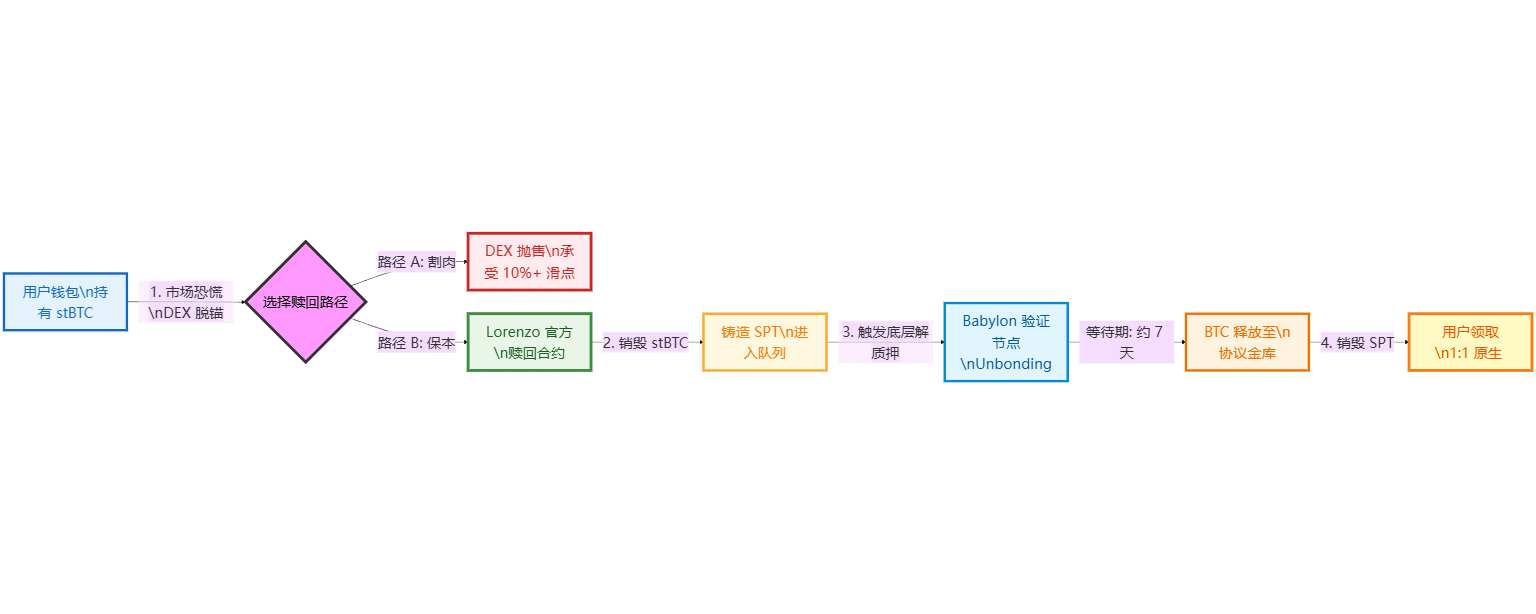
This process has three key features that are crucial for you:
Orderly and transparent rules
Queue order and redemption request size can both be observed on-chain;
There's no need to rely on the project team's "Don't panic" to maintain confidence.
The target price is clearer
The official channel is designed to help users get their BTC back at a ratio closer to 1:1.
Instead of going to DEX to take advantage of extreme discounts when you're in the worst mood.
Systemic pressure is controllable
Even if there is a short period of concentrated redemptions,
Lorenzo Protocol can also process staking in an orderly manner according to the underlying unstaking rhythm.
To avoid draining TVL instantly and disrupting the entire ecosystem.
V. Advantages of SPT: Providing an additional "predictable path" in high-pressure scenarios
From a risk management perspective, the SPT channel primarily serves the following purposes:
1. More price-friendly
DEX sell-offs are directly tied to current market depth and sentiment.
It is easy to be forced to accept unexpected discounts at crucial moments;SPT's design shifts more of the "uncertainty of exit" to the time dimension.
It helps you avoid making the worst sales decisions when you're in the worst emotional state.
2. Safer for large sums of money
Positions with seven or eight figures were dumped directly on the DEX.
They themselves can also become a source of "market shocks";Exiting via the SPT channel allows this pressure to be distributed across the time dimension.
It won't cause the price to plummet within a single block.
3. More conducive to the long-term stability of the agreement.
There is a verifiable, queued official redemption channel.
This will alleviate the panic behavior of "immediate bank run" to some extent;For holders of governance tokens such as BANK,
The SPT mechanism is a crucial component in helping the entire Lorenzo system operate more smoothly.
VI. The Costs of SPT: Time Lock-in & Opportunity Cost
Every protection mechanism comes at a cost, and SPT's core costs lie in two areas:
1. Time Lock
Once the funds are placed in the redemption queue, they will be unable to be withdrawn for a period of time.
period:
You cannot use these funds to participate in new opportunities;
If BTC itself continues to fall, the amount you get back remains the same, but the fiat currency value may decrease.
Therefore, the SPT channel is more suitable for:
Those who have clearly decided to reduce this portion of their positions are "determined exiters".
Rather than short-term users who hope to "change their minds at any time".
2. Arbitrage Opportunities and Risks
When stBTC is trading at a significant discount on the secondary market
An arbitrage strategy may emerge in the market: "Buy discounted stBTC → Redeem through SPT official channels".But this behavior also exists:
Price volatility risk;
The waiting period is uncertain;
Risks such as dynamic adjustment of protocol parameters or strategies.
This is a special note:
The above only describes common market behaviors.Phenomenon description,
This does not constitute any trading strategy advice or profit guarantee.
VII. Conclusion: Truly mature participants know in advance "where to withdraw".
In the highly volatile crypto world,
"How to get in" is often the topic of most discussion.
But "how to exit in an orderly manner" is the part that truly determines the survival rate.
The Lorenzo Protocol's SPT redemption mechanism is essentially based on:
Use transparent rules to reserve an orderly exit path for extreme situations;
The exit price, which was originally entirely dependent on emotions and depth, was taken from the perspective of...
Try to bring it back to the "predictable" range;Break down system-level bank run risks into time-based dimensions and use queues to mitigate them.
This does not mean that Lorenzo or SPT are without risk:
The underlying networks and protocols themselves still face technical and economic uncertainties;
Smart contracts may still have problems that have not yet been exposed;
Extreme macroeconomic events may still exceed the model's assumptions.
For users who are following stBTC and $$BANK , what's more important is:
When everything is normal, first figure out:
If things go wrong, what are the possible avenues for your funds, and what are the costs associated with each one?
SPT is not a button that must be pressed.
But it's within the Lorenzo system.
One retreat option that needs to be understood beforehand.
Risk Disclaimer
This article is a personal understanding and compilation based on publicly available information and general protocol design principles, intended for educational and communication purposes only, and does not constitute any investment advice, legal opinion, or profit guarantee.
The article mentions Lorenzo Protocol, stBTC, SPT, Babylon, and bank-related protocols and tokens.
All of these involve multiple risks, including price fluctuations, protocol parameter adjustments, smart contract vulnerabilities, underlying network security incidents, and changes in regulatory policies.
Any redemption, asset allocation, or potential arbitrage activity should be based on your independent research (DYOR) and risk tolerance.
Before engaging in live trading, please ensure you are using official channels and be wary of phishing websites and fake applications.
I'm like someone who clings to outdated methods, focusing on the essence of things and ignoring noise. @Lorenzo Protocol #LorenzoProtocol $BANK



