
At 3 AM, the phone screen suddenly lights up, "Liquidation Warning" wakes you from your dreams—
The market didn’t go wrong, and the direction was right, it was just that an odd spike occurred mid-way, causing your position to be liquidated by the system first.
In a 7×24 hour continuous trading and highly volatile market,
The most tormenting thing is often not the loss, but: clearly having the right direction, yet falling victim to short-term fluctuations.
Falcon Finance aims to help users reduce overall market risk through strategies like Delta neutral.
However, for positions using Tier 3 (altcoins) as collateral to mint USDf,
The risk of liquidation due to sharp price fluctuations remains real.
This is more like a "survival lesson":
It's not about teaching you how much more money you can make, but about teaching you how to build a multi-dimensional price monitoring and automatic defense system for yourself.
Minimize the probability of liquidation as much as possible, so that you can sleep soundly even during periods of high market volatility.
First, let me clarify: no system can guarantee 100% "never experiencing a margin call".
This article presents a risk management approach aimed at helping you manage leverage more rationally, rather than promising outcomes.
Why is it important to build this system? Because clearing is a one-way street.
In Falcon Finance's collateral-minting model, liquidation is an irreversible operation:
When your LTV (Loan-to-Value) reaches a certain threshold (for example, the common warning line for Tier 3 collateral is around 70%, and the liquidation line is around 75% - please refer to the official parameters for specifics),
The smart contract will automatically sell your collateralized assets to repay your debts.
A certain percentage of liquidation penalty will also be charged.
This means:
You've lost the leverage to buy back at a lower price.
Once the collateral is sold off and the position is forcibly closed, any subsequent rebounds will only make you a "spectator."
You paid additional costs for this forced liquidation.
In addition to price slippage, there are also liquidation penalties, so the overall loss is higher than that of "actively reducing positions".
"Green" does not equal safe.
Many people become complacent when they see the Health Factor indicator is green on the Dashboard;
However, in extreme market conditions, assets can fall from the "safe zone" to the liquidation line in just a few minute-level candlestick charts.
Setting up an automated monitoring and response mechanism is essentially like having a 24/7 online "risk manager":
We help you gain those precious few minutes of reaction time before the liquidation line is reached.
II. Toolbox: First, prepare the "defensive weapons" and "ammunition".
Before you start calculating the safety cushion, you'll need a basic set of tools:
1. Falcon Finance Official Dashboard
For real-time viewing:
Value of mortgaged assets
Amount of USDF borrowed
Current LTV / Health Factor
Expected Liquidation Price
Falcon Finance is the "main panel" of the entire defense system.
2. External pricing and alarm system
It is recommended to configure at least one or two:
Price alerts: TradingView alerts, cryptocurrency price alert apps, etc.;
Automated trigger class:
Tools like HAL and Cryptocurrency Alerting allow you to set thresholds and send notifications.
Notification channels:
Telegram bots, emails, and mobile push notifications—make sure there's at least one channel that's loud enough to wake you up.
3. "Lifesaving Fund" Pool
No matter how sophisticated the surveillance, if there are no available funds in the wallet, no defensive action can be taken.
suggestion:
Always keep a reserve of "unused stablecoins/mainstream assets" in your primary wallet, such as USDC/USDT/ETH;
The amount can at least support:
Add margin to the key position; or
Directly repay a portion of USDF to lower the overall leverage.
The sole purpose of this money is for replenishing margin accounts or repaying loans in times of crisis.
Do not treat this portion of funds as "disposable balance" under normal circumstances.
Third, first calculate: how thick is your safety pad?
Don't judge safety based on "feelings" alone; quantify it using a simple formula.
1. Find the liquidation price
In the Falcon Finance Dashboard,
Find the position corresponding to your current positionLiquidation Price;Also note the current market price.
2. Calculate the "percentage of safe distance".
A simple indicator can be used:
Safety buffer percentage = (Current price - Liquidation price) / Current price × 100%
For example:
Current price = 1.00
Liquidation price = 0.82
Safety buffer = (1.00 - 0.82) / 1.00 = 18%
3. Judgment Interval
Of course, everyone's risk tolerance is different, but a relatively conservative reference is:
>25%: Relatively generous, normal fluctuations are acceptable;
15%–25%: Increased vigilance is needed; more stringent alert settings are recommended.
< 15%They were essentially in a state of "going to battle without armor."
I suggest you consider this immediately:Additional collateral (deposit), or
Repay part of USDf (Repay)
Turn the leverage back to a level where you can truly "sleep soundly".
IV. Three lines of defense for prices: Distinguishing between "I need to pay attention" and "I must take action".
Many people set their only price alert near the "clearance price".
By the time the phone rang, only emergency response time remained.
A more prudent approach is to set up at least three layers of defense for the position:
1. First line of defense: Warning zone (approximately 20% above the settlement price)
Triggering conditions:
When the price of the coin approaches downwards from the current level
When the buffer between the price and the liquidation price narrows to approximately 20%.
Notification method:
App push notifications / email alerts.
Purpose:
I'm telling you: "The market has clearly weakened, so start paying more attention."
Depending on the specific circumstances, consider whether to reduce leverage in advance.
2. Second line of defense: Warning zone (approximately 10% above the settlement price)
Triggering condition: The safety cushion shrinks to approximately 10%;
Notification method:
More prominent audio alerts: High-priority push notifications for SMS/phone/Telegram messages;
Purpose:
This is the moment you sit down at your computer and open Falcon Finance.
For most people, this range is already worthy of a substantial adjustment:
Supplement the collateral appropriately;
Alternatively, you could pay back a portion of USDF first to lower the LTV.
3. Third line of defense: Decisive battle zone (approximately 5% above the liquidation price)
Triggering condition: Touching the buffer edge at approximately 5%;
Handling method:
If you haven't adjusted your positions yet, it's time to take immediate action;
Users with some technical skills can use scripts/automation services in this section.
Perform the pre-defined Repay or Deposit operation.
The combined effect of these three lines of defense is:
The first warning message indicates that the weather is turning cloudy.
The second level urges you to "put on your raincoat";
The third option is "You should open your umbrella now," instead of waiting for the downpour to hit your face.
V. Decision-making flowchart: Clearly write down your "Risk Control SOP".
To make this logic more intuitive, please refer to the risk control flowchart below.
Think of it as your personal defense system SOP at Falcon Finance:
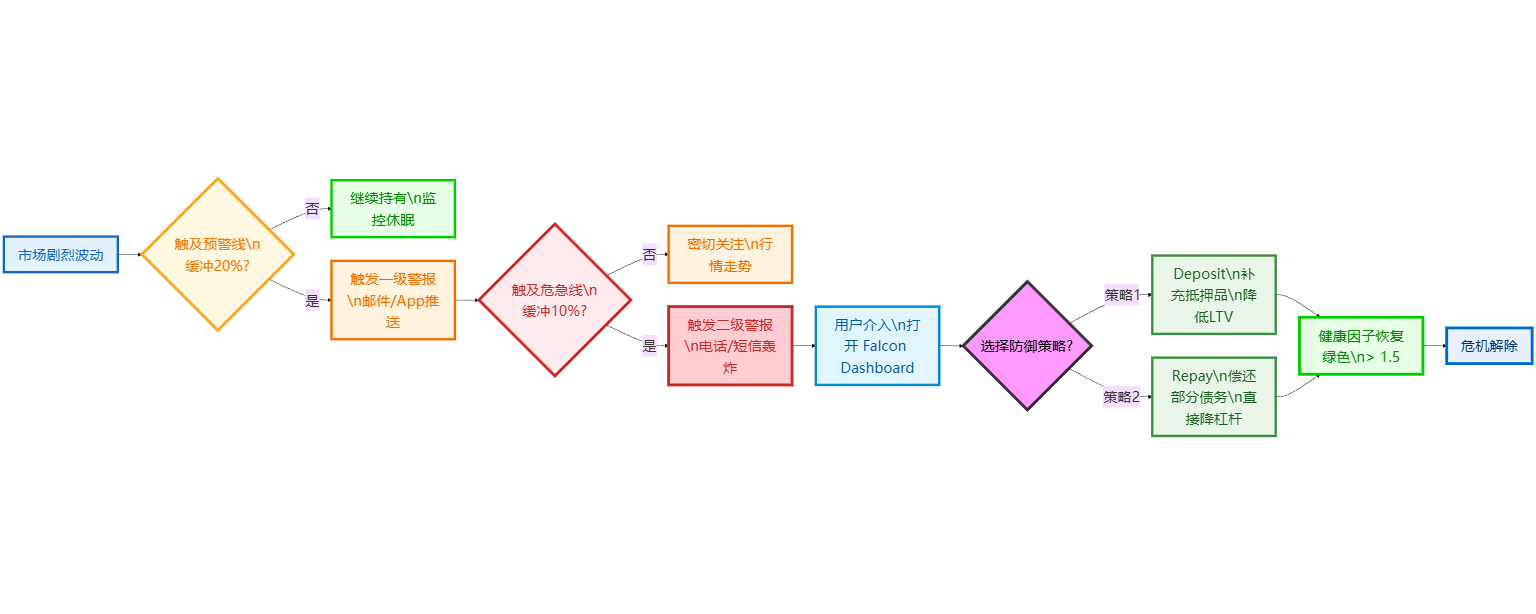
You can fine-tune these figures (20%/10%/5%) based on your asset size and risk tolerance.
But the key is to write out a clear process for "when to remind – when to take action".
6. Conduct a "fire drill": Don't wait until a real accident happens to find that the alarm didn't go off.
Once the system is set up, be sure to conduct a complete test:
Simulated price alert
Set a test alert near the current price.
Make sure you receive notifications on your phone/email/Telegram immediately;
Check if the sound and vibration are noticeable enough.
Check Falcon Finance's notification settings
If Falcon Finance offers email alerts or on-chain event subscription functionality,
The binding and verification have been completed.
Confirming the flow of "lifesaving funds"
When the network is not congested, try making a small deposit/repayment.
How long does it take from "making a decision" to "on-chain confirmation"?
Gas strategy for extreme market conditions
On the day of the historic crash, the gas on networks such as Ethereum once soared to hundreds or even thousands of Gwei;
It is recommended to pre-set a "high-priority gas template".
In an emergency, it can be called directly instead of manually dialing it for a long time;Experienced users can learn about RPCs that support private trading channels/MEV anti-front-running.
Reduce the probability of transactions getting stuck in the mempool during congested periods.
When it comes to risk management,
Practicing a "false alarm" is far more worthwhile than conducting a "real cleanup" afterwards.
7. After setting up the system, what you need to adhere to is "discipline".
Once this multi-layered defense is complete, you'll find your mindset changes:
In the past, I would stay up all night watching the market during every fluctuation.
It is now within a reasonable range.
Dedicate more energy to work and life, rather than being dictated by prices.
Falcon Finance provides a programmable collateral-minting infrastructure;
Whether you manage your positions well and respect the risks of liquidation depends entirely on your discipline.
At any time, if the leverage you're using is so high that you can't sleep soundly, then the position itself needs to be reassessed.
Even the best strategy will fail without a defense system and disciplined execution.
Sooner or later, the market will teach them a lesson at some extreme moment.
In the highly volatile crypto world,
Making money relies on knowledge.
Protecting what you've already earned relies on risk control and self-discipline.
This combination of multi-dimensional monitoring, three lines of price defense, and practical exercises...
It's the "defensive armor" you build for yourself within the Falcon Finance system.
Risk Warning
This article is a compilation and sharing of my personal risk control ideas, intended for learning and discussion only, and does not constitute any investment advice or guarantee of returns.
The Falcon Finance, USDf, Tier 3 collateralized assets and related tools mentioned in this article are for technical examples only.
Actual liquidation parameters (such as LTV thresholds, penalty rates), available features, and network conditions may change over time.
Please refer to the official Falcon Finance documentation and interface for accuracy.
Any leveraged operations, mortgage lending, and liquidation-related activities are accompanied by high risks.
Before using Falcon Finance or other DeFi protocols, please conduct thorough research on your own (DYOR).
Make prudent decisions based on your own risk tolerance and reasonably control your position size and leverage ratio.
I'm like someone who clings to outdated methods, focusing on the essence of things and ignoring noise. @Falcon Finance $FF #FalconFinance


