

As the presidential inauguration weekend begins, the infamous former U.S. congressman is about to walk into a "cryptocurrency ball" with tickets costing $2,500.
Article author and source: MarsBit
A few days before Donald Trump's return to the White House, George Santos walked up the steps of the nearby Andrew W. Mellon Auditorium. It was January 17, the prelude to the presidential inauguration weekend, and the infamous former U.S. congressman was about to enter a $2,500 "cryptocurrency ball."
Santos strode confidently past a row of men in tuxedos into the neoclassical building. Inside, House Speaker Mike Johnson posed for photos with cryptocurrency influencers and lobbyists, while Donald Trump Jr. filmed a TikTok video. Brock Pierce, the child star of *Pretty Woman*, was also present—now a co-founder of an $180 billion cryptocurrency company; Trump's political advisor Alina Habba played a claw machine. Incoming Treasury Secretary Scott Bessent and former dating coach Zak Folkman, now a partner of the Trump family in their cryptocurrency ventures, were also in attendance.
Before Snoop Dogg took the stage as DJ, some attendees pulled out their phones to check an announcement the president-elect had made on his social media platform, Truth Social: he had launched a cryptocurrency named "TRUMP." "Have fun!" he wrote, and the price of the coin immediately soared. Some at the party were furious at not having been able to buy in advance, while others suspected Trump's account had been hacked. "This is definitely fake," one cryptocurrency founder told a colleague.
But it is real—not that Trump has any real investment value, but that it wasn't a hacked forgery. In fact, it belongs to "Meme Coin," a digital token entirely based on hype. That same weekend, his wife Melania also launched her own Meme Coin, "MELANIA." The scene resembled the Trump family filling the National Mall with slot machines bearing the "Trump" logo.
The prices of these tokens surged, and within hours, the market value of tokens held by the Trump family and their business partners exceeded $50 billion. Subsequently, the prices plummeted, leaving hundreds of thousands of ordinary investors with nothing. (A lawsuit has been filed against Bloomberg LP, and the case is still pending.)
At a press conference a few hours before the dinner, White House Press Secretary Levitt defended Trump, saying he was "attending in his private time," as if "clocking out" could absolve him of any conflict of interest. "It's ridiculous to suggest that the president is using his position for personal gain," she said.
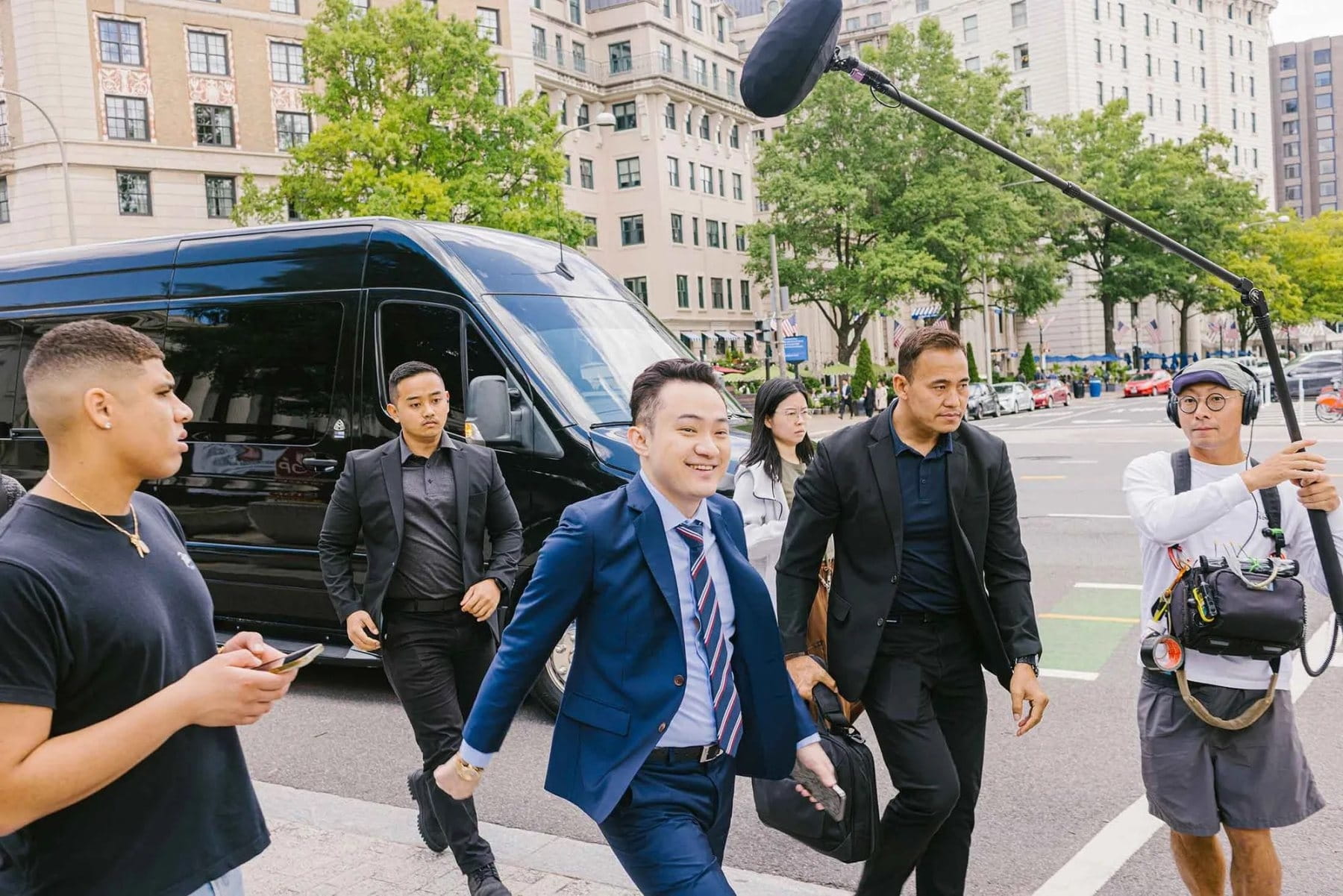
In May 2025, Sun arrived at the White House. Photographer: Jason Andrew / (The New York Times)/Redux
That evening, dozens of protesters braved the rain to gather outside the golf club entrance. Justin Sun arrived accompanied by an assistant holding an umbrella and three photographers; at security, attendees were required to show identification—many of which were foreign passports—giving the protesters an opportunity to mock him. As two guests in tuxedos walked by, someone shouted, "What are we having for dinner, you bastards?"
The main course at the dinner was filet mignon. Zanke attended as the host, wearing a blue suit and a red tie. During the event, he stood on the podium (with the American flag behind him) and held up a magazine with Justin Sun's image on the cover.
But this opportunity for "rent-seeking" clearly didn't materialize—one attendee revealed that he didn't see anyone speak privately with the president. Trump arrived by helicopter, delivered a routine "buy cryptocurrency" speech, and then left.
This dinner at least confirms one thing: Zanke's involvement is not simply "a name on Delaware papers." But there are still no new clues about "how the president created and traded digital tokens."
Key Clues: The Argentine President's "Meme Coin Scandal" and "Blockchain Tracking"
A turning point came a month after the Trumps launched their token: another world leader was embroiled in the Memecoin controversy – Argentine President Javier Milei. This president, known for his "Trump worship and chainsaw-wielding" persona, endorsed a token called "Libra" on February 14th. Hours later, the token's price plummeted, and Milei hastily deleted his endorsement from social media.
Cryptocurrency transactions are stored on a public ledger called the "blockchain," essentially leaving a traceable record. "Most of the data is absurd and inaccurate," he texted. "I'll get all the facts straight before I speak." (The lawyer representing the Davis family stated that the magazine's questions contained "numerous inaccuracies," without specifying what they were.)
Whistleblower emerges: Unveiling the connections of the "exchange executive"
Fortunately, a former associate of Davis came forward as a "whistleblower"—he also revealed that Davis was not the real mastermind behind it all.
Shortly after the collapse of Libra, Moty Povolotski, co-founder of the cryptocurrency startup DefiTuna, publicly stated that his company had partnered with Davis to issue the Meme coin and possessed "evidence of a larger conspiracy" involving executives of a cryptocurrency exchange. While Povolotski's statements were somewhat incoherent, he was the only one at the time willing to reveal the truth behind the scenes. In April 2025, he agreed to meet at the "Solana Crossroads" cryptocurrency conference in Istanbul (his home city).
When we met, Povorodsky was wearing black jeans and a DefiTuna black hoodie, sporting a buzz cut on his square head, and sporting a bright smile. He bluntly stated, "Most Meme coins are scams; it's a manipulated game, essentially about pumping and dumping." As he spoke, he nervously opened and closed his AirPods case repeatedly.
But this didn't stop him from getting involved. Povorocki revealed that Davis had hired his company to "assist with Meme coin trading"—which isn't suspicious in itself, since most cryptocurrency issuers hire experts to ensure smooth early trading. But from the beginning, Davis's sole objective was clear: "To make money for himself." Povorocki recalled that his former partner asked Davis in a group chat "how to handle the upcoming token trading," to which Davis replied, "Sell as much as possible, even if the price drops to zero." "Guys, to be honest, we're going to squeeze every last penny out of this token," Davis wrote in a text message.
MELANIA operated similarly: Davis transferred approximately 10 million tokens to Povolotti's partners, instructing them to "sell them once the market capitalization reached $100 million," and also instructing them to "operate anonymously." "They said 'it must be sold anonymously,'" Povolotti recalled with a laugh.
Two weeks later, Povorotsky visited Davis in Barcelona—Davis was then launching another Meme coin, ENRON, named after an American energy company that had gone bankrupt 20 years earlier due to accounting fraud. In a hookah bar, Povorotsky saw Davis's father showing off "an automated program" used to "secretly target ENRON."
Povorocki said his former partner was "the one who primarily handled deals for Davis," and that he severed ties with both men after witnessing everything in Barcelona. (This partner, Vlad Poznyakov, did not respond to messages, and his old phone number is no longer in service.)
When asked about Davis's other partners, Povorotti mentioned a key figure: an executive at the cryptocurrency exchange Meteora. He explained that Meteora explains "why the Trump family can make so much money so quickly"—this platform is larger and more customized than Pump.fun, and although it doesn't specialize in Memecoin, Trump, Melania, and Libra all launched on the platform.
Meteora's co-founder is none other than Meow, who used an "astronaut cat" as his profile picture. According to colleagues, while Meow didn't have an official title, he was the de facto head of the exchange. Povorodsky also said that when he first met Davis at a party in Singapore in September 2024, they were introduced by Ben Chow, then CEO of Meteora; Ben Chow seemed deeply involved in the exchange's "large-scale Meme coin issuance project," and Davis frequently mentioned "Ben Chow's instructions" in text messages and phone calls.
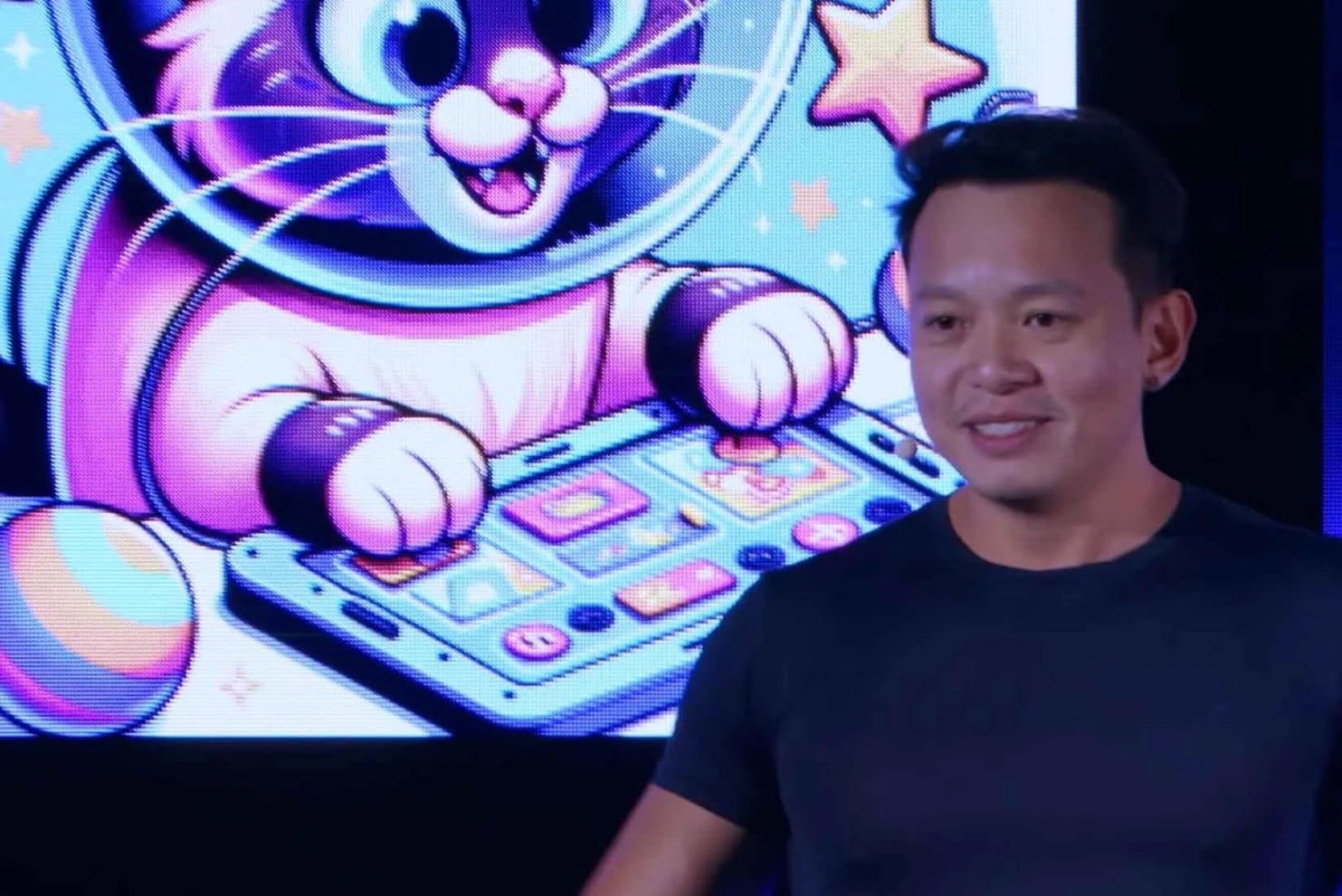
Meow at the Solana Crossroads conference in 2023. Source: YouTube
Confrontation and Silence: Ben Zhou's Resignation and the Mystery of Meow's Identity
After the MILEE collapse, Povorotti confronted Ben Chow. He recorded their video call and showed it to Bloomberg Businessweek. In the call, Povorotti stated that he suspected Davis had been running a pump-and-dump scheme, and mentioned that he often felt that Ben Chow and Davis were partners: "Davis would always say, 'Oh, Ben said so,' 'Ben made her do it this way,' 'Ben said the token was going to launch,' 'Ben said she would tweet about it.'"
In the video, Ben Zhou appeared visibly surprised when Povorocki accused Davis of fraud. "I'm so upset," he groaned. However, he didn't deny his close relationship with Davis, admitting to having introduced business to him. "I was just a middleman, right?" Ben Zhou said. "You know, Melania's team needed help, so I introduced them to Hayden Davis."
If Ben Chou and the Meteora exchange facilitated Melania's connections, were they also involved in the operation of Trump's tokens in the same way? Povorodsky wasn't sure, but he told Bloomberg Businessweek that he didn't believe Chou's claim of "complete ignorance." "That's all nonsense," he scoffed.
Povorodsky said that after the call, he contacted Meow seeking answers. However, Meow ignored his inquiries, so Povorodsky shared the video of the call with cryptocurrency media outlet SolanaFloor. Amidst the public outcry, Ben Zhou resigned. (Neither Ben Zhou nor his lawyers responded to requests for comment.)
(Bloomberg Businessweek) When asked if Meow knew who was behind the Trump token and how it generated huge profits, Povorodsky suddenly fell silent. For a full 15 seconds, his expression and body language shifted—a grin, an eyebrow raise, a shrug, a stare, and another forceful shrug—clearly restraining himself from revealing certain information. Finally, he simply raised his hands and smiled.
It seems it's time to find Meow himself.
The true face of Meow: Singaporean businessman Goh Ming Yao and his "financial utopia".
Finding Meow wasn't difficult. He's a celebrity in the Meme coin trading community: in addition to co-founding the Meteora exchange, he also developed the popular cryptocurrency trading app Jupiter. Earlier this year, a Bloomberg Businessweek reporter stumbled upon him in an online chat room—where television personality Nick Cannon was promoting Meme coin for his improv comedy show, Wild'N Out.
"You can make a lot of money if you can attract enough attention, but it's a double-edged sword," Meow said in the chat room. "In theory, we're creating a whole new financial system. But at the same time, you're attracting the worst people in the world."
"We're talking to the big boss!" Cannon later exclaimed excitedly. A few days later, the token's price crashed.
Immediately after Trump's inauguration, Meow hosted a conference in Istanbul, attracting over 1,000 attendees. He named the conference "Catstanbul," essentially a celebration—perhaps also a "victory parade" for Davis after profiting from Trump tokens. Text messages reviewed by Bloomberg Businessweek show that Davis said he was "spending 24 hours a day with Ben Zhou and Meow."
The highlight of the "Catstanbul" conference was the lighting of a 15-foot (approximately 4.6-meter) tall cat sculpture—a style inspired by Burning Man. The sculpture's eyes glowed red in the firelight, while Meow posed for photos with fans nearby.
On his personal website and podcast, Meow frequently shares philosophical insights about the "free market for cryptocurrencies" he helped create: he envisions a system called "GUM" (Giant Unified Market) where anyone can trade any asset; he also believes that creating new currencies is key to achieving a "more equitable future." In one article, he calls Memecoin not a scam, but a "pioneer of a new era of digital interconnection and cultural expression"; in another, he compares issuing cryptocurrency to "founding a religion": "Founding a new religion or creating a new god essentially only requires a new symbol, coupled with a corresponding community and story," he writes, "and I find it particularly interesting! After all, why should only warlords monopolize the power to construct society, and only central banks monopolize the power to issue currency?"
Despite Meow's efforts to maintain an "anonymous" image, his real name can actually be found online. His personal website lists several startups for which he provides consulting services, one of which publicly identified him in a press release, leading to the discovery of several abandoned social media accounts. It was eventually revealed that Meow's real name is Ming Yeow Ng, a Singaporean in his 40s.
Facing Wu Mingyao directly: The metaphors of "the US dollar is also a Meme coin" and "the baby in the bathtub"
After exchanging text messages about Memecoin, Presidential Tokens, and other topics (including a photo of his cat), Wu Mingyao agreed to meet. (Bloomberg Businessweek) suggested meeting at a cat cafe near his Chinatown office in Singapore.
When we met, Wu Mingyao, dressed in a T-shirt, linen pants, and flip-flops, limped into the café—he had just returned from Nepal, where he had sprained his knee while hiking with a YouTuber who had also introduced him to supposedly hallucinogenic "honey." Inside the café, several young people chatted while playing with a lazy cat. Wu Mingyao eagerly began discussing a new article he was writing, claiming that "all financial assets are essentially Meme coins" because their value is built on "people's shared beliefs about something." In his view, even the US dollar was no exception. "The US dollar is a Meme coin," Wu Mingyao slammed his hand on the table, his eyes wide, "Everything is a Meme coin!"
Wu Mingyao grew up in Singapore, where his parents ran a stall in a local food market. He later studied computer engineering in Singapore. In the late 2000s, he developed a service called "Mr. Tweet" in San Francisco—filling a gap in Twitter's (now X platform) "recommended follow" feature at the time. Back then, he was still using the nickname "Steve."
Wu Mingyao said he first learned about cryptocurrency at a Dogecoin-themed party and became deeply fascinated with it. In 2021, he launched the cryptocurrency application "Mercurial Finance," which received investment from the Sam Bankman-Fried hedge fund. Later, Bankman-Fried was exposed for operating a large-scale fraud, so Wu Mingyao renamed the application "Meteora." In an article at the time, he wrote that he was annoyed by "remaining silent about the garbage and chaos he saw" and regretted "blindly participating" in what he called "filthy things."
The Meteora exchange allows the issuance and trading of various cryptocurrencies, not just Memecoin. However, the Memecoin craze has indeed brought Wu Mingyao considerable profits. According to data from cryptocurrency research firm Blockworks, approximately 90% of the exchange's $134 million in revenue over the past year came from Memecoin trading—trades that typically incur higher fees. Wu Mingyao stated that, in a sense, the Memecoin market is more "pure" because it only reflects "the value that users assign to it based on their own beliefs," nothing more. "I have no interest in moral judgments," he said. "I only focus on the actual phenomena. For example, if you bought Fartcoin a few months ago, you can buy a lot more with it now."
Avoidance and justification: "Technical support" and "Don't throw the baby out with the bathwater"
When the conversation finally turned to the roles played by the Trumps, Davis, and Wu Mingyao's company, he became taciturn. "If I told you that things are actually much more boring than you think, would you believe me?" He frowned, looking troubled.
He admitted that someone from Trump's team (who wished to remain anonymous) contacted Meteora before the token launch, hoping to obtain technical support to complete the token setup. However, he emphasized that Meteora only provided "technical support," and the team did not participate in any transactions or engage in any improper conduct. "There was absolutely no behind-the-scenes trading."
Wu Mingyao stated that his decentralized platform aims to "allow anyone to issue any token," rather than "regulate the intentions of issuers." He believes that innovations like Bitcoin could never be born within a strictly regulated system. "There are many things we really can't and shouldn't interfere with," he said, as a gray and white cat climbed onto the railing and began scratching at his phone with its paws.
He argued that it was unfair to judge the entire cryptocurrency industry as a "scam"—as the old saying goes, "don't throw the baby out with the bathwater." He then elaborated on this analogy: "There might be dog poop, baby poop, or even E. coli in the bathtub, but there might actually be a baby in it. What I'm saying is, that 'baby' exists."
Using this vivid analogy, promoters like Davis, who "issue large quantities of rapidly collapsing tokens and flood the market," are clearly "the ones who take a dump." So, did Wu Mingyao ever ask Davis to "get out of his bathtub" (i.e., cease cooperation)?
Wu Mingyao said he only met Davis once, for about 20 minutes, and had no idea what Davis was doing. "It's hard to judge," he added, also stating that his team was not involved in the issuance of the Miley token at all.
Behind the Scenes: The "Little Horse Empire" and the "Infinite Currency" Fantasy
The discussion later shifted to Jupiter's office above a noodle shop on the street corner. Shoes lined the dilapidated wooden staircase leading to the second floor, and inside, about 30 men and a few women were busy working on their laptops. When an employee demonstrated a new QR code feature—sending some Fartcoin—Wu Mingyao squealed with excitement; another developer showcased a prototype that "made token issuance simpler" (she had just used this prototype to create a token called "Little Horse Empire"), while Wu Mingyao watched intently, munching on pork jerky.
Over the next few days, the reporter met with Wu Mingyao several more times, repeatedly focusing on "Davis" and "Trump tokens," which clearly annoyed him. He claimed that the issuance of a large Meme coin was "not actually that important" to his business (but Blockworks data shows that the weekend of the Trump token issuance was the second-highest trading weekend in Meteora's history). He also stated that his plans were "much grander than that." "Currency can be infinite," he said. "What if we could create a dedicated currency for every problem?"
While eating noodles at a food stall, Wu Mingyao said that he focuses solely on "creating the best token issuance and trading technology," rather than "controlling how people use these technologies." As for Meme coin trading, which "looks more like a casino than the utopian future he envisions," he believes this is the norm in the real world.
"Cryptocurrency is actually a microcosm, right? It reflects what the world really wants," Wu Mingyao said while scooping fish balls into a bowl. "This world wants to make money immediately and wants something for nothing."
Epilogue: The Hype Fades and the "Ultimate Value Extraction Machine"
Perhaps Wu Mingyao is right. Clearly, when the Trumps issued their tokens, some people were aiming for a quick profit. But as the token prices plummeted month after month, and few celebrities stepped forward to attract investors, Meme Coin gradually lost its appeal. According to Blockworks data, as of November, Meme Coin's total trading volume had decreased by 92% from its January peak. Investors were repeatedly "harvested" until their funds were exhausted.
In June 2025, Fight Fight Fight announced plans to develop a new Trump cryptocurrency trading app. However, Trump's sons publicly condemned the plan, stating it was "not approved by the family"—the family was planning to develop its own cryptocurrency app. In early December, Zank announced his latest plans: a mobile game called "Trump Billionaire Club" that would incorporate Trump Meme Coin elements. However, this news failed to boost the token price. As of December 10th, Trump had fallen 92% from its peak to $5.90; Melania had plummeted 99% to just $0.11—virtually worthless.
Davis is now a "discarded child" in the cryptocurrency industry—no easy feat in an industry that already scoffs at rules. No one knows where he is now, and his social media has stopped updating, but blockchain data shows his wallet is still processing Meme coin transactions.
As for Wu Mingyao, the Meteora exchange launched its own cryptocurrency in October, and its total market capitalization has now exceeded $300 million.
As long as those who helped issue and promote Memecoin remain silent (not to mention the Trumps themselves), it will be difficult to ascertain how they amassed such enormous profits in such a short period. In the stock market, if someone makes huge profits through suspicious transactions, regulators can scrutinize transaction records and request copies of private information to look for evidence of market manipulation. But in the Memecoin space, such regulatory action seems unlikely in the near future.
Regulatory gaps and conflicts of interest: The Trump family's cryptocurrency empire
“This is the ‘ultimate value extraction machine’ designed by a group of highly capable people,” said Max Burwick, a New York lawyer who has been pushing for accountability for the Meme coin market and its issuers. In 2025, he sued Pump.fun on behalf of investors who had suffered losses, calling it an “insider-run casino.” In another lawsuit, he sued Davis, Ben Zhou, and the Meteora exchange, accusing the platform and its executives of multiple “pump and dump” scams. Both lawsuits are currently pending, and no allegations of wrongdoing against Trump or Milley have been made. All defendants have denied the allegations: Davis’s lawyer stated in court documents that MILEI “is not a scam” and they never promised that the token would appreciate in value; Ben Zhou’s lawyer stated that Ben Zhou “was only involved in the development of the Meteora software” and that any illegal activities were unrelated to him.
Berwick told Bloomberg Businessweek that the people behind the Memecoin craze made hundreds of millions of dollars by exploiting “unsuspecting traders.”
Meanwhile, Trump and his family have turned their attention to a "diversified portfolio of conflicts of interest," although they still deny that "personal finances influence government policy": the president pushed for a plan for the U.S. government to acquire a strategic reserve of Bitcoin; his son Eric owns a Bitcoin mining company; the government has pursued a deal to sell fighter jets to Saudi Arabia, while the Trump family licensed the "Trump" brand to a waterfront skyscraper in Jeddah; Trump also pardoned billionaire Changpeng Zhao (co-founder of Binance), which provided key support for another of Trump's cryptocurrency projects. (All those involved in the Changpeng Zhao pardon case deny any conflict of interest.)
Many influencers who promoted Meme have moved on to other areas – some of whom have started promoting "prediction markets." During the Biden administration, regulators largely classified such markets as "illegal gambling" and banned them, but the Trump administration took a more lenient approach, allowing the Trump family to enter the field. On prediction market platforms like "Polymarket" and "Kalshi" (both with Donald Trump Jr. as advisors), users can bet on almost anything, including sports events and election results.
The Polymarket platform even offers betting on whether Hayden Davis will go to jail this year—currently, the odds of him going to jail seem very low.


