
As a benchmark asset in the MEME sector of the cryptocurrency market, Dogecoin (DOGE) has long occupied mainstream attention due to its strong social attributes and unique token economic design. Its unlimited supply model and highly concentrated holding structure not only constitute its core differentiating features but also conceal the underlying logic of market volatility. This article will provide a professional analysis from three dimensions: total supply mechanism, distribution characteristics, and market impact, in conjunction with the latest on-chain data.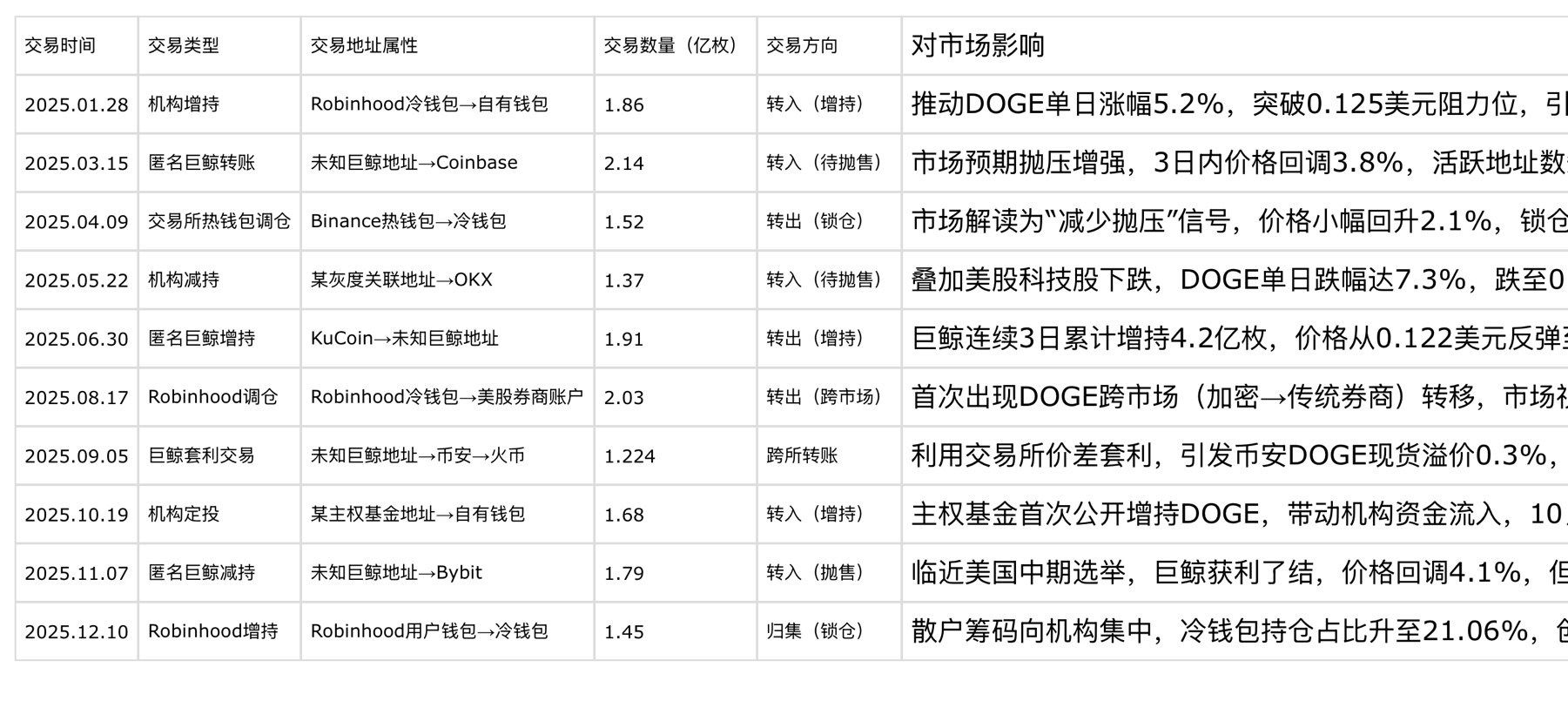
1. Total Supply Mechanism: Liquidity Balance Under Unlimited Inflation
1. Core Design of Unlimited Supply
In stark contrast to Bitcoin's deflationary model with a fixed total supply of 21 million coins, Dogecoin adopts a perpetual issuance model with unlimited supply, lacking a theoretical cap on issuance. This design is rooted in its positioning as a 'currency for everyday use' rather than a store of value, aiming to ensure network liquidity through the continuous addition of tokens, thereby avoiding the issue of excessively high thresholds for payment scenarios due to scarcity.
2. Issuance rhythm and current circulation status
Dogecoin's issuance mechanism is directly linked to mining rewards: A block is produced every minute, with a reward of 10,000 DOGE per block, resulting in an annual new supply of about 520 million. By the end of 2025, on-chain data shows that its total circulation has exceeded 152 billion, growing about 3.3% compared to the beginning of the year—despite the absolute value of issuance remaining stable, as the circulation base expands, the dilution effect of new tokens on the total supply is gradually weakening.
It is worth noting that this inflation model has been recognized by key supporters like Musk, who believe its "stable inflation characteristics" are a unique advantage that distinguishes Dogecoin from mainstream cryptocurrencies, enabling its continued application in retail payments and social tipping.
2. Token Distribution: A Dual Character of Centralization and Retail Popularity
1. Whale-dominated chip structure
Despite achieving decentralized transactions through blockchain technology, Dogecoin's holding distribution exhibits significant characteristics of large holders clustering:
• Single institutions have a prominent share of holdings: Robinhood's cold wallet, as the largest holding address, controls about 21.06% of total circulation, far exceeding the scale of ordinary addresses;
• Top addresses have extremely strong control: The top 10 holding addresses collectively hold over 60% of DOGE, while the top 115 holders account for as much as 65.4%, meaning that the trading behavior of a few whales is sufficient to influence the market supply and demand pattern.
• The trend of large whales increasing their holdings is evident: Since 2025, addresses holding 100 million to 1 billion DOGE have cumulatively increased their holdings by over 2 billion, with total holdings surpassing 27 billion, reflecting the continued optimism of institutions and high-net-worth investors.
2. The breadth of retail participation
In contrast to the centralized chip structure, Dogecoin's retail popularity ranks among the top in cryptocurrencies:
• The number of holding addresses continues to expand, exceeding 5.2 million by mid-2025, with small addresses holding fewer than 10,000 DOGE accounting for over 80%;
• Community application scenarios are active, with daily DOGE tipping transactions on Reddit and Twitter reaching 230,000, and the tipping scenario accounting for over 35%, confirming its positioning as a "social currency";
• The number of active addresses performed remarkably, reaching a peak of 71,589 in December 2025, a new high since September, indicating that despite price fluctuations, the actual trading activity on the network continues to increase.
3. Market Impacts and Risks Associated with Mechanisms and Distribution
1. Volatility risks caused by centralization
The high concentration of the chip structure exposes Dogecoin to significant "whale effect" risks: Large transfers, liquidations, or increases by a single whale can trigger severe short-term price fluctuations. For example, in September 2025, a whale withdrew 122.4 million DOGE (worth about $28.5 million) from Binance, directly pushing its price up nearly 8% within three days; when a whale concentrated its sell-off near the $0.14 resistance level, even though the number of active addresses surged, the price still struggled to break through the critical range.
2. Value game of the inflation model
The perpetual inflation brought by unlimited issuance forms the core game point of Dogecoin's value:
• On the positive side: Stable issuance guarantees miners' income, maintains network security and hash rate stability, while its low price characteristic lowers the threshold for retail participation, supporting its popularity in payment and tipping scenarios;
• On the risk side: If demand growth does not keep pace with supply expansion, it will exert long-term devaluation pressure on the coin price. Especially against the backdrop of numerous celebrity MEME coins being issued in 2025, Dogecoin faces challenges of liquidity diversion, further amplifying the value dilution risk brought by inflation.
3. Divergence between fundamentals and technicals
Since 2025, Dogecoin has shown a unique divergence of "bullish fundamentals and weak technicals": On one hand, whales continue to increase their holdings, institutional funds have flowed in 480 million, and the number of active addresses has surged significantly; on the other hand, the price has long oscillated in the range of $0.13 to $0.14, with multiple attempts to break the $0.1409 resistance level failing. This phenomenon is related to the market liquidity shortage caused by whale holdings and reflects investors' cautious attitudes towards the inflation model and centralization risks.
Overall, Dogecoin's total supply mechanism and token distribution are the result of the interplay between its MEME attributes and market laws. Unlimited inflation and a whale-dominated structure determine its high volatility characteristics, while a large retail base and continuous application scenarios provide it with long-term viability. For investors, it is necessary to pay attention to whale movements, inflation dilution effects, and changes in market liquidity to gain a more comprehensive understanding of its investment logic#Dogecoin $DOGE


