

@KITE AI For most teams building intelligent software, the hardest part is no longer the model. It’s everything around it. Orchestration, payments, identity, state, trust, and the endless glue code that turns a promising prototype into something users can actually rely on. That gap between idea and production is where time disappears and momentum dies. Agentic systems make the problem sharper. Once software can decide and act on its own, the underlying systems have to be solid, transparent, and safe out of the box.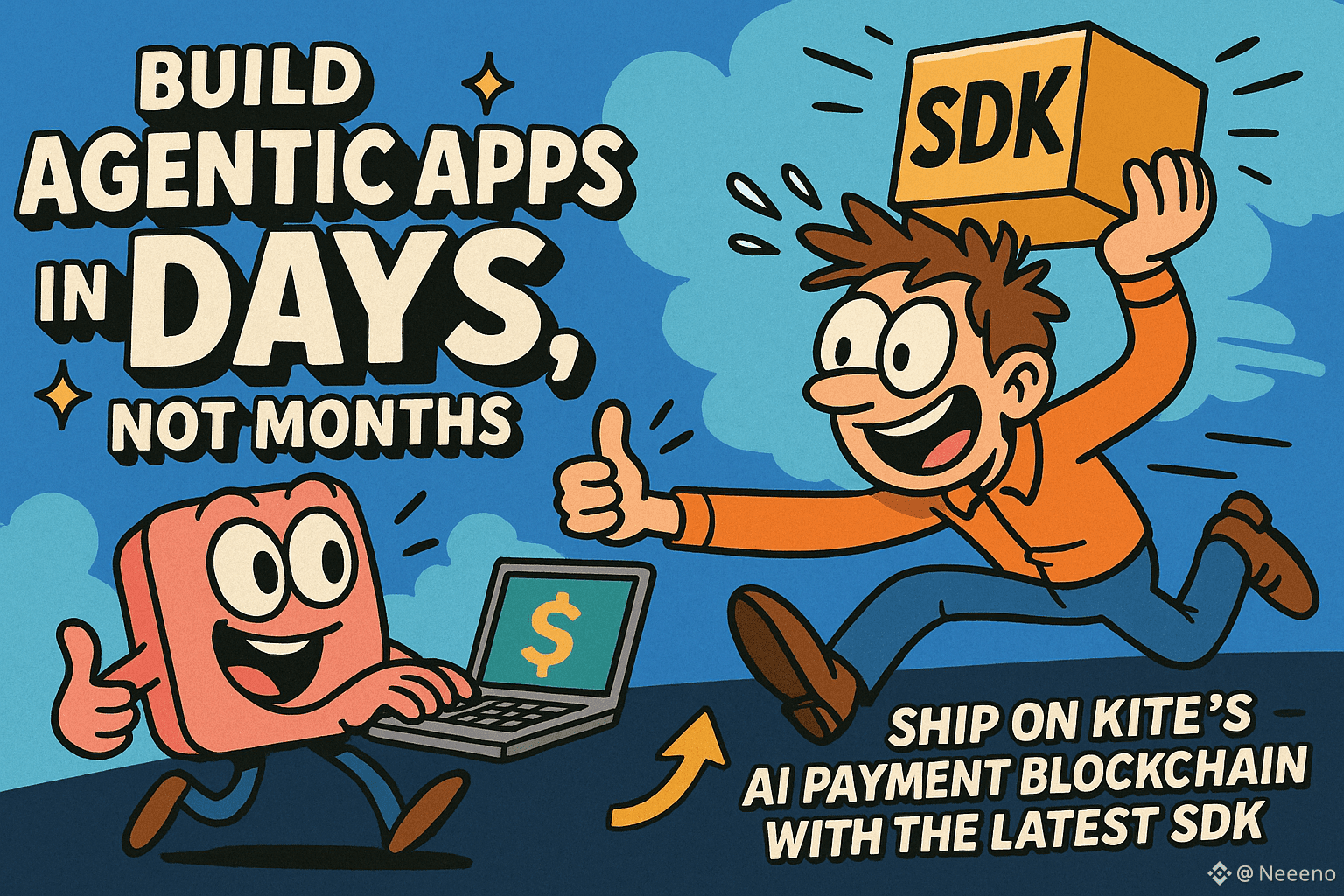
That’s when building agentic apps in days stops being a dream and starts being doable.Not because development suddenly got easier, but because the stack beneath it finally matches the complexity of what’s being built. @KITE AI Payment Blockchain, paired with its latest SDK, sits squarely in that shift. It treats payments, execution, and intelligence as parts of the same system, rather than separate concerns duct-taped together at the end.
Traditional payment rails were never designed for autonomous software. They assume a human is always in the loop, clicking a button or approving a transaction. Agentic applications break that assumption immediately. An agent might negotiate pricing, allocate resources, trigger services, or compensate other agents in real time. If every action requires a manual workaround or custom payment logic, the architecture collapses under its own weight. Kite’s approach starts from the opposite direction. It assumes software will act independently and builds payment logic that is programmable, verifiable, and native to that behavior.
The SDK reflects that mindset. Instead of forcing developers to think in terms of separate wallets, APIs, and settlement layers, it exposes primitives that feel closer to how agentic systems actually operate. An agent can initiate a payment as part of its reasoning flow, with clear constraints around limits, permissions, and outcomes. Transactions become events the system can reason about, not side effects buried in backend services. This matters because it changes how applications are designed from the first line of code.
Speed comes from that coherence. When payments, identity, and execution live in the same environment, developers spend less time stitching systems together and more time shaping behavior. An agent that books compute, pays for data access, and compensates another service does not need a separate financial subsystem bolted on later. It’s already part of the logic. That’s how days replace months, not through shortcuts, but through alignment.
There’s also a quieter benefit that shows up once systems scale. Autonomous software needs accountability. When something goes wrong, you need to know why an agent acted, what it spent, and under what authority. Kite’s blockchain layer provides a shared, immutable record of those actions without forcing developers to become blockchain experts. From the application’s perspective, it feels like a reliable execution log with financial guarantees. Under the hood, it’s doing the harder work of settlement, verification, and trust.
The latest SDK leans into this by reducing friction at the boundaries. Integration feels closer to working with a modern cloud service than navigating a crypto-native environment. That’s intentional. The goal isn’t to pull developers into a new paradigm for its own sake, but to remove barriers that slow real-world deployment. Agentic apps already introduce enough complexity. The tooling shouldn’t add more.
What’s interesting is how this changes product thinking. When payments are programmable and cheap to execute, new behaviors become viable. Agents can make micro-decisions that would never justify a traditional transaction fee. They can collaborate economically, paying each other for tasks completed or resources shared. Entire workflows that once required centralized control can emerge organically through incentives encoded in software. This isn’t speculative. It’s a direct consequence of reducing the cost and friction of autonomous value exchange.
There’s still discipline required. Agentic systems amplify mistakes as easily as they amplify efficiency. The difference is that with infrastructure like Kite’s, those risks are visible and bounded. Developers can define rules, caps, and permissions that agents cannot exceed, even when acting independently. That balance between autonomy and control is where serious applications live.
What ultimately stands out is how unremarkable the experience aims to be. Not flashy, not loud, just solid. You write code, agents act, payments settle, and the system keeps moving. That’s the kind of progress that rarely gets celebrated but quietly changes what’s possible. When building intelligent software stops feeling like an experiment and starts feeling like engineering again, teams move faster without cutting corners.
Agentic applications are not coming someday. They’re already here, struggling against infrastructure that wasn’t built for them. Tools like Kite’s AI Payment Blockchain and its SDK don’t promise magic. They promise fewer obstacles. And in practice, that’s what turns ambitious ideas into systems that ship, iterate, and survive contact with the real world.



