

Interoperability has been one of those ideas in crypto that everyone agrees with in theory and struggles with in practice. For years, we’ve talked about assets moving freely across chains, liquidity flowing without friction, and users barely noticing which network they’re on. In reality, we’ve lived with bridges that feel risky, fragmented liquidity, and a constant tradeoff between convenience and safety. That’s why the recent push around @Lorenzo Protocol assets moving fluidly across chains feels different not revolutionary, but quietly important.
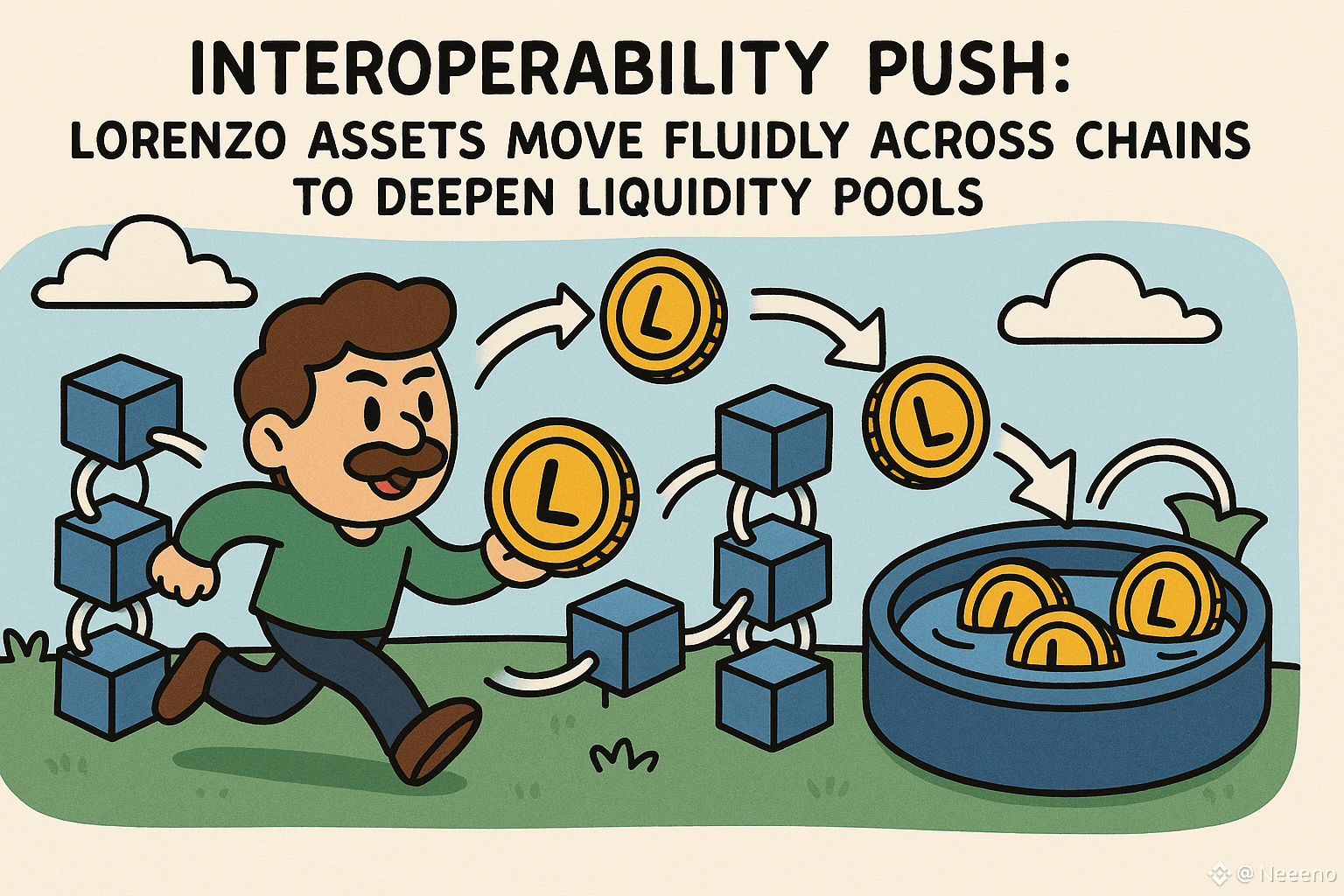
What’s driving the renewed attention now is less about bold promises and more about timing. The ecosystem has grown. Big players are involved, users are more careful, and systems need to be reliable. Interoperability isn’t a bonus anymore—it’s required In that environment, interoperability isn’t a nice-to-have feature anymore. It’s infrastructure. If assets like those issued or managed through Lorenzo can move across chains without breaking composability or trust assumptions, it changes how liquidity behaves at a foundational level.
Liquidity fragmentation has been one of the most persistent problems I’ve seen up close. I’ve personally watched decent products struggle simply because their liquidity was stranded on the “wrong” chain at the wrong time. Traders don’t care about chain loyalty; they care about depth, price stability, and execution. When liquidity is split across ecosystems, everyone pays the cost through slippage and inefficiency. Lorenzo’s approach—designed to let assets exist and function across multiple chains—targets that problem directly. The goal isn’t to force users to migrate, but to let liquidity meet demand wherever it shows up.
The key difference is the thinking behind it. Earlier efforts focused on one chain, with interoperability added later as a quick fix. That mindset led to fragile bridges and clunky user experiences. The newer wave, Lorenzo included, treats multi-chain reality as the default state. Assets are designed from the start to be portable, verifiable, and usable across environments. That design choice matters more than any individual feature.
Another reason this topic is trending now is the changing risk tolerance across the space. After several high-profile bridge failures, users are understandably skeptical. There’s a quiet demand for systems that minimize trust assumptions and reduce attack surfaces. Lorenzo’s interoperability push isn’t framed as a shortcut; it’s framed as careful plumbing. That might sound boring, but boring infrastructure is often what survives. When liquidity pools deepen because assets can move safely and predictably, confidence grows slowly but steadily.
There’s also an economic angle that doesn’t get enough attention. Deep liquidity pools don’t just benefit traders. They stabilize protocols, reduce volatility, and make long-term participation more attractive. When Lorenzo assets can contribute to liquidity on multiple chains, they’re not just increasing volume; they’re smoothing out imbalances between ecosystems. Over time, this can prevent one chain from dominating and help competition stay fair. For developers, interoperability opens up new ways to build. Builders no longer have to choose a single chain and accept its limitations. They can design applications that assume assets will arrive from elsewhere and leave just as easily. Flexibility makes experimentation easier. When developers have more freedom, ideas improve.Interoperable assets connect ecosystems across chains. The work isn’t finished, and cross-chain systems are riskier because they’re more complex. Managing upgrades and governance can be hard. The real test for Lorenzo’s interoperability push won’t be in launch announcements or early metrics, but in how it behaves six months or a year down the line. Does liquidity stay sticky during market stress? Do users trust the system enough to leave assets deployed across chains without constantly monitoring them? Those are the quiet indicators that matter.
What I find encouraging is the tone of the conversation around this effort. It’s less about disruption and more about alignment. Instead of positioning one chain against another, the focus is on letting each do what it does best while sharing value. That’s a healthier way forward for an industry built on rivalry. Good interoperability keeps differences and makes them valuable. Meanwhile, users are getting more experienced. They’re asking better questions about how assets move, who controls the mechanisms, and what happens when something goes wrong. Lorenzo’s work sits right in the middle of that scrutiny. Transparency and restraint will matter just as much as technical execution. In my experience, trust is built less by bold claims and more by consistent, uneventful operation.
In the end, the significance of Lorenzo assets moving fluidly across chains isn’t about any single feature or protocol. It’s about momentum toward a more connected financial layer where liquidity isn’t trapped by design choices made years ago. If this approach continues to mature, we may look back and realize that the most important progress wasn’t flashy at all. It was the moment when assets stopped caring where they lived, and liquidity finally started behaving like liquidity should.
@Lorenzo Protocol #lorenzoprotocol $BANK



