

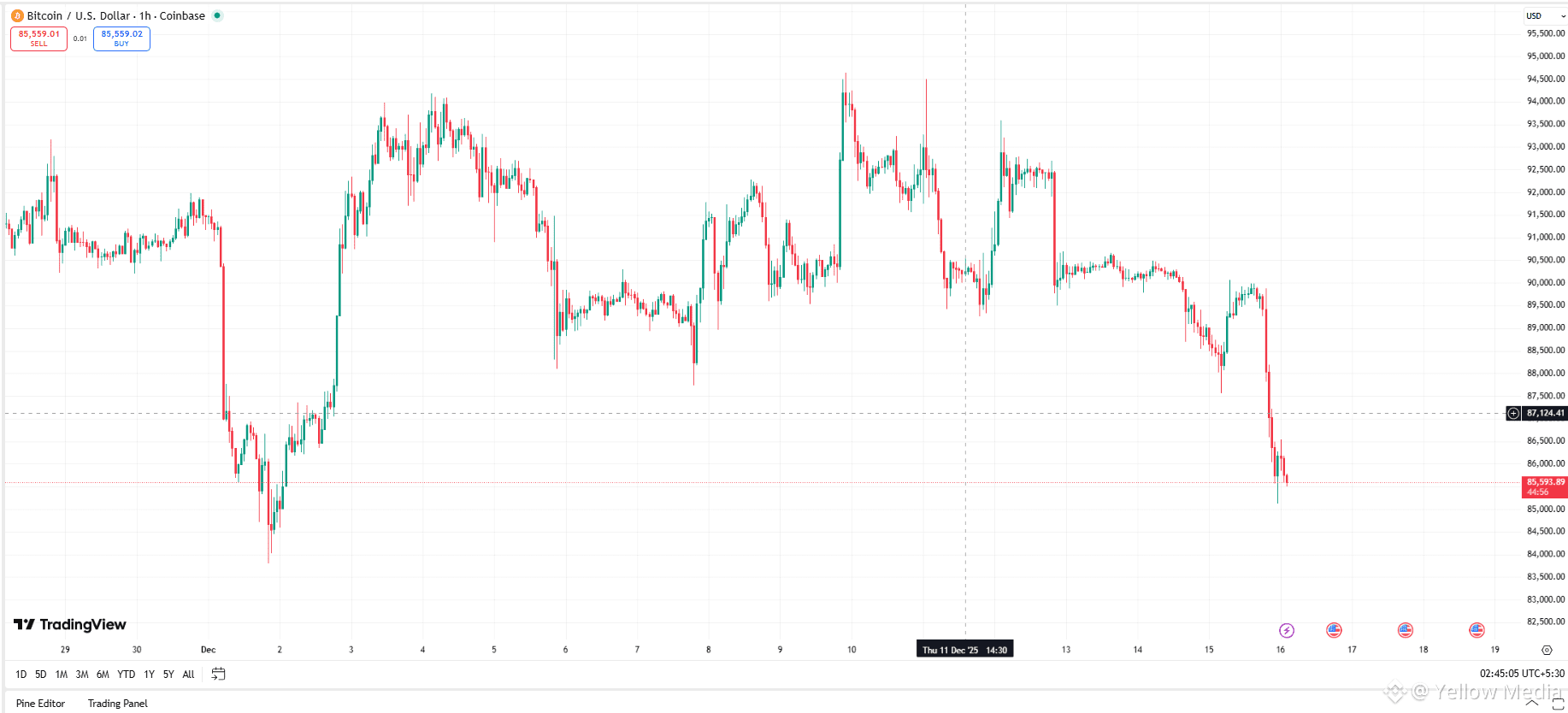
Even as Bitcoin (BTC) tumbled near the $85,000 mark on Monday, the underlying market conditions are deteriorating as short-term traders and speculative capital exert increasing influence over price behavior, according to a new analysis.
A Glassnode report on Monday stated that the market has shifted into a structurally fragile phase where liquidity is thinning, long-term demand is weakening, and volatility is being consistently underpriced.
What Happened
Bitcoin is trading down over 3% on Monday evening Eastern time, while other majors like Ethereum (ETH), BNB, XRP and Solana (SOL) are trading down 5%, 4%, 5% and 3.5% respectively.
One of the clearest signals comes from the distribution of supply between long-term and short-term holders.
The short-term holder (STH) share of supply has surged beyond its upper statistical band, meaning reactive market participants now command a disproportionately large portion of circulating coins.
At the same time, Glassnode’s Hot Capital Share, which measures the volume of capital that has recently entered Bitcoin and is likely to be price-sensitive, has climbed to 40.3%, also above its upper threshold.
Together, these metrics suggest the market is increasingly driven by fast-moving capital rather than long-term conviction.
Liquidity conditions paint a similar picture.
Spot trade volumes have fallen toward the lower end of their historical range, and cumulative volume delta (CVD) readings show persistent negative pressure from sellers.
Also Read: What Happens If Quantum Computers Target Satoshi’s Wallet? Experts Say Bitcoin Has Time, But Not Forever
With fewer buyers absorbing supply, price movements become more vulnerable to abrupt shifts in sentiment.
The demand side is weakening as well. Realized Cap Change, a proxy for the rate at which new, committed capital enters Bitcoin, has fallen to just 0.4 percent, dipping below its lower band.
This indicates a slowdown in long-term accumulation, reducing the stabilizing force that typically offsets short-term speculation.
Why It Matters
Despite these risks, volatility metrics show that markets may be complacent.
Glassnode’s volatility spread remains deeply negative, signaling that options traders are pricing in unusually low realized volatility relative to historical norms.
When paired with concentrated short-term ownership and softening inflows, this creates conditions for sharper, more disorderly moves if sentiment turns.
Glassnode’s data suggests that Bitcoin’s apparent calm masks a market structure leaning heavily on its most fragile participants.
Until long-term inflows re-accelerate or speculative dominance recedes, the report warns that BTC is likely to remain susceptible to sudden volatility spikes and deeper drawdowns. Read Next: BOJ To Start ETF Sales Next Month In Unwinding Plan That Could Take 100 Years



