

Magma treats liquid staking as an active financial primitive rather than a passive yield tool, redesigning staking to match the speed and capital dynamics of high performance blockchains like Monad.
By integrating MEV capture directly into staking returns, Magma shifts yield from inflation driven rewards toward value that reflects real network activity and usage intensity.
Through distributed validator technology and future restaking integrations, Magma positions staking as a multi layer source of economic security and yield rather than a single chain mechanism.

WHY LIQUID STAKING STOPPED BEING A SOLVED PROBLEM
For much of crypto’s history, liquid staking was treated as finished infrastructure. The model was straightforward and rarely questioned. Users locked native assets, received a liquid token in return, and earned predictable yield while retaining some flexibility. This structure proved itself on Ethereum and was replicated across nearly every proof of stake network that followed.
Over time, liquid staking faded into the background. It became dependable but unremarkable. A neutral layer that supported the ecosystem without shaping it. That stability rested on a critical assumption. Blockchains were slow.

When block times are long and execution is sequential, staking works as a passive system. Capital can sit idle for days or weeks without meaningful opportunity cost. Yield is driven mainly by inflation. MEV exists but plays a secondary role. In that environment, liquid staking only needs to restore liquidity. It does not need to rethink how value is created or distributed.
That assumption no longer holds.
Monad represents a structural break. With parallel execution, one second block times, and single slot finality, it compresses financial time on chain. Capital moves faster. Strategies recycle more frequently. Liquidity rotates within hours rather than days. In such conditions, staking stops being neutral. Locking capital becomes expensive. Passive yield turns into a constraint rather than a feature.
Magma emerges from this shift. It does not attempt to replicate Ethereum era liquid staking on a faster chain. Instead, it starts from a different premise. If blockchains enter a high performance phase, staking itself must be redesigned.
WHEN BLOCKCHAINS GET FASTER STAKING BREAKS
High performance blockchains change user behavior at a fundamental level. Short unbonding periods reduce tolerance for idle assets. Faster execution increases capital velocity. DeFi becomes continuous rather than episodic. Under these conditions, staking systems built for slower networks begin to show strain.
On Monad, the cost of immobilized capital rises sharply. Assets locked for yield compete directly with assets deployed in fast moving strategies. The tradeoff between safety and flexibility becomes harder to justify. Liquid staking can no longer be treated as a wrapper around base staking. It must become a financial primitive that fits the tempo of the network.
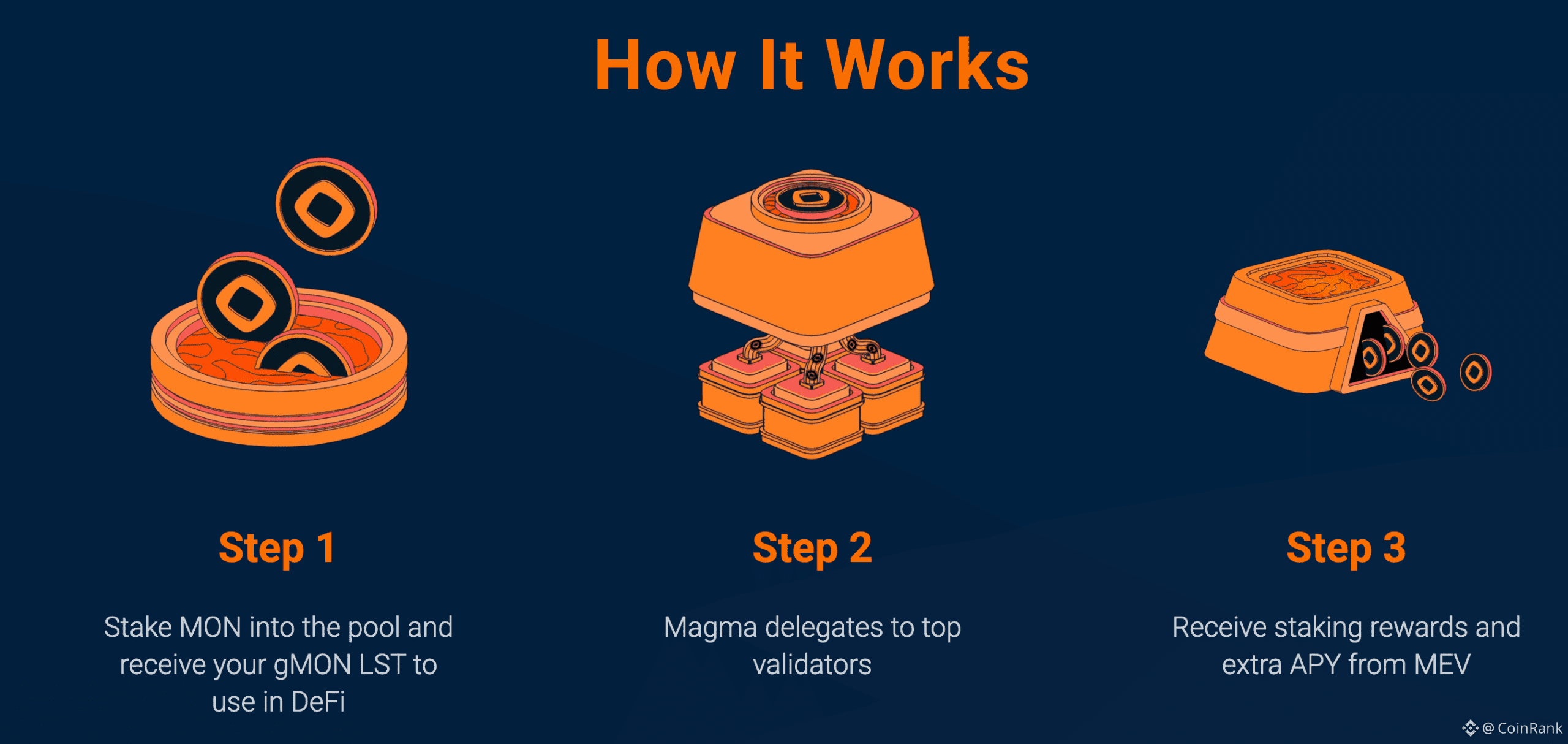
Magma’s design reflects this reality. Its liquid staking token gMON follows a value accruing model rather than a rebasing one. Balances remain stable while value accumulates through exchange rate appreciation. This choice is not cosmetic. In high frequency environments, rebasing tokens introduce friction across automated market makers, lending protocols, and derivative systems. Value accruing tokens behave like standard assets, allowing them to integrate cleanly across DeFi.
This makes gMON usable not only as a yield instrument, but as active collateral. It can be traded, borrowed against, or deployed in strategies without constant accounting adjustments. In a network designed for speed, composability becomes non negotiable.
FROM PASSIVE YIELD TO MEV DRIVEN VALUE CAPTURE
In most proof of stake networks, MEV is tolerated rather than embraced. It exists as a side effect of transaction ordering and is captured by specialized actors. For typical stakers, MEV plays a minimal role in expected returns. Inflation remains the dominant yield source.
Monad changes this dynamic. High throughput produces persistent arbitrage, liquidation, and ordering opportunities across a wide range of assets. MEV becomes continuous. It stops being a marginal phenomenon and starts to resemble a core economic layer.
Magma treats this shift seriously. Rather than allowing MEV to remain isolated at the validator level, it builds infrastructure to capture and redistribute it. Through its block engine and searcher interfaces, Magma turns block space into an auctioned resource. Transaction ordering value flows back into the staking pool instead of remaining fragmented.
This approach reframes staking itself. Yield becomes responsive to real network activity rather than static protocol parameters. When Monad is busy, staking earns more. When activity slows, returns adjust naturally. Staking begins to reflect the economic life of the chain.
The implication is subtle but important. Stakers are no longer passive participants securing the network in exchange for inflation. They become indirect beneficiaries of the value created by the network’s usage.
SECURITY AND DECENTRALIZATION UNDER HIGH THROUGHPUT CONDITIONS
Performance introduces tradeoffs. Higher throughput increases hardware and operational requirements for validators. Over time, this pressure favors professional operators and large institutions. Without intervention, validator sets tend to concentrate.
For a liquid staking protocol, this trend creates systemic risk. Centralized validator infrastructure undermines the security assumptions that staking is meant to provide and concentrates failure modes.
Magma addresses this challenge through distributed validator technology. By working with Obol, validator responsibilities can be shared across multiple operators. No single node holds full signing authority. Fault tolerance improves. Slashing risk decreases. Participation widens beyond a narrow set of infrastructure providers.
This design aligns staking with the realities of high performance networks. Stability does not require exclusivity. It requires coordination. By separating security from single operator control, Magma aims to scale without sacrificing decentralization.
STAKING AS A MULTI LAYER FINANCIAL PRIMITIVE
Magma’s vision does not stop at optimizing staking within Monad. Through its planned integration with Ether.fi, gMON is positioned as a future restaking asset. This extends staking beyond a single network and opens the door to additional yield layers tied to external security services.
In this model, staking becomes modular. Base rewards come from network inflation. Additional yield comes from MEV. Further layers emerge from providing economic security to other protocols. Yield is no longer defined by a single rate. It becomes a stack.
This shift reflects a broader evolution in crypto infrastructure. As networks mature, economic security itself becomes a service. Assets that can provide it efficiently gain strategic value. Magma positions gMON within this trajectory.
The risks remain real. MEV infrastructure must operate reliably. Liquidity must hold during market stress. Restaking integrations must move beyond concept into production. These variables will determine whether Magma fulfills its thesis.
Yet the strategic direction is clear. If Ethereum era liquid staking solved the problem of locked capital, high performance era staking must solve a different one. It must remain relevant in a world where time compresses, capital rotates rapidly, and passive systems fall behind.
Magma is not optimizing staking for yesterday’s chains. It is testing what staking becomes when blockchains finally operate at speed.
〈How Magma Is Redefining Staking for the High Performance Blockchain Era〉這篇文章最早發佈於《CoinRank》。


