
Recent months have revealed a clear divide within the cryptocurrency market. As prices have declined, investor behavior has shifted towards caution, favoring assets that offer liquidity and familiarity at the expense of higher-risk narratives.
Despite its pullback from the peak, Bitcoin remains the primary destination for capital during this phase.
Key points
* Capital is concentrating in Bitcoin as investors reduce risk across the cryptocurrency market.
* The performance of most altcoin sectors has been worse than Bitcoin during the recent downturn.
* Bitcoin's relative strength reflects stability and liquidity rather than renewed bullish momentum.
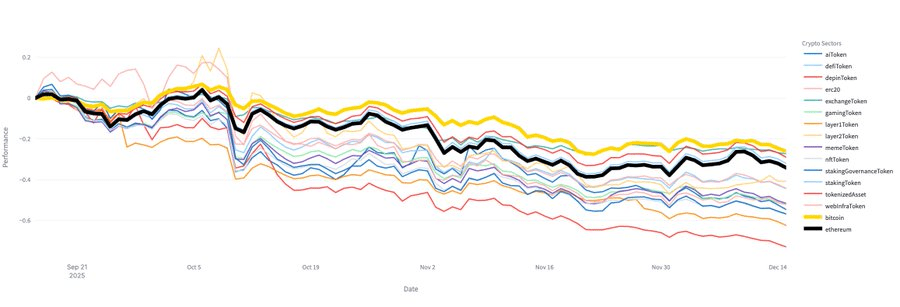
On-chain data shows that Bitcoin has outperformed most cryptocurrency sectors on a relative basis over the past three months. According to 'Glassnode', average returns across almost all categories have lagged behind Bitcoin, suggesting that capital is not rotating (not shifting between assets) but contracting and moving towards concentration.
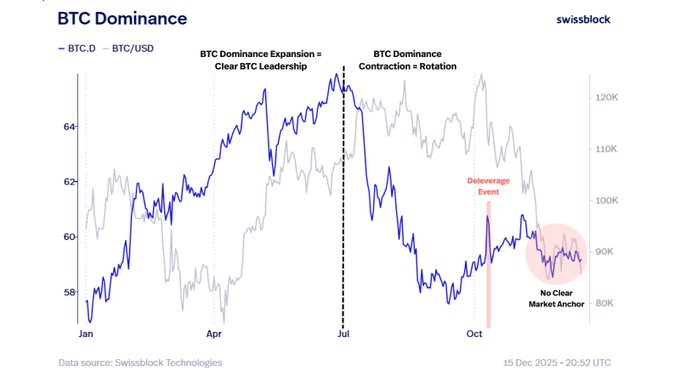
Rather than spreading out into altcoins, it seems investors are reducing their exposure and consolidating their positions around Bitcoin. This behavior reflects a market prioritizing capital preservation while awaiting clearer directional signals.
Rotation attempts are losing momentum
Some market observers noted that Bitcoin's dominance has weakened in the second half of the year, opening the door for Ethereum and other sectors to regain leadership. Despite attempts at short rotations, they have failed to gain momentum.
Every recovery attempt following the deleveraging events faded quickly, indicating a lack of conviction. The result is a market lacking a strong secondary leader, with Bitcoin remaining the anchor by default, not solely due to strength.
Altcoin sectors are bearing the brunt of the downturn
The divergence becomes more apparent when examining sector performance. Ethereum has experienced a deeper decline than Bitcoin, while higher-risk categories (high-beta) such as AI tokens, meme coins, real-world asset (RWA) projects, and decentralized finance (DeFi) have seen much sharper declines.
These losses indicate that exposure to speculation has been unwound more aggressively than core positions. As risk appetite shrinks, complexity and leverage are being priced out of the market faster than liquidity and volume.
Bitcoin's role is shifting towards stability
Analysts say this pattern aligns with Bitcoin's behavior during uncertain market conditions. When confidence wanes, capital tends to gravitate towards the most established asset in the space.
In the current environment, Bitcoin's relative strength reflects its role as a stability alternative rather than a growth driver. Until overall sentiment improves or new catalysts emerge, Bitcoin's ability to retain capital may remain the defining characteristic of the market.
