You know, when you look at the price $KITE of 0.0858 dollars and see a decrease of 3.05% for the day, at first it seems like just a regular correction after a rise. But when you start to understand what @GoKiteA is really building, you realize we are on the brink of something fundamentally new. Not just another blockchain project, but an infrastructure that could rewrite the rules of the game between people and machines.
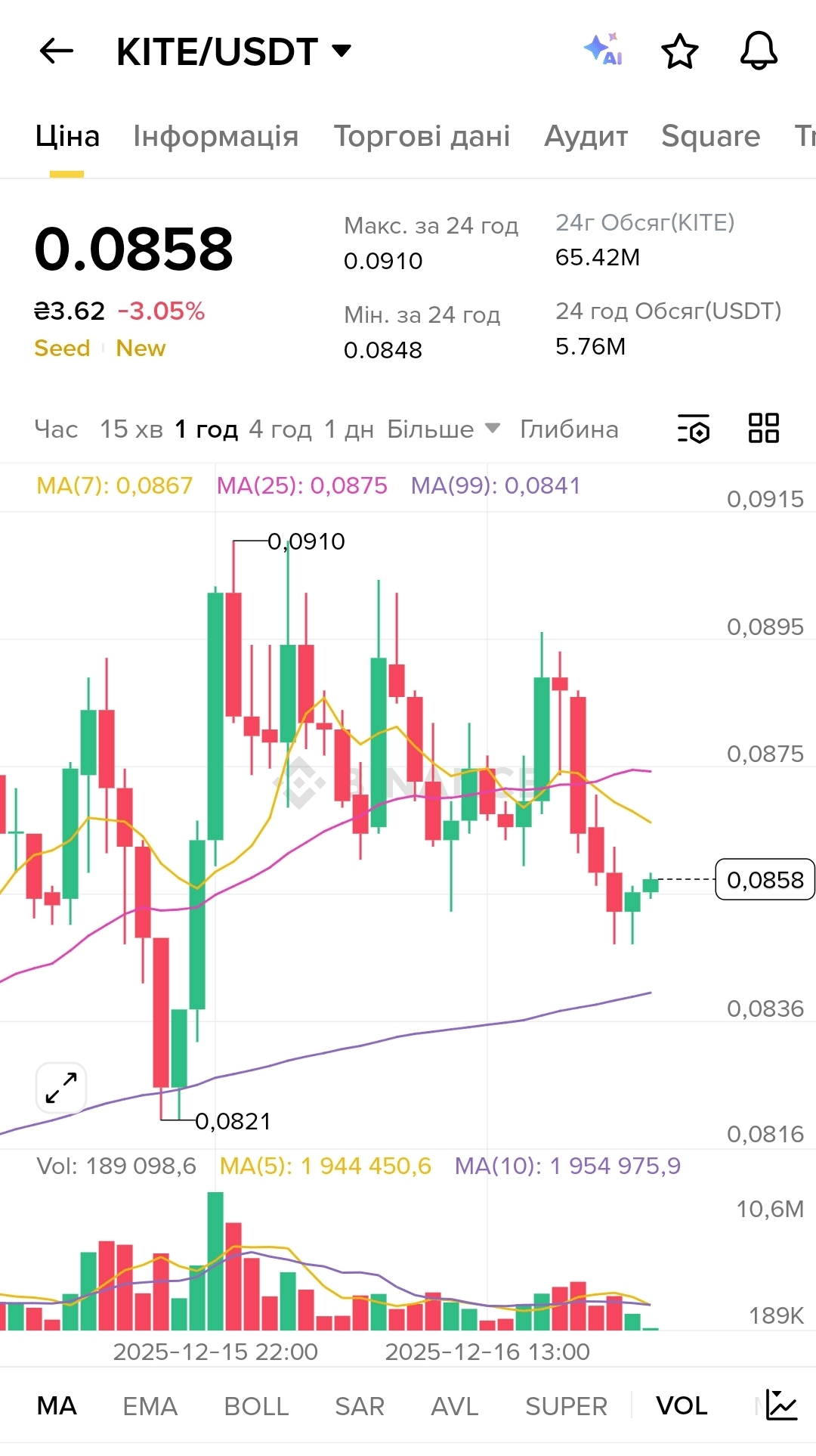
I sit down to analyze the chart on an hourly timeframe and see the history of the last days. The maximum for the day was 0.0910 – that was the moment when everyone began to realize what was happening. The minimum was 0.0848 – a typical moment of profit-taking after rapid growth. The moving averages tell their own truth: the seven-day at 0.0867, the twenty-five-day at 0.0875, the ninety-nine-day at 0.0841. An interesting arrangement – the short-term is below the medium-term, but both are above the long-term. We are in the process of forming a new support level after impulsive growth.
But technical analysis is just the surface. The real story begins when you understand what makes #KITE unique. Imagine a world five years from now. Billions of AI agents performing tasks autonomously – booking travel, making deals, ordering goods, exchanging data, paying for services. But how do they do it? Who verifies their identity? How do they manage budgets? How to prevent abuses? It is these questions that the project from @GoKiteA addresses.
I look at the trading volumes – 65.42 million tokens per day paired with the token itself, 5.76 million dollars paired with stablecoins. The five-day moving average of volumes is almost 2 billion tokens, the ten-day is about the same level. Stable volumes after launch are a good sign. It means the project has found its initial audience and is now building a foundation rather than just hyping on news.
What really impressed me when I started digging deeper is the Kite AIR system. The agent passport is not just pretty words. It's a three-layer system of cryptographic identification, where each participant – user, agent, session – has a separate identity. Imagine a chain of trust: I create an agent, the agent gets its passport, it starts a session for a specific task, and all actions can be traced back to the source. It's like having cameras at every step, but instead of video – cryptographic signatures that cannot be forged.
When they received 18 million dollars in September from PayPal Ventures and General Catalyst, I didn't pay much attention. I thought – well, another investment round. But then in October, money came from Coinbase Ventures. And that's when I realized the scale. When two giants of the payment industry invest in one project one after another, they see a future that is not yet obvious to most. Total funding of 33 million dollars is serious capital for building infrastructure.
The chart shows an interesting dynamic of candles. Large green candles in the left and central parts were breakout moments when news about partnerships and investments reached traders. Red candles after each rise are a natural correction. But pay attention to the volumes during the rise versus the volumes during the falls. Green candles with high volume, red ones with lower. A classic picture of healthy growth, where buyers are stronger than sellers.
Integration with the x402 protocol from Coinbase is where the magic begins. This is not just a technical standard; it is an attempt to create a universal language for agent payments. Kite has become one of the first layer one blockchains to fully implement this standard at the chain level. What does this mean practically? An agent can send an intention – "buy me a train ticket for tomorrow at eight in the morning" – and the blockchain will automatically decode this intention, find the required service, make the payment, and receive confirmation. All without human involvement.
I look at the purple line of the long-term moving average on the chart – it is rising with a slope that seems small, but it is a trend. From the lows around 0.082, we are slowly moving higher. This is not a rocket that will take off tenfold in a week; this is foundational building that takes months but then lasts for years.
What truly distinguishes the project is the team. Director Chi Zhang has a PhD in artificial intelligence from the University of California, Berkeley, and has led key products at Databricks. CTO Scott Shi built real-time infrastructure at Uber and was one of the first AI engineers at Einstein in Salesforce. The team has over 30 patents and publications at top conferences. These are not random people from a startup; they are researchers and engineers who understand the problem at the deepest technical level.
The volumes on the chart below show waves of activity. The yellow and purple moving averages of volume move in sync, without sharp deviations. This is stability. There are no moments of panic when volumes shoot up by dozens of times – a sign of manipulation or pump-and-dump schemes. Here, there is pure organic growth of interest.
The agent application store – the second component of the AIR system – is a marketplace where agents can find services and pay for them. There are already live integrations with Shopify and PayPal. Any merchant on these platforms can connect through the Kite store and become visible to agents for purchases. Purchases are made on-chain with full transparency, using stablecoins and programmable permissions. Imagine an agent who gets a budget of 100 dollars per month for office supplies, and it finds the best prices, orders, pays, all automatically.
The current price of 0.0858 is between the seven-day and twenty-five-day moving averages. This is a battleground. If we break through 0.088-0.090 with good volume of over 100 million tokens per hour, the path opens for testing the psychological level of 0.095-0.100. But if we can't hold above 0.085, a pullback to 0.082-0.083 is possible, where strong support from the long-term moving average is located.
Programmable management is the third superpower of agents on Kite. I can create an agent and set rules for it: a maximum of 50 dollars per transaction, no more than 10 transactions per day, can only buy from verified merchants, must obtain my consent for purchases above 20 dollars. These are not just limits, this is a full policy, coded into smart contracts. The agent operates autonomously, but within the boundaries I defined.
Tokenomics shows that this is a project with long-term thinking. The token has utility in the ecosystem – payment for agent transactions, staking for data validation, protocol governance. This is not just a speculative coin; there are fundamental reasons to hold it. The more agents use the network, the greater the demand for the token to pay for gas and services.
I look at the candlestick pattern of the last hours – a series of small candles with small shadows. This is consolidation; the market is looking for direction. Buyers and sellers are in balance. Such periods often precede large movements when one side gains prevailing strength.
Integration with over 100 partners from web2 and web3 demonstrates the scale of ambitions. This is not just a blockchain project living in its bubble. They are building bridges to the real world – traditional finance, e-commerce, payment systems. When PayPal is natively integrated, it means that millions of merchants are potentially available to agents.
Forecast for the next month? Technically, I see two scenarios. The first – continuation of consolidation in the range of 0.083-0.092 until the market gets a new catalyst. This could be an announcement of a new major partnership, the launch of the main network, a listing on a top exchange. The second scenario – a breakout above 0.092 on good news and movement to 0.110-0.120 during December. Personally, I lean towards the first scenario – the market is digesting previous gains, accumulating strength.
In the medium term, the picture depends on execution. If the @GoKiteA team delivers the launch of the main network, shows real use cases for agents in commerce, expands integrations – the token could reach 0.15-0.18. This is a growth of 75-110% from current levels. For a project of this scale and with such funding, this is realistic.
Long-term, the bet on $KITE is a bet on the agent economy. Analysts predict 30 trillion dollars in transactions by autonomous agents by 2030. That's five years from now. If Kite captures even 1% of this market, we're talking about 300 billion dollars in transaction volume. Given the tokenomics of the protocol serving such volumes, today's valuation looks like a joke.
But let's be honest about the risks. First, competition. Other protocols are also seeing this opportunity. Whoever builds better infrastructure, attracts more developers, and gets more integrations – will win. Second, technical risks. This is a new technology; vulnerabilities, bugs, and scalability issues are possible. Third, regulatory questions. Autonomous agents conducting financial transactions without human involvement is new territory for regulators. How they will react is still unclear.
Trading volumes are stable, without sharp spikes or crashes – this is a sign of project maturity even at an early stage. I see a base of investors forming who understand the long-term perspective and do not panic at every correction.
The separation of authentication and payment systems is another technical detail that matters. Traditional systems mix these functions, creating problems for micropayments. Kite separates them, allowing agents to handle micropayments and subscriptions without embedding transaction data into tokens. This opens the possibility for streaming payments and automated processes at a new level.
Support for standards like AP2 from Google and ERC-8004 strengthens the position as a universal platform. This is not a closed garden, but an open infrastructure that can work with different agent standards. The more standards supported, the more developers and projects can integrate.
I look at how the price is bouncing off the level of 0.085 – that's where the support zone lies, which the market has tested several times in recent hours. Each time, buyers emerged. This is a psychological barrier, below which they do not want to let it drop in the short term.
The ecosystem of protocol x402 is growing rapidly. Developers are creating tokens and memecoins directly on the protocol. CoinGecko has already allocated a separate category for tokens of x402 with a total capitalization of about 180 million. This indicates that real activity is forming around the standard, rather than just a technical specification on paper.
Projects like PING – an agent for monitoring tokens – show that the infrastructure is already being used for real cases. Tools like x402scan and servdev make development easier. The more tools there are, the easier it is for developers to build on the platform. The network effect begins to work.
Partnerships with Cloudflare, Visa, and Google signal an evolution from a pilot project to an industrial standard. When such corporations invest time and resources into integration, they are betting that this will become the foundation of future infrastructure.
My personal conclusion after deep analysis? #KITE is building something important. This is not hype around a trendy word; it is a real attempt to solve a fundamental problem – how to enable agents to operate autonomously in the financial world. Technically, the chart shows healthy consolidation after growth. Fundamentally, the project has the team, funding, partnerships, and technology for success. Risks exist, but the potential significantly outweighs.
If I were to form a long-term position, I would hold a horizon of at least one to two years. This is not a token for a flip in a week. This is an infrastructure project that will be built over years. Those who have the patience and understanding of the technology can do well. Those looking for a quick x in a month – better look elsewhere.
And the last thought that won't let me rest. When you look at the history of technologies, the biggest opportunities were at moments of paradigm shifts. The transition from personal computers to the internet. From the internet to mobile devices. From mobile to cloud services. Now we are on the brink of a transition from human-driven systems to agent-driven ones. Projects that are building the infrastructure for this transition could become the foundation for the coming decades. Is @GoKiteA one of them? Time will tell, but everything indicates that they are on the right track.