

Hyperliquid, which once held 80% of the decentralized perpetual contract market, faced severe challenges in the second half of 2025. Its market share plummeted to about 20% within months, raising widespread concern and worry about its future direction.
Is this crash the end of a dynasty, or just a growing pain in a strategic transformation?
 1. Extreme Dominance (Early 2023 - Mid 2025)
For two and a half years, Hyperliquid was the undisputed leader in the market. Its market share continued to grow, peaking at about 80% in May 2025. This dominant position was built on multiple structural advantages:
● Incentive Mechanism and First-Mover Advantage: Points-based early incentives attracted a large amount of liquidity. More importantly, the team, with keen insights into market trends, repeatedly seized opportunities in the launch of perpetual contracts for new assets (such as TRUMP, BERA), making it the preferred platform for 'pre-IPO trading.' Traders, in pursuit of trends, had no choice but to flock to Hyperliquid.
● Excellent Product Experience: The platform offered the best UI/UX experience among decentralized perpetual contract exchanges at the time, with lower fees than centralized exchanges, and maintained zero downtime stability during severe market fluctuations, gaining user trust.
● Ecological Expansion and Technological Innovation: By introducing spot trading, releasing Builder Codes, HIP-2, and integrating HyperEVM, Hyperliquid continually unlocks new scenarios and expands its ecological boundaries. Its exclusive L1 chain, based on the HyperBFT consensus mechanism, offers sub-second execution speed, significantly leading in technology.
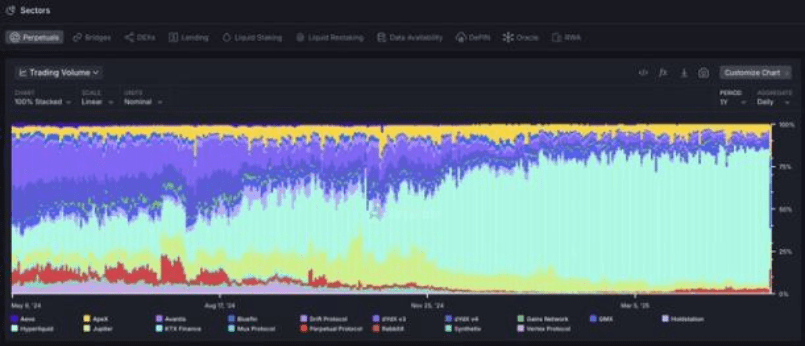
At this time, Hyperliquid is fully ahead in innovation and execution speed, with almost no direct competitors. Its token HYPE has also established a strong value accumulation model by using 97% of transaction fees for buybacks, driving a significant price increase.
2. Growing Pains (May 2025 - End of 2025)
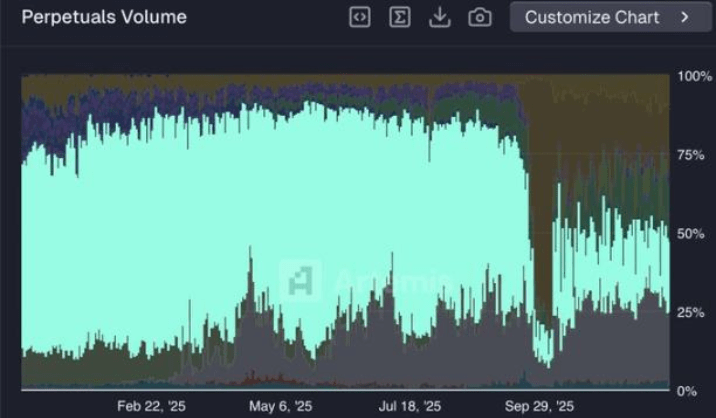
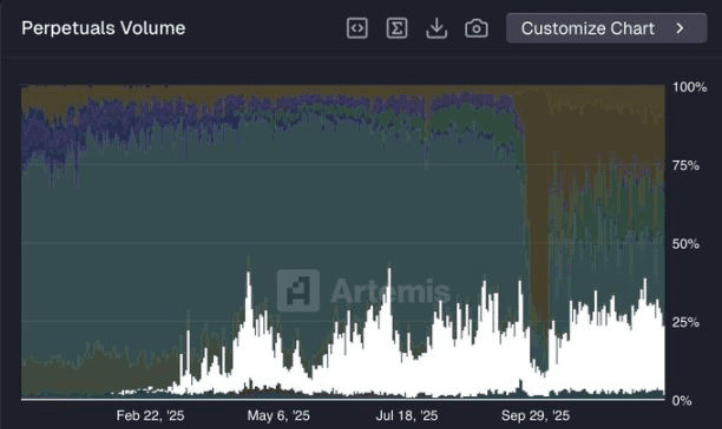
Since the peak in May 2025, Hyperliquid's market share has entered a rapid decline channel, falling to around 20% by early December. This 'loss of momentum' is the result of a combination of internal and external factors.
 2.1 Shift of Core Strategy: From B2C to B2B
Hyperliquid made a key strategic choice: no longer focusing solely on pure consumer-facing (B2C) competition, such as developing its own mobile application, but instead shifting to enterprise services (B2B), aiming to become the 'AWS of liquidity.' The core of this strategy is to build an open infrastructure:
● Builder Codes: Allow any external team (such as wallets, trading terminals) to seamlessly integrate their front-end interface with Hyperliquid's back-end order book and liquidity, and share transaction fees generated.
● HIP-3 Proposal: Aimed at allowing anyone to create new perpetual contract markets on Hyperliquid without permission by staking HYPE tokens.
However, this long-term strategy has brought growing pains in the short term. It has partially handed over the initiative in product development and marketing to third parties, while external developers initially could not match Hyperliquid's original team in distribution capability and user trust.
2.2 Competitors Rising to the Occasion
While Hyperliquid focused on infrastructure, competitors adopting a fully vertically integrated model acted more swiftly. They maintained complete control over everything from product to marketing and used aggressive incentives to seize market share.
● Aster: Gained a lot of attention due to its close association with Binance and its co-founder Zhao Changpeng (CZ). It experienced a massive surge in trading volume through large-scale airdrop incentives, at one point even surpassing Hyperliquid, with its market share quickly climbing from single digits to 19%.
● Lighter: Built on the Ethereum Layer 2 network, focusing on zero-fee trading and extremely high transaction speed. Before its token issuance, its points incentive activities attracted a large amount of 'hired liquidity' trading for airdrops, causing its market share to reach around 25%.
2.3 Challenges of 'Hired Liquidity'
Hyperliquid has not launched an official incentive program for over a year, while its competitors are in the midst of a 'points season' or airdrop activities.
In the DeFi world, the characteristic of liquidity chasing profit has been greatly amplified. A large number of traders have migrated from Hyperliquid to platforms like Aster and Lighter, primarily driven by short-term incentives and airdrop expectations.
Analysis indicates that this incentive-driven trading volume may contain 'speculative bubbles,' and once the token issuance (TGE) is completed, market share is likely to decline.
 3. Ecological Counterattack and Future Path
Although short-term shares have been impacted, Hyperliquid's transformation strategy is beginning to show long-term potential. Its goal has evolved from being a mere exchange to a complete decentralized financial infrastructure stack.
3.1 HIP-3: Opening Up Permissionless Market Innovations
Launched in October 2025, HIP-3 is a key step in Hyperliquid's ecological transformation. Any participant staking 500,000 HYPE can create a custom perpetual market. This has brought unprecedented asset diversity:
● Traditional Financial Assets: Such as perpetual stocks launched by @tradexyz.
● Yield-bearing Asset Market: Such as trading markets built on collateral like sUSDe for Ethena.
● Forward-looking and Alternative Assets: Including synthetic exposures to pre-IPO companies like SpaceX provided through @ventuals, as well as niche speculative markets created by @trovemarkets for Pokémon, CS:GO skins, etc.
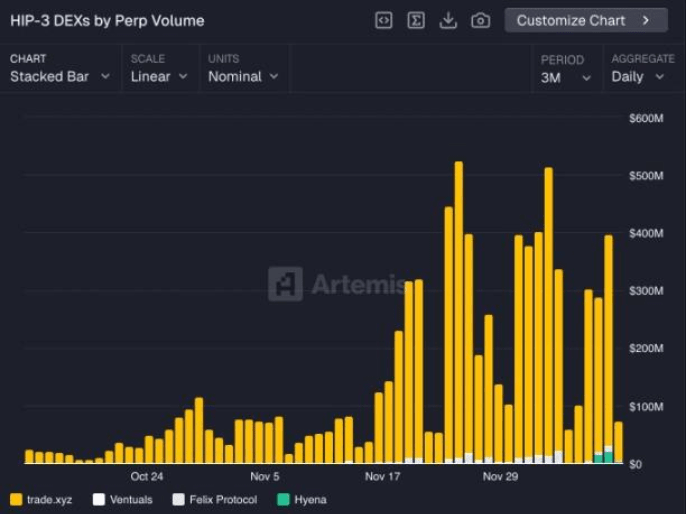
By 2026, the trading volume of the HIP-3 market is expected to account for a significant share of Hyperliquid's total trading volume. This transforms it from a limited trading platform into an infinite derivatives market infrastructure layer.
3.2 Distribution Network Built by Builder Codes
Builder Codes and HIP-3 generated strong synergies. This means any application integrated with the Hyperliquid front end (such as Phantom, MetaMask, Rabby, and other mainstream wallets) allows its users to directly access all the innovative markets created by HIP-3.
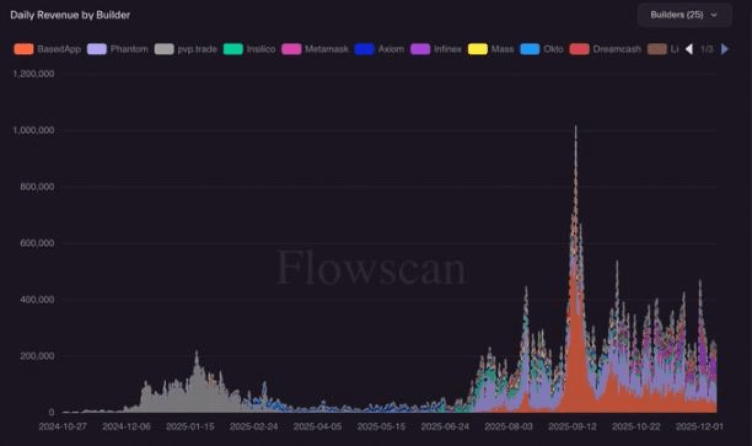
This has formed a virtuous cycle of growth: developers are motivated to create unique markets through HIP-3 because these markets can reach massive users via the extensive Builder Codes network; meanwhile, applications integrated with Builder Codes can provide their users with a much richer product offering than other vertical exchanges. To date, Builder Codes have routed over $158 billion in trading volume for partners, generating nearly $50 million.
3.3 Building a Self-Circulating Financial Ecosystem
Hyperliquid's ambitions extend beyond trading. It is building a more in-depth and resilient ecosystem through a combination of 'Layer 1 + stablecoins + open protocols.'
● HyperEVM: As a smart contract chain running in parallel with the high-performance trading chain HyperCore, it has attracted over 100 protocols for deployment, with a total locked value (TVL) exceeding $2 billion, supporting a thriving DeFi ecosystem.
● Native Stablecoin USDH: In order to recover the approximately $100 million in annual revenue that flows to competitors due to the use of USDC, Hyperliquid selected Native Markets led by senior community members through bidding to issue its native stablecoin USDH. This not only creates a new profit model but also enhances the financial closed loop of its ecosystem.
4. Summary and Outlook
The sharp drop in Hyperliquid's market share is essentially a result of its proactive strategic transformation and the intense external competitive environment. The table below summarizes its evolutionary trajectory in three stages:
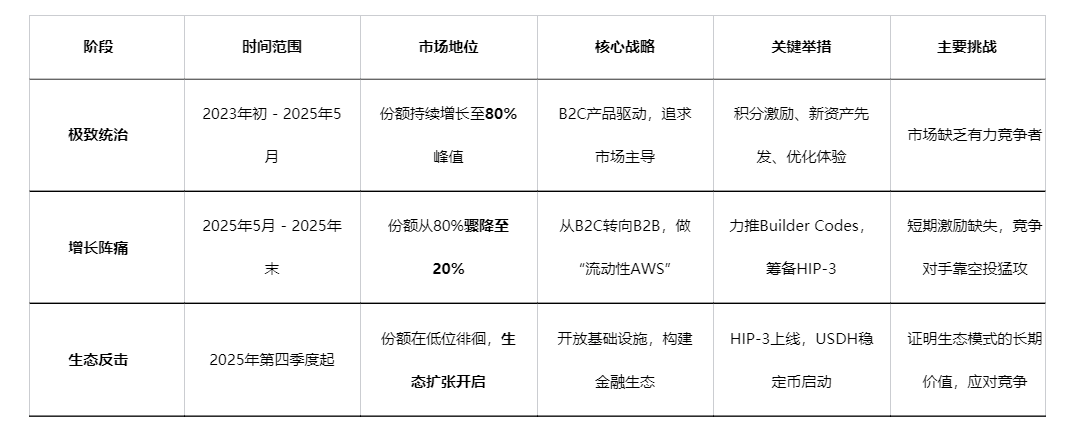
In the short term, Hyperliquid still faces immense pressure. Competitors' airdrop activities may continue to siphon off trading volume, while the maturation of the HIP-3 and Builder Codes ecosystems will take time.
But in the long term, Hyperliquid has chosen a more difficult but potentially more sustainable path. It is no longer satisfied with just being the best decentralized exchange but is committed to becoming the core protocol layer that supports future on-chain finance. The real test will be whether traders stay on a platform with a single function but generous incentives or move to the Hyperliquid ecosystem, which offers diverse products, deep integration, and a smooth experience when the airdrop music stops.
Hyperliquid's 'do-or-die' battle not only concerns the rise and fall of a project but may also reshape the competitive logic and landscape of decentralized derivatives and even the entire DeFi world.
Join our community to discuss and become stronger together!
Official Telegram community: https://t.me/aicoincn
AiCoin Chinese Twitter: https://x.com/AiCoinzh
OKX benefit group: https://aicoin.com/link/chat?cid=l61eM4owQ
Binance benefit group: https://aicoin.com/link/chat?cid=ynr7d1P6Z


