
The sideways movement in the crypto market is never just lying flat; it's a tug-of-war happening under the table — whoever gives in first will be pressed down and rubbed on the ground.
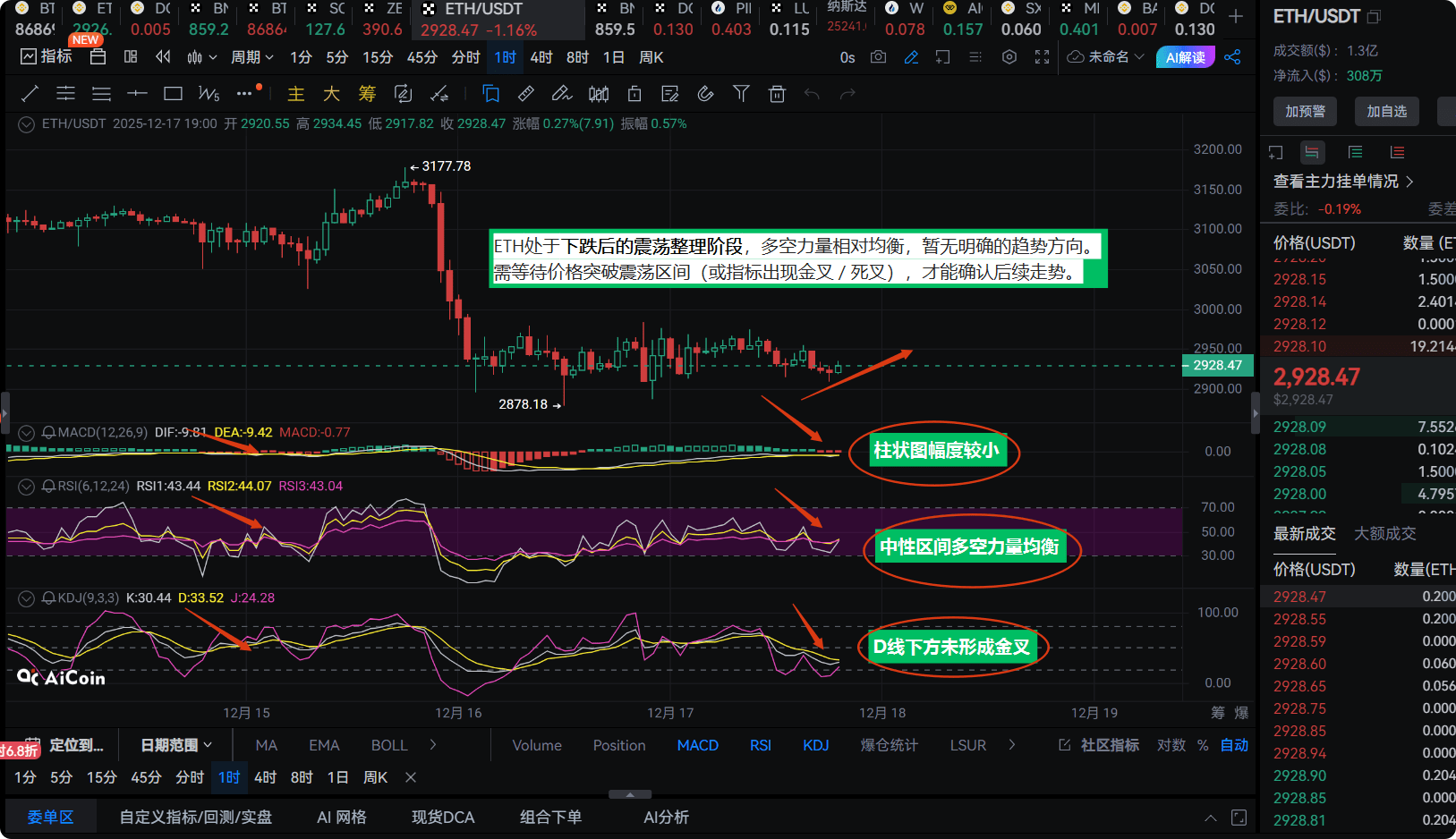
This morning, I opened the 4-hour chart, and ETH's movement resembles that cat basking in the sun downstairs in our community: lying near the 2900 mark, its tail occasionally swaying (fluctuation 0.57%), but its body remains motionless. It's not that it's too lazy to move; it's that there are too many 'hands' behind it — yesterday, BlackRock transferred $140 million worth of ETH to the exchange, and BitMine quickly added 100,000 coins. On one side, institutions are 'unloading goods,' while on the other side, capital is 'bottom-fishing'; it's like two big players at the market yelling, 'I'll take this vegetable' and 'I insist on bargaining,' with the vegetable price stuck on the scale, and neither gaining an advantage.
Let's talk about something real: Right now, ETH is in a "head and shoulders top" neck defense battle. If this position at 2900 doesn't hold, it will need to find support at 2600; if it holds, the 3000 mark will have a chance to breathe. You can see that the MACD bars are as short as toothpicks, the RSI is hovering around 50, and the D line of KDJ is still lying on the floor — this clearly shows that "both bulls and bears are out of bullets." Yesterday, after the long liquidation of 750 million was just finished, today no one dares to open new positions easily, especially with that old man from the Federal Reserve still shouting "no rate cuts" and the Bank of Japan about to raise rates tomorrow; with these two "macro giants" not giving any signals, who would dare take the lead?
But I have to say something from the heart: At this time, don't just focus on the K-line; you need to look at the "dark line." JPMorgan just launched a tokenized fund for Ethereum, entering the market with $100 million; BitMine has stockpiled nearly 4 million ETH, which is almost 3.2% of the total supply — are these institutions fools? They are focusing on the "Fusaka upgrade" and the blob expansion. Once the upgrade is completed on December 3, ETH's gas fees could be halved, and when the second layer network comes alive, won't the traffic surge? Last year's Dencun upgrade saw ETH soar from 1800 to 4000; I'm familiar with this script.
Some say "now is a bait for shorts," I believe it halfway. You see, ETH reserves on exchanges have dropped by 6%, the available coins have decreased; the funding rate has fallen by 64%, and leveraged players have been cleaned out — this is called "low volume bottoming." But let's not be stubborn; a few days ago, a fan told me, "I bought the dip at 2950," and now they ask me daily, "Should I cut losses?" I just reply with one sentence: "If the key level breaks, then run; if it holds, then hold on, don’t fall in love with the market."
Finally, let me leave you with a hook: Tomorrow, when the Bank of Japan raises interest rates, if ETH can hold steady at 2935, I will go live the day after tomorrow and share the "ETH target for the next three months" and the "buying points table" for free. To be honest, the crypto world isn't easy; when prices rise, everyone is a genius, and when they fall, everyone curses. But I've been in this circle for eight years, and I believe in one thing: "When others are fearful, you need to see who is secretly picking up chips."
This market is very similar to last November when ETH was sideways at 2200 for a week. What happened later? It shot straight up. Let’s hang in there a bit longer; once this wave of "macro clouds" clears, won't ETH give us something big?
Twelve years in finance, the exclusive secret of pioneers in the crypto world: Insight into the market, steady progress, pay attention to the Master’s teachings on how to grow steadily, where risks and opportunities coexist in investment; blind operations are a big taboo in the crypto world!
