

A few years ago, most conversations about crypto yield started and ended with farms. You locked tokens into a pool, watched numbers flicker upward, and hoped nothing broke before you withdrew. It felt experimental, sometimes thrilling, sometimes exhausting. Today, the tone is changing. People are still chasing yield, but they’re asking different questions now. Where does the return actually come from? Who carries the risk? And can these systems look a little more like grown-up finance without losing what made them open in the first place?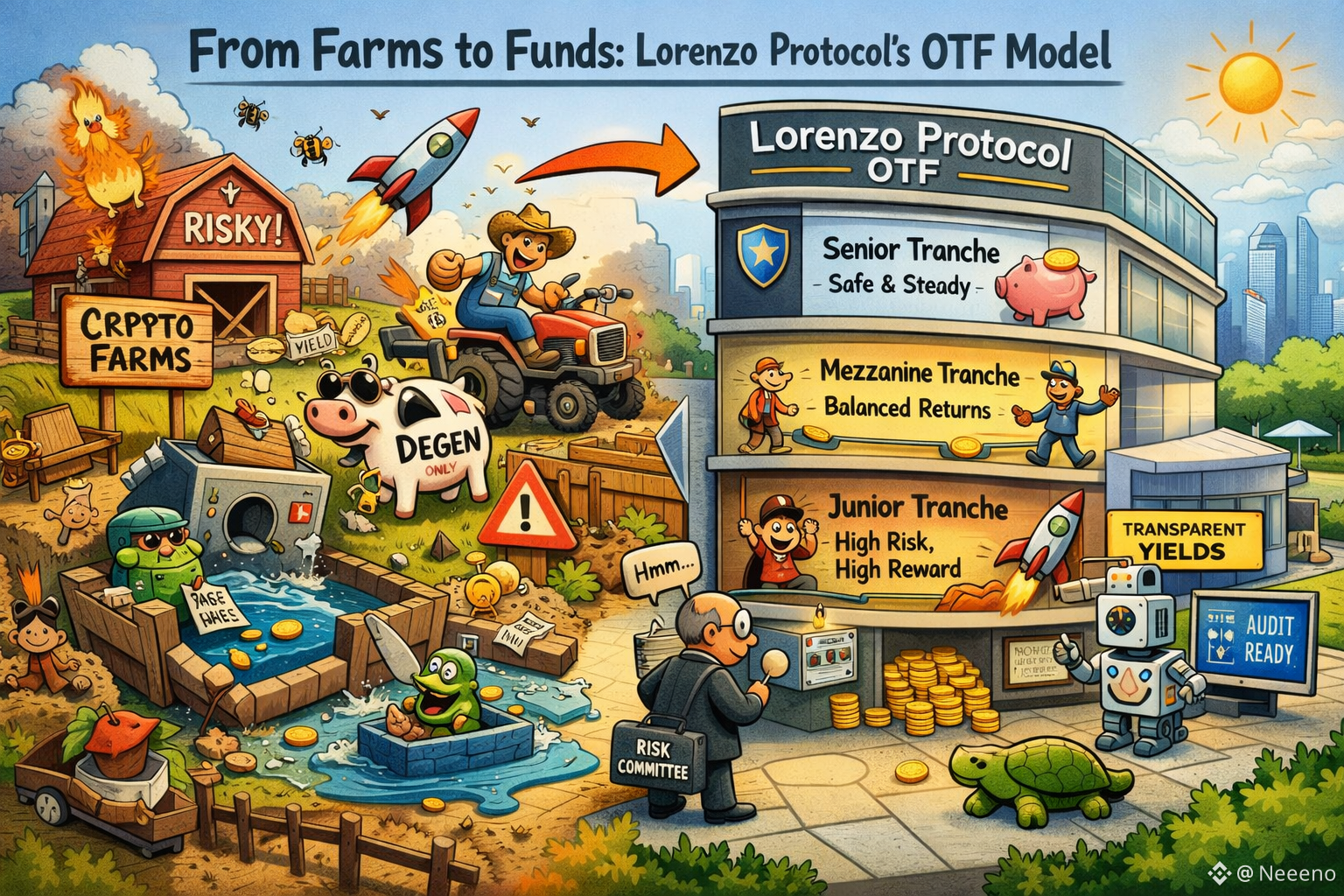
That shift is part of why @Lorenzo Protocol OTF model has been getting attention lately. OTF, or On-Chain Tranche Finance, sounds technical at first, but the idea behind it is surprisingly familiar. Instead of everyone taking the same risk and earning the same variable return, yield is split into structured pieces. Some participants want steadier outcomes. Others are willing to accept more uncertainty for higher upside. The protocol organizes these preferences on-chain, using smart contracts instead of desks and spreadsheets.
What stands out right now is both the design and the timing. Over the past year, DeFi has been growing beyond experiments and starting to focus on durability. After cycles of hacks, collapses, and overpromised returns, there’s been a quiet demand for systems that feel more predictable. You can see it in the rise of real-world asset protocols, in the renewed focus on treasury management, and in how institutional players talk about DeFi now. They’re less interested in flash and more interested in frameworks they can explain to a risk committee.
Lorenzo’s approach fits into that mood. The OTF model doesn’t try to reinvent yield from scratch. It reframes it. Instead of one blended pool, yield streams are separated into tranches with different profiles. Senior tranches might aim for more stable, lower returns, while junior tranches absorb more volatility in exchange for potential upside. This is a structure traditional finance has used for decades, but seeing it executed transparently on-chain changes the feel of it. You can watch positions update in real time. You can audit the logic.
There’s no need to trust a black box. Transparency feels more important now than ever.Early DeFi focused on moving fast and trusting that things would work. If something worked for a few months, that felt like success. These days, people want to understand what happens in month twelve, or year three. They want to know how a protocol behaves when markets turn dull, not just when everything is pumping. Structured yield models like OTF invite those longer conversations because they force clarity around risk allocation.
Another reason this topic is trending is the changing makeup of DeFi users. It’s no longer just traders hopping between farms. Treasuries, DAOs, and even smaller funds are parking capital on-chain and leaving it there. They need tools that match that behavior. A DAO managing payroll can’t afford wild swings every week. At the same time, more speculative capital still wants leverage and optionality. OTF lets both exist in the same ecosystem without pretending they want the same thing.
There’s also a cultural shift happening. The language around “degeneracy” is giving way, slowly, to conversations about sustainability. That doesn’t mean risk is gone, or that returns are boring. It means people are becoming more honest about trade-offs. When yield is structured explicitly, you can’t hide where the danger sits. Someone has to take it. Seeing that laid out on-chain feels refreshing in a space that once relied on vibes and dashboards.
Of course, no model is a silver bullet. On-chain tranching introduces its own complexity. Smart contract risk doesn’t disappear, and liquidity dynamics can get tricky if one side of the structure dries up.
These concerns are valid and worth looking at closely. It helps that projects like Lorenzo seem cautious, choosing a slow and careful rollout rather than pushing growth too fast.
At a bigger level, none of this is new. Finance has always worked by matching people with different comfort levels around risk.DeFi tried to flatten that for a while, mostly out of necessity. Now it’s rediscovering nuance. Lorenzo’s OTF model is part of that rediscovery. It’s a sign that on-chain systems are learning to grow up without losing their openness.
That’s why people are paying attention now. Not because the yields are magically higher, but because the structure makes sense for the stage DeFi is in. The industry is past its adolescence. It’s starting to ask how value is created, shared, and protected over time. Structured yield, done transparently, feels like one honest answer to that question. It doesn’t shout. It just quietly works, and sometimes that’s exactly what progress looks like. It invites slower thinking, clearer choices, and a kind of confidence that comes from seeing the machinery working.
@Lorenzo Protocol #lorenzoprotocol $BANK

