

@KITE AI There comes a point in almost every new technology cycle where a phrase starts showing up more and more: people are saying it at conferences, tweeting about it, and asking real questions at dinner tables. “Agentic money” is one of those phrases right now. It sounds abstract or futuristic, but when you peel it back, it’s simply about how autonomous systems software agents, AI helpers, robot assistants might one day make decisions and move value on our behalf, without us having to click “approve” every time. Recently, projects like Kite AI have begun to make that idea feel a bit more concrete, not just speculative. 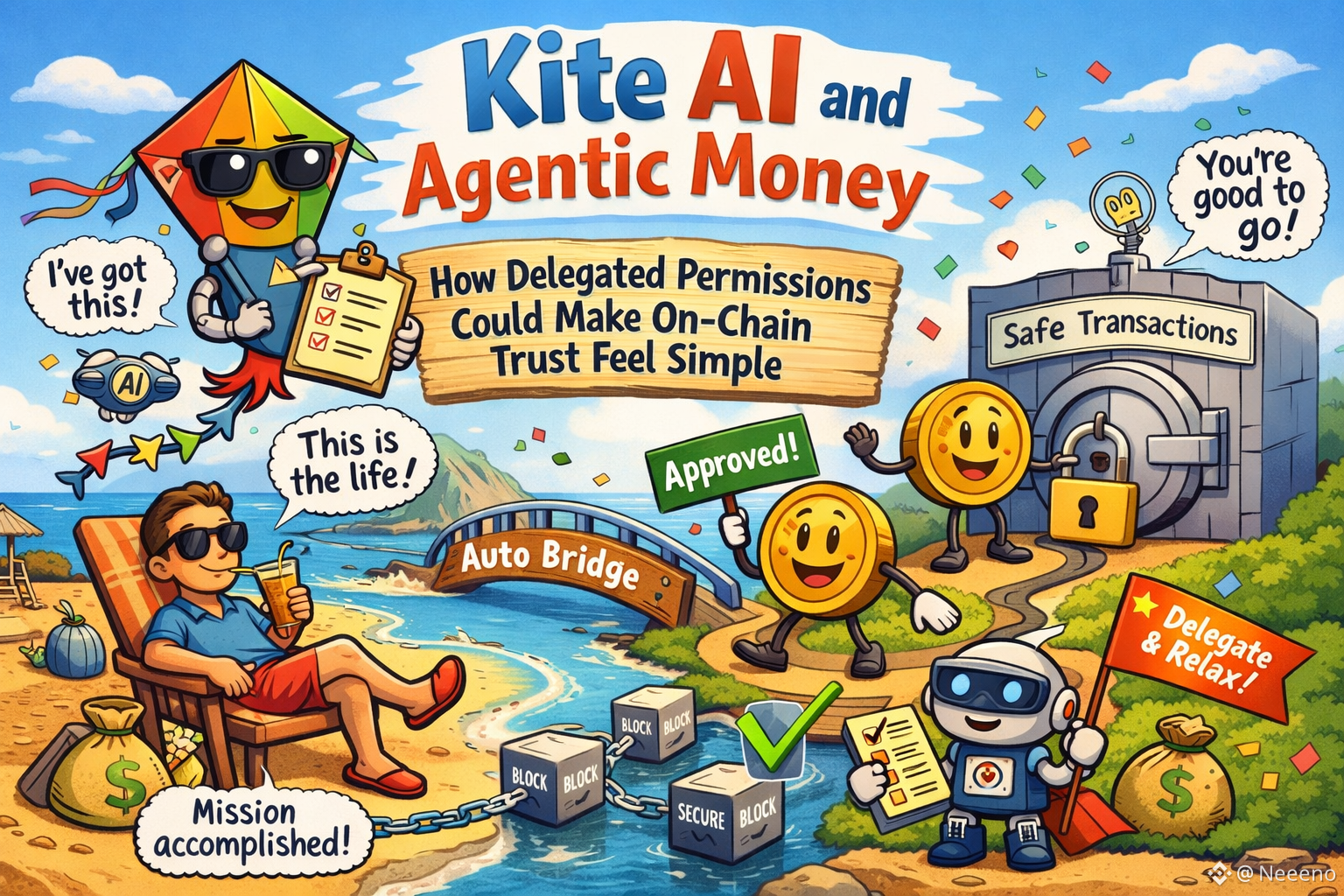
At its core, the discussion is about trust and delegation. On the internet we use today, most systems treat identity and money as things humans control directly. I log into a bank, I authorize a payment.
This has been the usual way for decades. But AI is getting smarter. It can take instructions, talk to other systems, and improve how work gets done. That raises a new question: can we give it some freedom to act for us without making things risky or confusing? It’s a personal question as much as a technical one. We want help, but we want guardrails.
This is where Kite enters the picture. Emerging in 2025 as one of the first blockchains purpose-built for what its backers call an agentic economy, Kite aims to create an environment where AI agents have cryptographically verifiable identities, programmable permissions, and native access to micropayments. That’s a mouthful, but what it really means is: you could, in theory, give an AI agent authority to act in certain financial or contractual contexts, and that agent could operate with clear limits and an auditable trail.
Until recently, blockchains were mostly about wallets held by people or organizations. A wallet belonged to you, and it was up to you to sign any transaction. What Kite and similar projects are exploring is a slightly different model: you hold the root keys, and you delegate specific powers to agents—little digital actors—that can make decisions and even move money under defined conditions. These delegations aren’t vague. They are enforced by cryptographic constraints on what an agent can and cannot do. For example, you might allow one agent to spend up to a certain amount on your behalf for specific services, but nothing beyond that. That’s what people mean by delegated permissions in this context.
There’s something quietly powerful in that. We already trust systems with a lot of our daily habits—our phones, our schedules, our playlists. But money has always been different. For most of us, handing over financial authority has required an active decision every time: “Okay, yes, I authorize this payment.” Agentic money imagines a world where that prompt becomes the exception, not the rule. A home energy-management agent, for instance, might autonomously buy and sell power to optimize costs. A travel assistant agent might autonomously book tickets, choose hotels, and settle invoices—all within parameters you set. The idea isn’t that machines take over. It’s that they relieve humans of repetitive decision-making, while still operating within boundaries we find acceptable.
What’s different today, compared with five or ten years ago, is that both AI and blockchain technologies have matured enough to make these concepts plausible in practice. The AI systems of today can plan, decompose tasks, and interact with services in increasingly autonomous ways. Blockchains have grown more efficient and, crucially, can now assign and enforce identity and permissions in a way that wasn’t practical a few years back. Kite’s architecture, for instance, is designed to offer fine-grained control over delegated permissions (who can do what, and under which conditions), and to record every action on chain in a way that’s auditable and traceable.
That emphasis on trust is important. When an autonomous agent is authorized to spend money or interact with other services, people naturally ask: how do we know it’s doing the right thing? What if it goes off the rails? The promise of on-chain delegation is that every action carries proof of both identity and intent. You can see which agent acted, the limits that were set, and the cryptographic authorization that made that action valid.
This kind of trust feels new. Instead of trusting a person to manage things quietly, you trust rules and records you can actually see.
But we’re still figuring out a lot. How will regulators respond when machines are, in effect, economic actors? How will we make sure that delegated permissions don’t become pathways for abuse? What happens when these systems interact across different platforms and legal jurisdictions? It’s one thing to let an agent autonomously reorder office supplies; it’s another entirely to let it negotiate multi-party contracts or manage significant funds. These questions are very real and not fully answered yet.
I find myself thinking back to early internet innovations—like the first time someone sent email automatically on behalf of another. It felt novel, then normal. Now we take it for granted. Agentic money may follow a similar arc, but it’s deeper because it touches issues of autonomy, accountability, and trust in new ways.
Right now, projects like Kite are at the frontier of this shift. They are building systems that make these ideas tangible, not just in demos but in things people can actually test and use. That progress—incremental, careful, and yet undeniably forward-leaning—is why discussions about delegated permissions and on-chain trust feel especially relevant in late 2025. We’re not talking purely about future theory anymore. We’re talking about frameworks that might underpin real-world systems in the coming years.
In that sense, agentic money isn’t just a buzzword. It helps us see how our relationship with digital tools might change. Instead of approving every action ourselves, we may start letting systems act for us within clear limits we set. And if something feels off, we can check what happened and why. It’s hard to know if this shift will be smooth or messy. But people are watching closely right now because the technology is finally real enough to test, and it could change how money, choice, and trust work online.



