

@Falcon Finance The speed of change in DeFi can feel like a lot. Week after week, new protocols appear and promise higher yields, stronger liquidity, or more flexible collateral. But when prices start swinging, many of these projects don’t hold up and vanish.That’s not just noise; it’s a real signal that something deeper is happening in crypto: users and builders are starting to ask for resilience, not just novelty.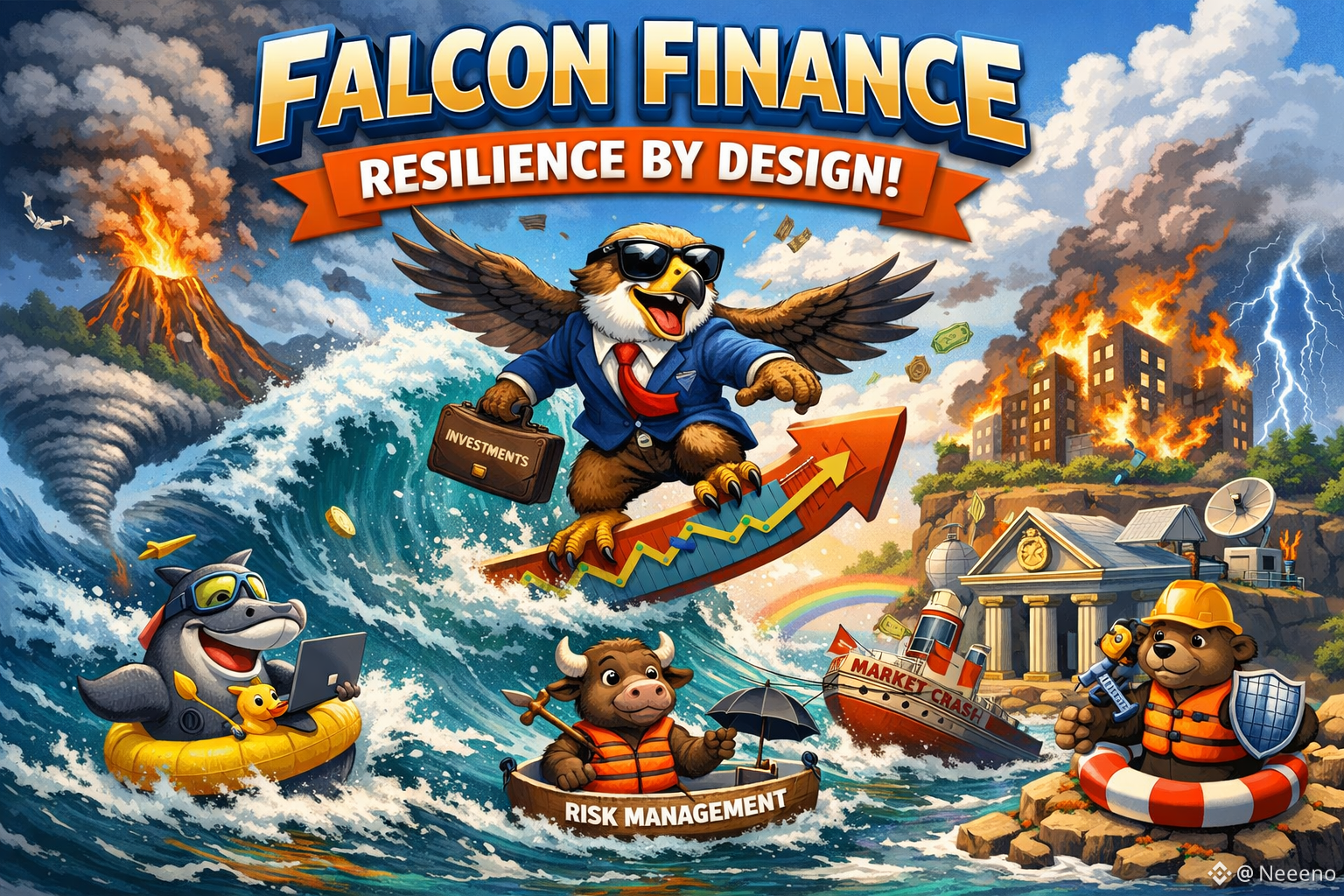
@Falcon Finance has become part of that conversation, and the reason is surprisingly simple. Instead of launching with a flashy gimmick or a viral token presale, Falcon Finance was built around one core idea: durability. It’s a project that doesn’t want to be the next flash in the pan. It wants to be infrastructure something that can sit underneath a broad range of financial activity and be trusted to hold up when markets get ugly.
When you step back and look at what that means, it’s actually a pretty old-fashioned instinct. Stablecoins and synthetic dollars have existed in crypto for many years. But what has often been missing is a clear framework that treats stability as a first-order design principle rather than an afterthought. Falcon’s approach to creating USDf — its overcollateralized synthetic dollar — speaks directly to this. By requiring more collateral than the amount of USDf issued, the protocol builds in a buffer against sudden price swings or contagion from other parts of the market. In a space where leverage and speculation often run rampant, that’s not glib risk management; it’s practical engineering.
The early results are interesting. USDf isn’t just a theoretical asset on a whitepaper anymore. It’s already circulating on chain with billions of dollars of backing, and its reserves are published in a Transparency Dashboard designed for public inspection. Falcon Finance has even brought in external auditors to review the numbers periodically, an unusual step in DeFi that reflects a real commitment to openness. That’s the kind of thing institutional investors tend to look for before writing big checks, and it hints at why conversations about traditional capital moving on-chain are no longer speculative fantasies but active discussions.
A few months ago, I remember talking to a colleague who’s worked in both traditional finance and crypto. He pointed out something that stuck with me: “Institutions don’t get excited about new yield curves. They get nervous about counterparty risk.” In other words, an asset that promises 20 percent returns but could collapse under stress is usually less attractive than something that returns 5 percent consistently without unexpected shocks. Falcon’s strategy — which stakes USDf into yield-bearing versions like sUSDf and then deploys capital into market-neutral strategies such as arbitrage and liquidity optimization — feels like it’s aimed at that middle ground. It’s not chasing outsized bets; it’s seeking dependable performance that doesn’t break when markets twitch.
That doesn’t mean the project is risk-free. No financial system ever is. But the way Falcon has structured its collateral, custodial partnerships, and real-time monitoring systems shows a seriousness about protecting assets that’s still rare in DeFi. There’s an implicit recognition here: resilience isn’t just surviving the good times, it’s surviving the bad ones too. And in markets that seem to oscillate between mania and fear, that mindset has value beyond the headline metrics.
Another piece of the story that’s worth mentioning is governance. Falcon Finance didn’t just mint a token and call it a day. It created an independent governance body, the FF Foundation, to oversee distribution and protocol decisions. That separation — governance handled by an independent foundation rather than the core developers — isn’t just cosmetic. It’s meant to build trust with participants who might otherwise worry about insiders dumping tokens or steering protocol parameters for short-term gain. It’s a governance structure you might expect from a traditional financial institution, not a typical DeFi startup.
And then there’s the broader context. The demand for stable and predictable digital dollar alternatives is real. As DeFi grows and more people and organizations look to utilize on-chain capital for real economic activity — not just trading or speculation — the need for assets that behave like money, rather than bets, becomes increasingly obvious. Falcon’s design reflects that shift. It’s acknowledging that the era of explosive yields funded by emissions and reflexive price moves may be fading, and something steadier is taking shape in its place.
The key thing is that this trend is spreading beyond one project. Across crypto, more teams are trying to be more transparent, easier to verify, and properly backed by real collateral. Regulators — at least in pockets of the world — are signaling that they want to see verifiable reserves and clear governance if digital financial infrastructure is going to scale. Projects that ignore that trend risk being left behind. Falcon’s steps toward auditing, independent governance, and public transparency align with what more mature markets are demanding.
I can’t say for sure where this is going. Crypto is still early, and it can be messy. Still, I trust projects more when they’re built to handle problems from the start, not just built to look impressive fast.
.To me, it’s like building a tower that’s made to flex and survive rough weather, not one that only looks strong on a sunny day. If you’re trying to understand why people are paying attention to some DeFi projects right now, this is the deeper point behind it.. People who’ve lived through crashes and spikes are tired of the same patterns repeating. They want systems that aren’t just clever on paper, but stable in practice. In that sense, Falcon Finance isn’t just another protocol. It’s part of a broader shift in the way we think about digital money and financial resilience.
@Falcon Finance #FalconFinance $FF

