

I remember the early days of decentralized technology when just getting a price feed reliably on-chain felt like a little miracle. It was a patchwork of providers, each with their own quirks, and developers crossed their fingers every time they built something slightly more complex than a token swap. Over time, we got more robust oracle networks services that pull real-world data and deliver it into blockchains so that smart contracts can act with some confidence. That notion, once a technical curiosity, is quietly turning into the backbone of real-world Web3 use cases, and @APRO Oracle is a vivid example. 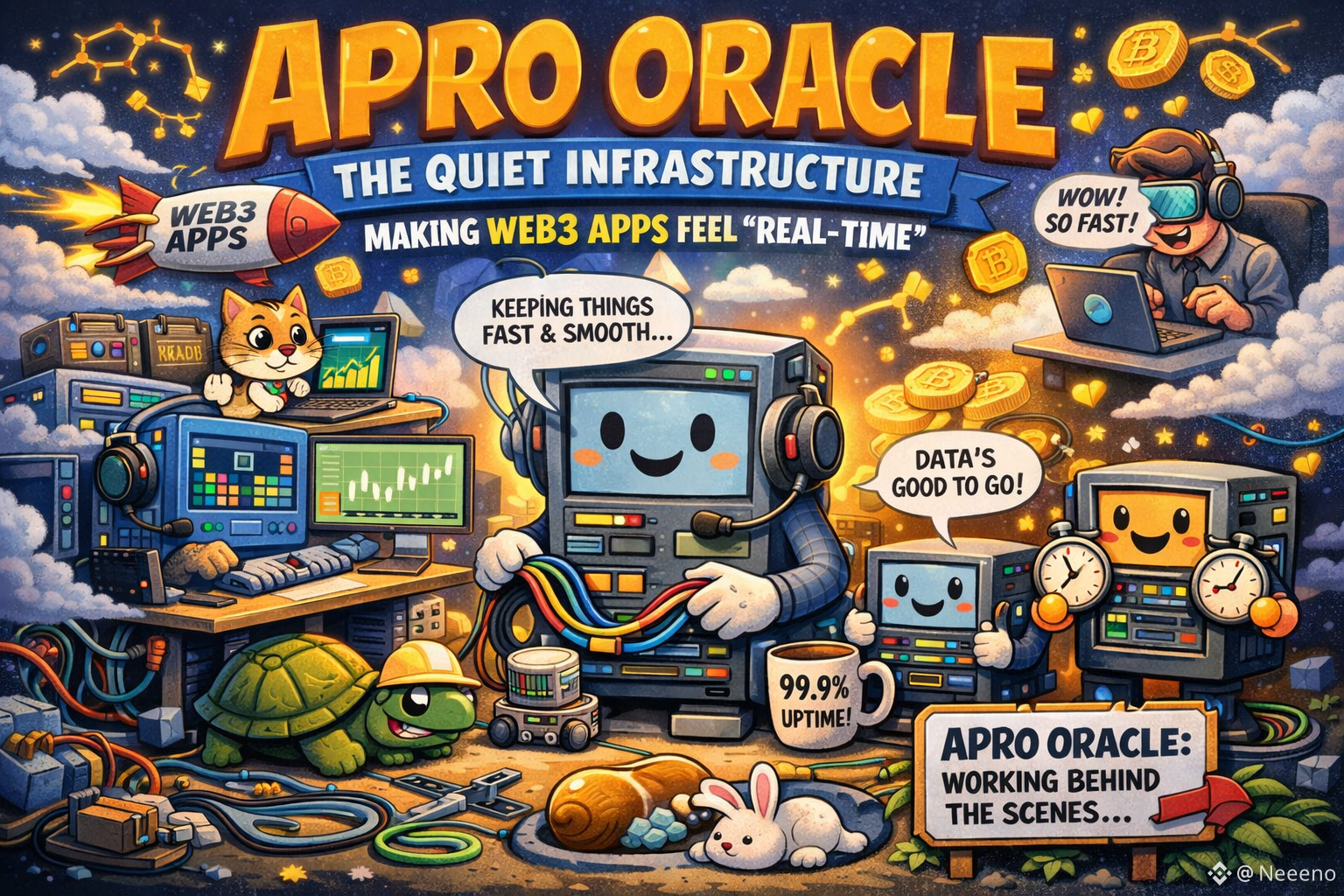
APRO is not a household name outside the blockchain sphere, but it is beginning to matter in ways you feel even if you don’t consciously notice. It’s a decentralized oracle network: a system that takes information from outside blockchains things like asset prices, event outcomes, and real-world asset data and feeds it into smart contracts in a way that those contracts can trust. The promise is that these contracts don’t have to guess about the outside world anymore. They can see it with verified, up-to-date information.
At face value, that might sound dry.And the use cases are huge. Real-world assets, or RWAs, like bonds, real estate, and commodities turned into tokens, are gaining interest because financial markets want easier trading (liquidity) and more visibility into how things work. Tokenizing an actual asset is only part of the story. If you want that token to behave predictably — to know its net asset value, whether interest was paid, or whether the underlying asset still exists in the form the contract assumes — you need accurate, timely, verifiable data flowing into the system. APRO seeks to provide that bridge.
Prediction markets let people bet on future results, and the app pays out once the result is known. That means the market needs exact info for each event, like: Did the team win? Did the price hit that target? Did the shipment clear customs? These are not simple price feeds. They’re conditional data points that need context and verification. An oracle like APRO aims to deliver this complexity reliably and quickly.
A part of what makes APRO feel like more than “another oracle project” is the way it leans into multi-chain support and scalable design. Today’s Web3 is not a single chain universe.
Apps don’t live on one network anymore—they span many. APRO is integrated with dozens of chains, so developers can send data where it needs to go without being locked into a single ecosystem.
That early design decision matters. When developers choose tools, they are thinking about longevity and compatibility — not just the flavor of the week.
What’s particularly interesting about this moment — and why APRO keeps coming up in early infrastructure discussions — is that the complexity of data required by decentralized applications has evolved. In the beginning, oracles were mostly about price feeds. You needed to know the price of ETH or BTC so you could execute a trade or settle a contract. Now, decentralized systems are making decisions based on dozens of variables. A lending protocol might need detailed collateral valuations that reflect interest and fees. A treasury system might need verified document statuses. An AI agent operating in a decentralized finance environment might need ongoing, verified data to adapt its strategy. These aren’t edge cases anymore; they’re fundamental to applications that feel real-time and robust.
There’s also something quietly hopeful about the way APRO interweaves off-chain computation with on-chain verification. This hybrid approach doesn’t just push data; it verifies it against multiple sources, and only after that does it anchor the result on the blockchain. That matters because blockchains are final and transparent by design, but they’re not great at heavy computing or pulling in external data on their own. By letting the system do the heavy lifting off-chain and then confirming trust on-chain, APRO tries to strike a balance between speed and security.
Of course, none of this is without challenges. The oracle landscape is competitive. Traditional providers have entrenched positions, and new models have to prove they can deliver not just raw data, but right data consistently over time. What’s changing, though, is the maturity of decentralized applications themselves. People are building with an expectation that oracles will deliver high-frequency, nuanced information — not just occasional price points. Part of it is simply that the ecosystem has grown up a bit. Tokenization of real-world assets is no longer just an academic exercise; it’s an emerging market with real economic heft. Prediction markets are expanding beyond simple binary events into more intricate conditional flows. AI and automated agents are beginning to inhabit on-chain environments with real stakes. All of this demands a richer, more reliable data fabric. And that’s where APRO and projects like it sit, quietly enabling systems to behave as if they were always meant to feel “real-time.”
In the end, what keeps me watching this space is not a flashy headline or a sudden boom. It’s the way infrastructure adapts when builders start asking for something more — not just faster or cheaper, but trustworthy in a deeper sense. Today that looks like networks that tie external truth into on-chain logic with precision and care. And even if most users never think about oracles directly, they will notice when decentralized systems stop feeling slow, clunky, or uncertain. That’s the quiet promise of tools like APRO — and the reason people are talking about them now.

