

@APRO Oracle I’ve spent enough time around markets, data pipelines, and decentralized finance to know that real-time stuff can feel like a loaded phrase. What exactly does “real-time” mean when money, contracts, and automated systems depend on it? In DeFi, the pace of markets and the fragility of automated logic have made latency a fraction of a second, even matter in ways they didn’t just a few years ago.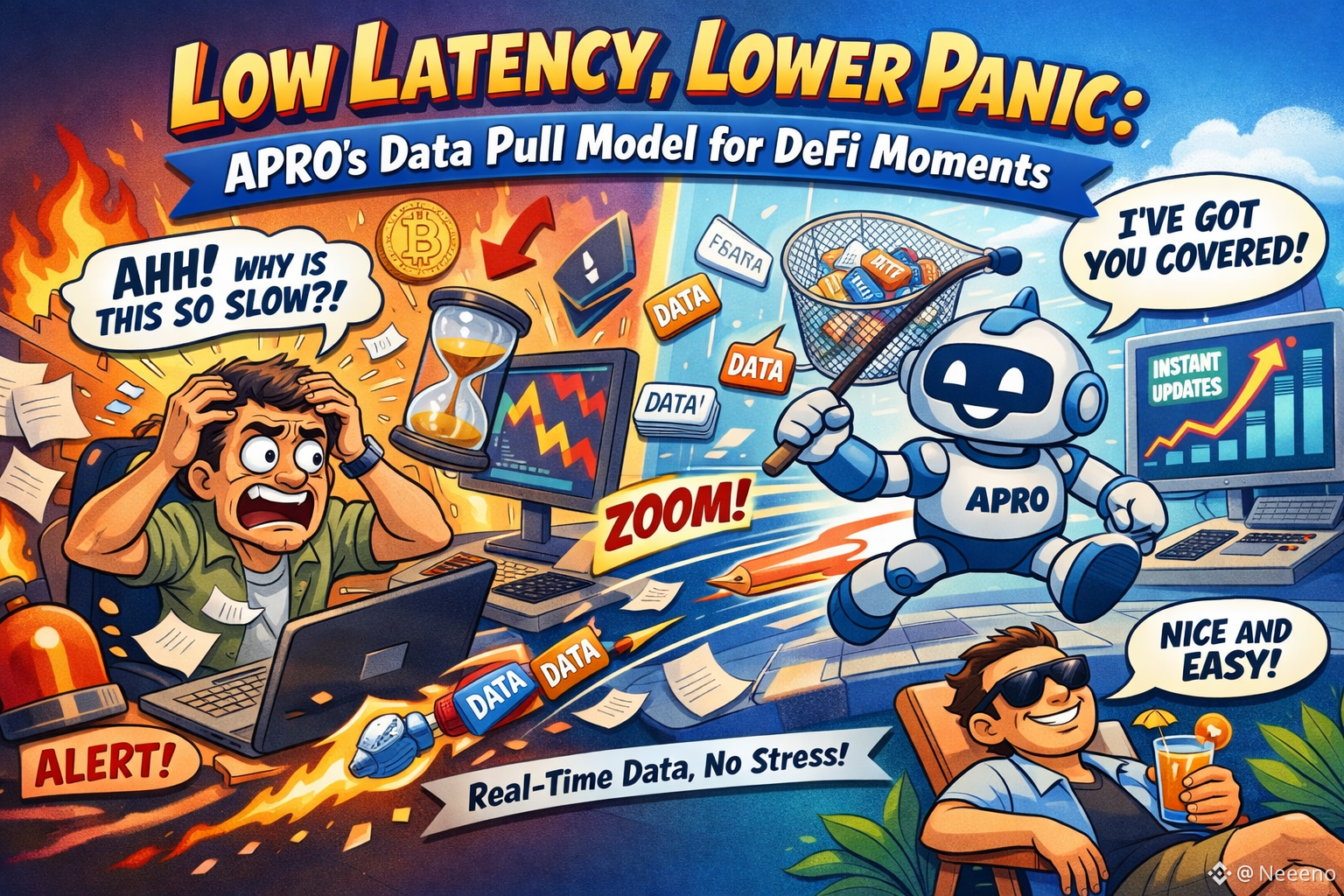
That’s why something like APRO’s data pull model deserves a careful look right now. This isn’t another buzzword. It’s a response to a subtle but constant stress point in decentralized systems: making sure what smart contracts see is what’s actually happening in the world outside the blockchain, at the moment they need it.
Here’s the idea: blockchains store history well. After something is recorded, it stays there and you can trust it happened. But they don’t innately know what’s happening right now in markets, external databases, interest rates, or commodity prices. That’s where oracles come in. Oracles bridge that gap. They fetch data off-chain and bring it on-chain in a form smart contracts can use. For years, oracle solutions mostly used a push model: gather data continuously and push updates into the chain at regular intervals or when something moves enough to trigger an update.
That push model is reliable in many scenarios. But it has limits. It updates even when nobody really needs the latest number right this second. It can create unnecessary transactions on the chain. It can add cost. And because there’s always a gap between when data is fetched and when it’s used, it creates a kind of soft latency: a delay that might not matter for basic pricing feeds, but absolutely matters for derivatives trading, liquidation engines, or any contract that needs the freshest price at execution.
What APRO’s data pull model tries to do is simple in principle but powerful in practice: let an application request data exactly when it needs it.
You don’t have to wait for other updates to go first. You just grab the most recent verified data when you ask for it. It’s like live TV versus on-demand video.. For fast-moving financial systems, pulling at the moment of transaction reduces blind spots, lowers unnecessary on-chain chatter, and helps keep costs down because you’re only paying for data when it matters.
Why does this matter now more than five years ago? Two reasons come to mind. First, the scale and complexity of DeFi have grown. Early lending platforms or simple automated market makers could live with minute-by-minute updates. Today’s markets have liquidations, leverage, multi-asset baskets, hybrid on-chain/off-chain risk systems, and predictive strategies that all hinge on precision. The cost of stale data isn’t abstract; it’s real. Contracts that misprice a liquidation or misjudge a ceiling can trigger cascading failures.
Second, developers and users alike are becoming less tolerant of surprises. When you send a transaction at what you think is a fair price, only to have logic execute with outdated data three seconds later, it erodes trust. Liquidity providers get jittery. Traders start building buffers into their systems. That’s panic in code. What the pull model offers is a way to reduce that jitter by tightening the feedback loop between action and information.
I’ve seen practical versions of this in other tech fields. When you build responsive user interfaces, the system that pulls data on demand feels more precise and respectful of resources than one that streams updates regardless of need. It’s cleaner, leaner, and often cheaper. In financial markets, those same principles apply—except the cost isn’t just efficiency, it’s solvency and fairness.
To work, the pull model needs reliable verification. You can’t just reach out to a random feed and hope for the best. APRO’s design layers off-chain intelligence with on-chain verification. That’s where things get interesting: data is aggregated and reconciled off-chain, vetted through a network, and only then delivered with cryptographic proofs. That extra step matters because it pushes back against two persistent threats in blockchain data: manipulation and noise. High-frequency markets are noisy by nature. You don’t want your contract seeing an outlier and acting on it as if it were gospel.
Another piece I find myself coming back to is the flexibility of the model. Not all applications want the same thing. A lending protocol might only need a fresh valuation when someone changes collateral. A prediction market might only need the result after an event resolves. A derivatives platform might need that price at exactly the moment of trade, with no lag.
A pull model means developers set their own timing based on what they’re building, instead of following one standard rhythm. It’s a small change that makes systems more reliable.
DeFi is exciting but unstable because it tries to cut out the people you normally rely on.. But the moment you depend on data from somewhere else, you need reliable, trustworthy systems even more. A pull model that’s also verifiable gives developers and users both control and assurance. It’s the difference between saying “we hope this is right” and “we know this is right when we ask for it.”
It’s too early to say whether this approach will become the dominant pattern in DeFi. But the conversation around oracle design has shifted. People are thinking harder about when and how data arrives, not just whether it arrives. And that shift matters, because as markets and decentralized systems grow up, the technology that supports them can’t be an afterthought. It has to be part of the nervous system of the protocols we rely on—and it has to do its job quietly, quickly, and without causing unnecessary panic.
And that’s the point of low latency and lower panic: not just speed, but clarity and confidence right when it matters most.


